
There is a growing list of reasons why water and wastewater utilities need to be on top of evaluating their pipe infrastructure. Among the many reasons: an aging infrastructure, a growing population, increasingly strict regulatory requirements, increased service demands, limited water supply, climate change, and limited state and federal funding. Aging and deteriorating systems create conditions that make water and wastewater service delivery more difficult as well as driving operation and maintenance costs higher.
The American Society of Civil Engineers’ (ASCE) 2009 report card gave America’s drinking water systems a D- grade. The ASCE estimates drinking water systems face an annual shortfall of at least $11 billion in funding needed to replace aging facilities that are near the end of their useful life and to comply with existing and future federal water regulations. The shortfall does not account for an increase in drinking water demands over the next 20 years.
The National Association of Sewer Service Companies (NASSCO) estimates that by 2020, more than half of all sewer pipes will be in fair to poor condition, with 9% in a stage of failure and 33% in poor or very poor condition.
Evaluating pipe infrastructure is a critical step toward addressing the health of a water or wastewater system.
“This is a very important topic that every water utility in North America is currently facing as their existing pipe infrastructure has reached, or is about to reach, its maximum service life and in some severe cases, has already become extremely dilapidated and in desperate need of repair,” says Bruce P. Curtis, regional sales manager for EBAA Iron Sales, manufacturer of joint restraint products.
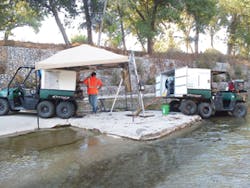
Custom built off-road inspection with 4,000 feet of inspection cable. This unit provides both CCTV and Sonar. The 4,000 feet of cable allows inspections of long distances where the access manholes are placed further away than normal.
“Regrettably, most water utilities are woefully under-funded and fall well short of having the appropriate amount of capital funds in their coffers that would be required to undertake such a project,” adds Curtis. “Also, at this late point in the game, trying to assess any kind of a nominal rate increase amount to the water utility bills of their existing customers would either fall significantly short of their immediate needs or it would have to be so high that it would cause severe “˜sticker shock’ and probably become public relations nightmare amongst their existing customers.”
One way of staying on top of pipe infrastructure is through asset management.
EPA points out that within the industry, asset management is defined as a management paradigm and body of management practices applied to the entire portfolio of infrastructure assets at all levels of the organization seeking to minimize the total costs of acquiring, operating, maintaining and renewing assets within an environment of limited resources while continuously delivering the service levels customers desire and regulators require at an acceptable level of risk to the organization.
Renewal and replacement of the nation’s water infrastructure assets is a constant and ongoing task in efficiently managing utilities, the EPA points out. The asset management approach has gained worldwide recognition and is executed across all infrastructure heavy sectors for its effectiveness in maximizing the value of capital as well as operations and maintenance expenditures.
The EPA points out that asset management is a scalable approach that can be implemented by systems of any size, from a small drinking water system serving 50 customers to the drinking water and wastewater systems of the largest cities. Because asset management is also used in other sectors such as transportation and housing where infrastructure needs to be managed for the long term, some communities are adopting cross-sector asset management programs that coordinate and prioritize infrastructure investments across different infrastructure areas.
In “Asset Management: A Guide for Water and Wastewater Systems, 2006 edition,” prepared by the Environmental Finance Center of New Mexico Tech, managing assets in a cost-effective manner provide several benefits: water and wastewater infrastructure represents a major public or private investment; well-run infrastructure is critical in economic development; proper utility operation and maintenance helps ensure public health and safety; utility assets provide an essential customer service, and asset management promotes efficiency and innovation in the operation of the system.
The EPA points out other benefits:
- Prolonging asset life and aiding in rehabilitation, repair, and replacement decisions through efficient and focused operations and maintenance
- Meeting consumer demands with a focus on system sustainability
- Setting rates based on sound operational and financial planning
- Budgeting focused on activities critical to sustained performance
- Meeting service expectations and regulatory requirements
- Improving responses to emergencies
- Improving the security and safety of assets
- Reducing overall costs for both operations and capital expenditures
Each utility is responsible for ensuring its system stays in good working order regardless of the age of components or the availability of additional funds, according to EPA.
The most efficient asset management programs have data that includes asset attributes such as the age,
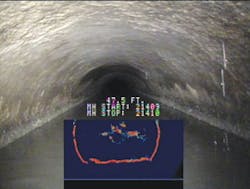
Screenshot of a typical CCTV and Sonar inspection in
progress. Defects above the flow line can be clearly
identified, and debris can be measured below the flow line.
condition, and criticality; life-cycle costing; proactive operations and maintenance; and capital replacement plans based on cost-benefit analyses.
Lowest life-cycle cost refers to the best appropriate cost for rehabilitating, repairing or replacing an asset. A high-performing asset management program incorporates detailed asset inventories, operation and maintenance tasks, and long-range financial planning to build system capacity, putting the system on the road to sustainability, EPA states.
Asset management is centered on a framework of five core questions: what is the current state of the assets, what is the required “sustainable” level of service, which assets are critical to sustained performance, what are the minimum life-cycle costs, and what is the best long-term funding strategy. To this end, EPA has made available “Asset Management: A Best Practices Guide.” The short guidebook is intended for owners, managers and operators of public water systems, local officials, technical assistance providers, and state personnel.
“Perhaps the water industry could follow the lead of the gas distribution industry. Led by the US Department of Transportation, the Pipeline and Hazardous Materials Safety Administration initiated an Integrity Management Program to assess underground assets,” says Tony Radoszewski, executive director of the Plastics Pipe Institute.
Based on failure rates, age of pipe and type of material, the highly regulated gas distribution industry is required to replace the assets to ensure public safety, he adds.
“The city of Palo Alto, California, recognizing the zero leak rate of their polyethylene [PE] gas mains could be translated to their water system, embarked on the path to replace their water mains with PE pipe as well,” says Radoszewski. “The day the water industry no longer accepts an average 15% leak rate will indicate it is taking the responsibility to protect precious limited natural resources seriously. Obviously, the gas industry does not have this luxury and has taken the necessary steps to ensure a high integrity pipe system.”
Climate change is also taking a more predominant role in assessing the health of underground infrastructure. The EPA points out that climate change poses challenges to drinking water, wastewater, and stormwater utilities in fulfilling their public health and environmental missions through such factors as extreme weather events, sea level rise, shifting precipitation and runoff patterns, temperature changes, and resulting changes in water quality and availability.
Consent decrees are negotiated lawsuits with the EPA to prevent communities from having excessive untreated or partially treated sanitary sewer overflows. Most consent decrees are written around the number and amount of overflows that happen in a given amount of time and require a town or city to inspect a certain amount of their sewer systems per year, says Joe Atol, vice president of operations for Compliance EnviroSystems. The company evaluates the pipes through cleaning, televising, smoke testing, manhole inspections, flow monitoring, and sonar.
“The first step in the process is to evaluate it instead of going out there to dig and replace the pipe or the line,” says Atol. “You have to know the condition of the pipe before you do that.”
Compliance EnviroSystems often hears from smaller municipalities that know the evaluations need to be done, but lack the funding. In doing evaluations, Compliance EnviroSystems uses the approach the client seeks.
“A lot of the projects we go on are to try to find the inflow and infiltration (I & I) in the system,” says Atol. “If they have a limited budget, we recommend a Sewer System Evaluation Survey (SSES) approach to start with the flow monitoring, which will identify the areas that have the most I & I. From there, you can start with some of the simpler tasks of manhole inspections and smoke testing to further define problem areas and then go in with the more comprehensive cleaning and Closed Circuit TV (CCTV) of the main line.”
CCTV and sonar evaluations are the most requested technologies, says Atol.
“The sonar allows you to see below the water line,” he says. “There are a lot of cameras now where you can launch the lateral line from the main line and actually view the condition of the private line while you’re doing the main line. That’s in high demand right now, and we are currently operating several of them.”
EPA utilizes the intent of such factors as the GASB 34–the Governmental Accounting Standards Board–when it prescribes consent orders, decrees or judgments, says Ed Diggs, manager of business development for Cues.
“As the infrastructure ages, it becomes very difficult for municipalities to gain the bonding money and things they need in order to do repairs or the grants from the federal government, because they haven’t created assets out of their sewer pipe,” says Diggs.
“Years ago, many of the progressive municipalities figured that out and started doing that by inspecting and assigning ratings to their pipes, so they actually created assets for the pipe,” he says, adding that these municipalities have been able to pinpoint what percentage of their system is in good shape and won’t need work for an extended amount of time.
Using a NASSCO priority rating system of 1 to 5—with 1 signifying the best condition with no problems—municipalities that engage in pipe evaluation can zero in on the worst pipes with the 5 ranking and start planning, Diggs points out.
“They know that in year one, they’re going to need to budget ‘X’ amount of money for that particular section in order to get that done, whereas a lot of municipalities operate their budget off the idea that they need 10% more of what they spent last year, but they’ve got nothing to justify it with, and they end up working on the same pipe section over and over again for years,” he says.
By creating assets out of the underground infrastructure, municipalities are able to have more certainty in what is needed to take care of the repairs.
“What ultimately ends up happening is as they make those repairs and cut down the amount of infiltration and inflow, they are now processing much less going to the treatment plants than they were before, so eventually as they get on board with it, they go from being a debt-ridden division into an actual cost center.
“They will be a profit center within themselves. They can make money to pay for themselves, and not have to worry about the budget cuts.”
Diggs says inspecting every five years is a “good rule of thumb.” Among the latest advances in inspection technology is Cues’ Digital Universal Camera (DUC), a semi-autonomous, high-resolution digital CCTV side-scanning camera that enables an inspection and assessment of 5,000 feet or more per day.
“With it, you’re able to get through to pipelines a lot quicker; municipalities now have the ability to inspect their entire systems in a time period of 12 months or less by utilizing the digital cameras,” says Diggs, pointing out that costs for evaluating systems depend on whether the work is being done in-house or outsourced, says Diggs.
“If a truck and a reel are involved, the price goes up significantly. If you’re going to sub it out, the price is based on pipe sizes and footage. If the municipality has had hiring freezes, it’s forced to sub it out. For most municipalities, it probably is more efficient to be subbing it out.”
Another consideration is knowing when to repair a pipe and when to replace it. While the pipe’s condition dictates that, so does its location. Being near pilings, train trestles and train tracks means “you’re probably going to want to do everything in your power to repair that,” says Diggs. “Once you start disturbing the soil around there, now you’re disturbing the integrity of the infrastructure around it as well.
“It’s the same way with streets. One of the biggest things that ticks off drivers is to pull down the street and find they are tearing it up. The public is going to force the city into trying to repair it or do horizontal drilling to put in something new.”
Other technological advances include gyroscope-based mapping probes for hydraulic modeling.
“Another technology that has come a long way in the last five years is large diameter pipe inspections utilizing laser high-definition TV and sonar at the same time,” says Diggs. “Also of note is the utilization of sonar to calculate capacity in the pipe and be able to schedule debris cleaning efficiently.
“By utilizing sonar for that, they’ve been able to cut their costs in half on cleaning,” he adds. “It’s going to be a big budget saver for them by doing that.”
Among the municipalities that are being proactive in infrastructure evaluation is Philadelphia, PA–which Diggs describes as being “the most innovative I’ve seen”; Seattle, WA; Portland, OR; the city and county of Sacramento, CA; and Austin, TX.
“Those who we refer to as “˜progressives’ did this without being made to do it,” he points out.
The proper approach to evaluating pipe infrastructure is to combine effective condition data along with an initial engineering analysis of the pipe, says Cameron White, a program manager with Pure Technologies’ engineering services group.
“Condition data is best collected using an inspection technology that addresses the specific failure mode of type of pipe in question,” says White. “Engineering analysis takes into account the pipeline’s surrounding environment—loading, soil conditions—and operating conditions.
“Once the pipeline’s environment is understood and relevant condition data has been collected, actionable information can be given to the utility in order to selectively rehabilitate or replace specific pipes that are at the greatest amount of risk.”
The proper approach to pipeline management is to selectively identify and rehabilitate sections of high-risk pipes before they fail, White says.
“These pipes are best identified using an inspection technology that addresses the failure modes of the pipe,” he adds.
Re-inspection schedules typically occur every two to seven years, depending on the condition of the pipe along with the risk consequence of pipeline failure, says White.
“The poorer the condition of the pipe during initial inspection, the more frequent the re-inspection should be scheduled,” he says. “Similarly for consequence of failure, pipelines that are situated in high risk zones, such as downtown urban environments, pose more of a risk than rural settings, and as such should be re-inspected more frequently.”
If the pipeline has a continuous monitoring program in place, such as fiber optics, the re-inspection time frame can be pushed out since the rate of deterioration is being actively watched, White adds. Pipes are generally replaced based on their total calculated risk, which is determined from the likelihood of failure combined with the consequence of failure, White says. The likelihood of failure is indicated in understanding the size of the defect relative to the pipeline’s operating conditions and active loading and the consequence of failure focuses on reduced water service and proximity.
“For example, a pipe section with 20 wire breaks may be tolerable in a rural area but the utility wouldn’t risk it in a populated downtown setting,” he adds.
Pure Technologies has done ongoing inspection work for the Washington Suburban Sanitary Commission’s (WSSC) Prestressed Concrete Cylinder Pipes (PCCP) Management Program in Montgomery County, MD. The company has inspected 77 miles of a transmission main measuring 48 inches and larger in a $14 million project. The WSSC operates the eighth-largest US water and wastewater utility, serving some 1.8 million residents in Montgomery and Prince George’s County, MD, in suburban Washington DC.
The more than 1,000 square mile service area contains more than 5,300 miles of sewer pipelines and nearly 5,500 miles of water pipelines, of which about 145 miles are comprised of large diameter–greater than 36 inches–of PCCP. To proactively manage the PCCP transmission pipelines against failures, WSSC embarked upon a comprehensive pipeline inspection, engineering evaluation, and management program. The inspection methodologies yielding a detailed condition assessment included SmartBall, a free-swimming acoustic leak detection tool, visual/sounding, electromagnetic, and sonic ultrasonic.
Following the pipeline inspection and needed repairs or replacements, Pure Technologies utilizes an acoustic fiber optic (AFO) monitoring system to detect wire break activity within the pipeline. A Web-based GIS reporting tool displays the condition/criticality rating horizontally on the ground surface with the electromagnetic and AFO detected wire break count displayed vertically via the bars along the pipeline. The condition/criticality color gradient is distributed from a low rating of green to a high rating of red using horizontal bars. The vertical bars represent the total wire break count for an individual pipe segment with the coloration identifying the current finite element analysis limit state.
Conroe, TX, has nearly 300 miles of wastewater and water lines servicing a residential and industrial population of 56,000. Last year, Conroe had a “fairly high” loss rate in its system during the Texas drought.
“We had a lot of water breaks due to the heat and the expansion and the contraction of the soil,” says Erwin Burden, assistant director of public works and city engineer for Conroe. “Those old asbestos cement lines were breaking almost constantly.”
The loss rate of nearly 10% was far more than the usual 3%, Burden says.
“We feel we have a pretty tight system,” he says. “We are constantly monitoring for leaks.”
For many years, the city has been evaluating its system to ensure it had no infiltration problems, says Burden.
As a result, the city repaired two and a half miles of a 30-inch line, slip-lining it with a 24-inch HOBAS centrifugally cast fiberglass reinforced polymer mortar pipe system. The city then discovered a great deal of infiltration occurring on the south side of town where a 60-inch and 54-inch pipe was connected to the wastewater plant.
“We televised it with RedZone robotics and found out it was in fairly bad condition,” says Burden. “It was around 27 years old. We set up a capital improvement project for around $10 million over a three-year period.”
The first part of the project—which was near Union Pacific Railroad tracks near I-45—was put out to bid about two years ago.
“It was a couple of thousand feet, but we made sure we got beyond the tracks,” says Burden, “We found a separated joint on top of the bells was gone, the gaskets were gone. We repaired that.”
This year, the city put out to bid the rest of the line.
“We were going to split the project in two pieces, but we saw that the costs were going down because of the economy, so we bid the whole project,” says Burden. “We were a little over our budget for this year, but we saw a $2 million savings overall in the entire contract awarded this year.
“We awarded the rest of that project, which was just under $7 million, and it completely replaces the line from the wastewater plant headworks all the way tying into the piece we had done at I-45 last year, and it goes over to the end of the 54-inch with the 48-inch liner of HOBAS and covers three miles worth of trunk line.”
This year, Conroe plans to replace the 60-inch main line going into its treatment plant with a HOBAS line, with plans to replace a tributary in the next few years.
“The other major trunk line going into that plant is already HOBAS, so we’re getting to where we’re in fairly good shape,” says Burden. “We have 10 miles or so of larger lines, and then we’ll start getting into the collector system pretty quickly.”
Conroe just awarded an $800,000 contract for three miles of pipe bursting and planned another $1 million worth of work for six additional miles of the collection system.
Conroe evaluates several aspects of its pipeline infrastructure, says Burden.
“We evaluate both water and sewer based on the demand, the capacity they have, and any degradation they have,” he says. “On a water line, you can get tuberculation on old cast iron lines, and that almost always means reducing the volume that will flow.”
Conroe uses chemicals in the water to keep tuberculation and other matter suspended in the water, Burden says.
“As a result, we had a bunch of lines that had degraded to a point where it almost seems like a six-inch line was down to a garden hose,” says Burden. “Since then, it has resuspended those materials to the point where most of our lines are at full capacity, and we don’t have that tuberculation inside of our water system.”
Sewer lines also can suffer adverse effects. “We are constantly cleaning the lines, evaluating them and looking at them and we also look at when things were put in,” says Burden. “There are certain materials in the wastewater lines. If it’s vitrified clay pipe or concrete, we know what time frames they were put in and we watch them closely to see what needs to be done.”
“There are some vitrified clay lines that are in pretty good shape and some that are in really bad shape. We evaluate them constantly to see what we need to replace next.”
Conroe is adding more durable materials to its system, Burden says.
“Each material has its good and bad pieces,” he says. “HDPE is one of the ones we look at for the smaller lines because it’s more efficient. You can reduce the number of joints you have, which is good in wastewater because you don’t have as many joints to worry about, but they also have creep on the walls, so your saddles can become more difficult, depending on how you hook them up.”
The same approach is taken for the water lines.
“We evaluate those depending on the materials that were built at the time, but also what they are today,” says Burden. “We still have a bunch of asbestos cement, and it’s starting to fail in several neighborhoods now. We had some cast iron that has failed, and we evaluate those.”
As for the tools used to do the evaluations, Burden points out the approach chosen is based on leaks and repairs that need to be done in an area.
“A water line is harder to televise,” he says. “You can TV sewer to check to see what they look like, see what kind of maintenance you have to do or what condition it’s in, and you rate it up when you can do it based on your funds.”
Conroe’s underground pipe infrastructure is a patchwork of various pipe materials.
“We’ve had Orangeburg pipe, which is made in World War II,” says Burden. “We have cardboard, asbestos impregnated fiberboard, vitrified clay, old ductile, cast iron, concrete, profile wall pipe, and several others. On the water side, we have a lot of cast iron, asbestos cement pipe, ductile, and PVC. We have HDPE on both sides.”
Lately, Conroe has been utilizing pipe bursting to put in HDPE on smaller sewer lines. Cured-in-place-pipe is used on larger lines, as well as a large amount of HOBAS.
“For water now, we have a lot of PVC and some HDPE, but they’re usually for the directional drills–our transmission lines only. We have a lot of ductile.”
Conroe’s infrastructure is in good shape with respect to capacity, says Burden.
“It’s a matter of the age of the line and how well it holds up at that point,” he says. “We check water breaks on the water system and have targeted several areas to replace several lines.”
Conroe’s primary emphasis is on its sewer lines, conducting smoke testing and checking for I & I.
“Between those combination of things and with the amount of repairs we have to do in an area, we have to use that to prioritize what we do first in both water and sewer and we usually go in to grid off an area,” says Burden. “We really don’t like to repair one line on one block and one block over do another piece of line and another piece of line. We’ve done those in the past. We are now going in and trying to fill in the gaps and grid off a section to when we’re done, we’re done.”
Acknowledging that each community does what works best for that community, Burden says he finds smoke testing works well in evaluating sewer systems.
“It’s a very cheap, effective way to do one type of testing,” he says. “Underground televising is a little more expensive. It can tell you if the joints are all connected, but it can’t tell you if the gaskets are there. The smoke will tell you the gaskets are working. On the water side, some people televise them. We do a very aggressive leak detection system.”
Conroe keeps track of its repairs on a computer program as city officials decide whether to replace or repair.
“If we have a line that breaks once every two to five years, it’s probably OK,” says Burden. “If we have something that breaks every month to every two weeks, it’s obviously time to do something more aggressive.”
In another community, Burden says workers dug down to put a repair clamp on the pipeline and there was no place to put it.
“When you dig it up and have to remove 10 clamps to put one on, it’s time to replace that line,” he says. “We don’t have it that bad here, but we do look at how often we’re repairing lines. There are some communities where you drive down the street and see potholes where they have repaired all of the breaks in the last five years. Obviously, that line needs replacement.”
Most of Conroe’s evaluations are conducted in-house.
“We have our own televising equipment,” says Burden. “We’ve done trunk lines that are a little bit bigger than our equipment is made to do. We can make it work, but it’s not as smooth.”
Sometimes, the city hired a contractor to do televising of trunk lines.
Because Conroe has a patchwork of materials, Burden has been able to evaluate those materials and their performance over time.
“I got real picky about it when I started off, but every material has a place,” he says. “It’s just a matter of putting it the right application. For most of the applications, I don’t like profile wall pipes because most are not installed the way the manufacturer recommended them and it takes really tight quality control on the construction site to ensure they are installed properly.
“Even if I take all of those precautions, it normally has not saved me any money. If I’m going to that much trouble, I usually pick materials I’m more comfortable with upfront and that’s why I go with the HOBAS.”
Burden says he does not like corrugated materials “because it has some roughness problems.” He likes solid wall PVC pipe.
“Concrete has its applications, even in wastewater. I don’t like to line things if I can avoid it because liners fail. You have stuff in there that gouges a hole in it.”
On the water side, Burden likes ductile iron, PVC and HDPE.
“You have to handle each one of them as you need to respect their properties,” Burden says. “Materials that have worked very well for me are the fiberglass, PVC, and HDPE. I’ll use any material that has a good track record with good results.”
A lot of it has to do with laying lengths, says Burden.
“When you get into the dense streets and the laying length of the material, sometimes you can’t use HDPE because you have to fuse it all together. You have to have really long runs like several hundred feet. You may not have that much room, so you need the PVC and ductile and things like that for the laying lengths to get into the trench,” he says.
“People need to look at how they’re using these materials that will help them select the products for them,” says Burden. “Not every product may be the best application because of strength or corrosion and it may not be the right one because of the laying length and construction issues.”
Burden says choosing pipe material is a matter of knowing the material as best as one can and using what’s most appropriate at the time.
“They all have their application; it’s just getting them into the right spot,” he says. “Profile wall pipes lend themselves more to stormwater, although there are some issues there with scour and you don’t know what’s going to be coming down the channels, creeks, and streams.
“I really don’t care for them as much because they’re harder to keep from leaking on the joints. You need to keep your joints real tight on sewers. If you put them together exactly the way they’re supposed to go together, they will work. But if you miss one little thing, it doesn’t work.”