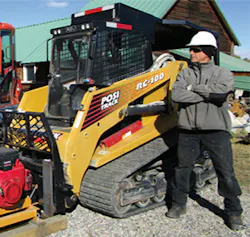
Rills and gullies on disturbed landscapes are as intriguing as they are destructive, notes John Whittingham. Accelerated soil loss resulting from human activities has always captivated Whittingham’s interest. Growing up in Colorado Springs, CO, during the 1960s and 1970s, Whittingham was often found hiking through deep ravines caused by construction-site stormwater runoff or exploring abandoned mines in the neighboring foothills. As co-founder of Basic Biological Services (BBS), in Dillon, MT, Whittingham now provides his expertise in soil and water resources for a company that offers vegetation management to agriculture, mining, forestry, construction, and recreation industries. Since 1999, BBS has employed biologists, botanists, reclamation specialists, skilled laborers, and himself, the company hydrologist. The company offers consultation, project design, permitting, and installation. BBS originally focused on providing revegetation and erosion control on pond and stream construction projects and now emphasizes vegetation management for highly disturbed landscapes regardless of cause. BBS works with large ranches on range and riparian management strategies, on annual mine reclamation requirements, and on stream and wetland habitat restoration projects. The company installs and maintains drainage structures on county and mine haul roads. Company crews also assess and work to eradicate destructive noxious and nuisance plants, followed up with a long-term revegetation strategy. Slopes and streambanks are the most common geographic features where BBS and Whittingham focus revegetation expertise.
What He Does Day to Day
Doing business in a remote rural community offers unique opportunities, notes Whittingham, who not only spends his time providing technical expertise to ranching and mining entities, but also operates heavy equipment. He designs, installs, and inspects stormwater discharge BMPs for international mining operations and prescribes and applies unique seed mixes with specialized equipment.
What Led Him to This Line of Work
Interests in wildland hydrology and surficial geomorphic processes in mountain landscapes led Whittingham to earn a B.A. in geology and geography from the University of Montana in Missoula. His M.S. in earth sciences from Montana State University enabled him to research shallow aquifers, springs, and wetlands in surficial glacial deposits. Whittingham spent 10 years employed as a hydrologist in southwestern Montana with the state’s Department of Natural Resources and Conservation, the US Forest Service, and the US Department of Interior Bureau of Land Management. “The best part was working with ranchers on the rehabilitation of impaired riparian habitats and engaging in active and abandoned mine reclamation projects,” notes Whittingham. “Stabilizing soils, slopes, and streambanks with appropriate vegetation was always emphasized, but federal planning activities seldom resulted in actual project implementation.” That led him to work in the private sector in 1999 for a company providing environmental field services and consulting. Whittingham is a Certified Professional in Erosion and Sediment Control and a professional wetland scientist, and he holds four Montana Department of Agriculture licenses. He is Mine Safety and Health Administration- and HAZWOPER-certified. He is currently the International Erosion Control Association’s Montana representative.
What He Likes Most About His Work
Since joining BBS, working directly with mine and construction engineers, ranch owners and managers, and Montana Department of Fish, Wildlife and Parks personnel has provided Whittingham with nearly two decades of frontline, in-the-trenches, “getter-done” project experience, he notes. “The variety of clientele and project objectives are constantly changing,” he points out. “Much of the field work is performed in remote and rugged locations in one of the least populated parts of the United States. Access to project sites often requires complex logistics. Performing environmental field services with BBS is adventurous work and presents daily adversities and risks. Adapting to new challenges and uncertainties is the best part of business.”
His Greatest Challenge
Doing business in a sparsely populated region presents unique challenges, he points out. “From active mine sites to trophy ranches, timber sales to highway construction, the work requires weekly equipment change-ups and use of different skill sets,” he says. “Southwest Montana and southeast Idaho offer five-inch precipitation zones in a cold desert setting, 20 feet of snow in alpine watersheds, 40 degrees below zero to 110 degrees above, and less than 100-day growing seasons. BBS is requested to perform difficult and obscure tasks, and is often requested to oversee personnel and labor crews from different companies. Adaptation is paramount.