Concrete Pipe Solves Tough Storm Sewer Challenge at Landfill
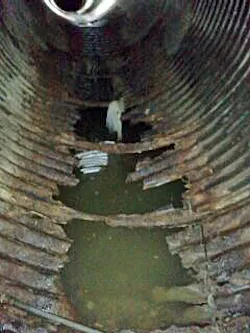
Otay Landfill of San Diego, Calif. is operated by Republic Services, a provider of solid waste collection, transfer, recycling and disposal services. When faced with a difficult storm water sewer challenge at the Otay Landfill, Republic selected Centri-Pipe, the centrifugally cast concrete pipe (CCCP) developed by AP/M Permaform, as the solution for large diameter pipe structural repair and waterproofing.
After the company noticed severe erosion around a pipe inlet, an inspection found severe failure and erosion in as much as 200 ft of 48-in. corrugated metal pipe (CMP), ranging from 8 to 20 ft below grade. It ran beneath sedimentation ponds that could not be disturbed. Also, trenching was not an option because it would likely disturb the large gravel stockpile at a nearby concrete aggregate plant. A 45º bend halfway through the pipe made sliplining impossible, and most liners would not provide the badly needed structural repair.
Spincasting: Thin, Strong and Waterproof
Centri-Pipe uses a precisely controlled spincaster to cast a new, thin-walled pipe that matches the contours of the existing failing pipe, which can be round or elliptical and made of any material, including corrugated metal pipe (CMP), concrete, clay, brick, etc. The spincaster is inserted into the horizontal pipe and withdrawn by winch at calculated speeds. Continuous runs greater than 400 ft are possible. While the spincaster is withdrawn, the operator in the pipeline visually confirms adherence and layer thickness, adjusting the withdrawal speed as needed. Typically, multiple layers are applied to develop the thickness specified by the design engineer.
Pressure-washing and basic preparation are important. A simple cofferdam was enough diversion for potential storm water. The pipe invert was filled in to secure the pipe and for the spincaster to be withdrawn without jerking motions. Eroded voids were filled and a new grout invert was poured. PL-8000, a fiber-reinforced mortar made by AP/M, was used for the invert and for spincasting the structural liner. PL-8000 has excellent properties, including high strength, quick curing, adherence in moist conditions and resistance to rust and corrosion.
With prep work completed, the AP/M crew worked from riser to riser, with the longest run at 150 ft. Three layers were applied, for a total thickness of 1¼ in. When working with CMP, special effort is made on the first layers to “flatten” the corrugations, ensuring that the final layer is uniform and smooth.
The 45º bend called for special techniques. “I normally just ride on the sled and radio to the winch operator,” said AP/M Technical Operations Manager Philip Birkey, who was the in-pipe operator on this project. “But when we got to the bend, I got off to guide the spincaster to keep the application consistent around the bend.”
When compared with trenching, CCCP is a safe procedure, but with an operator in the pipe, special care is taken. Confined space safety procedures are followed, including use of gas monitoring equipment, respirators and oxygen testers. The work can be noisy and messy; even so, Birkey said it can be pleasant.
“You get lost in it,” he said. “With the constant motion of the spinner head and adjustments to keep the winch speed in the ‘sweet spot’ so that adherence at the crown is perfect, it goes quickly.”
To guarantee quality and correct application, crews check layer thickness with a gauge during the run, as well as video-record the entire pipe both before and after the application.
Eight days onsite, including prep work and three passes, resulted in a clean, strong, rustproof pipe that only reduced the pipe’s inner diameter by 2.5 in.
Republic Services stated, “Centri-Pipe was shown to be cost effective when compared with trenching, and the quality of the rehabilitation exceeded our expectations. We’ll be using Centri-Pipe on additional lengths of pipe as soon as our budget allows.”