Nothing Else Came Close
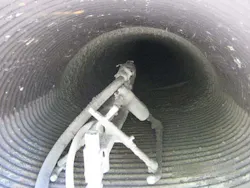
About 18 months ago, when he was just settling into his new job as Storm Water and Conservation Superintendent of Hays, Kan., Nicholas A. Willis decided to take a closer look at the storm water sewers underneath the picturesque brick streets in the city’s center. He knew from records that the sewer was 48-in. arched corrugated metal pipe (CMP), and a little over 50 years old. Because that is nearing the maximum lifespan for CMP, Willis was not expecting to find pipe in perfect condition. Still, what he did find surprised him.
“Basically, it was a cave,” Willis said. “Pipe had rusted out and been washed downstream, so I was shining my flashlight at an earth void and could see the under layer of the brick street. That’s just 6 in. of mesh-reinforced concrete, and we get semis and school buses in that part of town. I’m amazed it held up.”
After closing the street and initiating emergency repairs, the department inspected all of the large-diameter CMP in the city’s system. “Given that this pipe dates back to the early 50s, it has performed pretty well,” Willis said. “We have high pH soil, so pipe wasn’t being eaten from the outside, but 50-plus years is a long time.”
In fact, the system-wide inspection revealed about 300 ft of collapsing sewer, which was immediately addressed by trenching and replacement. And with that work done, there were still several thousand feet of pipe with rotted out inverts or other significant damage. Some of it ran underneath brick streets for hundreds of feet, and replacement by trenching would have been expensive—about $490 per ft—and would have seriously disrupted downtown traffic.
Willis then evaluated several trenchless methods. “We looked at just about everything, including two types of cast-in-place pipe,” he said. “Centri-Pipe was the best on price by far. Really, for large-diameter pipe, nothing else was even close.”
The Right Solution
Centri-Pipe is a centrifugally cast concrete pipe (CCCP) rehabilitation method developed by AP/M Permaform. A spincaster is inserted into pipe and withdrawn at a calculated speed while applying thin layers of structural grout or epoxy mortar. The finished product is smooth, tightly bonded, waterproof, and does not significantly reduce inner diameter or flow. It is especially efficient and cost-effective on large diameter pipe; the Florida Department of Transportation, for example, has used the system to rehabilitate 13-ft diameter sewers.
Crucially for Hays, Centri-Pipe is completely structural and adheres tightly to most substrates, including CMP. It behaves as if a new concrete pipe is built into the sewer, and the condition of the failing existing pipe does not affect the performance of the new pipe. Willis decided to test Centri-Pipe by rehabilitating 968 ft of 30- and 48-in. sewer in 2011, before committing to it as the prime solution for all of Hays’ failing sewers.
“We wanted to see how it performed and how it cured out over winter,” Willis said. “It did fine—there were some hairline cracks, like you would see in any concrete work, but after a year, it’s holding up very well with no shedding.”
In 2012, Hays rehabilitated an additional 2,500 ft of pipe, and Willis anticipates about 2,000 ft each year for a few more years. Costs work out to $180 per ft, with almost no traffic disruption.
“With the amount of work that has to be done, I don’t know how else we would be able to catch up,” Willis said, “For efficiency and cost, this has been a great solution for us.”
Since the CMP in Hays is arched, and concrete is applied by a spincaster. Willis said the new concrete was thicker in places, but that this does not really affect performance.
Most pipe required two or three passes, one to fill in and smooth out pipe corrugations, and one or two additional layers to add strength. One-inch layer thicknesses were specified, and inspection was done with a fairly low-tech method.
“We just drilled into it in a few places, until we got to metal,” Willis explained. “We found that coverage was even and predictable, and we didn’t need to drill into too many places.”
The contractor, Blue Nile Contractors of Kansas City, was paid when layer thickness met specification, and in a few cases a partial payout was made until an additional layer was added.
Finding out that you have inherited a sewer system with failing pipe—and that some pipe that has actually crumbled and washed away—is not the most pleasant way to start a new job. But Willis adapted quickly, and has already addressed the most critical pipe in the system. “We’re in a lot better shape after just two years, and Centri-Pipe is a big part of that,” he said. “Given our time frame and revenue, I don’t see how we could do without something like this. To any cities or agencies on the fence about it, I certainly recommend giving it a try.”
Angus W. Stocking, L.S., is a licensed land surveyor and fulltime infrastructure writer.