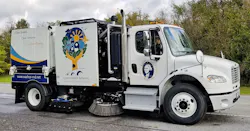
Schwarze offers a comprehensive line of sweepers, including models for parking area cleaning, industrial sweeping, airport runway sweeping, street sweeping and more.
undefinedCommunities across the U.S. face the challenge of effectively using taxpayer dollars to meet National Pollutant Discharge Elimination System (NPDES) permit requirements. Washington County, Maryland, which is in the Chesapeake Bay watershed, must also meet the U.S. Environmental Protection Agency’s (EPA) total maximum daily load requirements.
After a cost assessment of implementing Chesapeake Bay requirements tallied up to more than a billion dollars, “we really had to look at ways to become innovative and creative,” said Alex Reed, watershed specialist for Washington County.
The county struck on a solution that would have widespread impact and a quick return on investment: a street sweeper. Unlike other best management practices (BMPs) like storm ponds, which would only serve a small segment of the county, a sweeper could serve the entire community. Furthermore, in contrast to a storm pond that would take months or even years to plan, permit and construct, a sweeper could have immediate impact on local water quality and therefore Chesapeake Bay water quality. And, a 2011 study on the costs of storm water management practices prepared for the Maryland Department of the Environment Science Services Administration found that street sweepers provided the lowest average annual cost over 20 years per impervious acre treated.
Double-Duty Sweeper
Washington County’s NPDES permit requires it to reduce or treat its approximately 700 acres of impervious surface by 20 percent, according to Reed. To help meet these goals, the county opted to purchase an A8 Twister regenerative air sweeper from Schwarze Industries. According to EPA guidelines, one lane-mile of sweeping with a regenerative air sweeper is equivalent to one impervious acre treated. The staff has broken the county into 45 “sweepable sections” that each will be swept 25 times per year, with a goal of sweeping at least 12 lane-miles per day.
The sweeper provides the county double functionality when it comes to BMPs—in addition to street sweeping, it also has catch basin cleaning capabilities. This was a feature Washington County particularly sought when selecting the A8 Twister, Reed said.
Another factor that helped Washington County decide on the A8 Twister is its high dump feature, which allows the county to pair the sweeper with a dump truck, so it does not have to stop sweeping to drive to a dump facility to unload. “Once the dump truck is full, it can run to the landfill, where it dumps the material and then comes back to be staged,” Reed said. “Then we never stop the street sweeper during the day while it’s out and about.”
Achieving Community Buy-In
Because the sweeper is able to serve the entire county, people from communities across the economic spectrum are able to see it at work in their neighborhoods. “A lot of the lower-income places and communities in the county, those are areas that have already been developed,” meaning there is not space for BMPs like storm ponds, Reed explained. A sweeper, however, can get into those communities and make a difference. “The debris is picked up, and then all of a sudden these underserved communities aesthetically look better,” he said.
The public response has been overwhelmingly positive. “I’m honestly surprised—happily surprised—how many phone calls we’ve gotten from people calling to thank us,” Reed said.
Washington County also uses the sweeper to promote its Clean County Initiative, a program that aims to ensure taxpayer dollars are used effectively and create awareness of the county’s efforts to improve the environment. The sweeper features the Clean County Initiative logo and its motto, “Clean Streets, Clean Streams, Clean County.”
“People recognize it and they’re starting to get that brand recognition with good work in the community,” Reed said, adding that events such as stream cleanups and tree plantings at schools have recently experienced higher attendance. “As long as we have that community buy-in, we’re going to be able to continue to reach our goals and therefore, be one of the counties that actually meets our NPDES goals, and that’s something we’re pretty fired up about. And doing that on limited resources—that’s even better.”
To view a video case study of this article, or to learn more about how Schwarze street sweepers are a cost effective BMP for storm water management, visit http://schwarze.com/stormwater.