San Diego's Cedar Fire Diminished Nature's Ability to Retain Storm Water and Clean Air
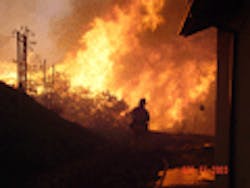
The fall 2003 Cedar Fire that swept into the city of San Diego not only destroyed homes, it burned a significant portion of that landscape, diminishing nature’s ability to protect air and water resources, according to a new study conducted by American Forests, a national nonprofit conservation organization.
This project is supported by the California Department of Forestry and Fire Protection and the San Diego Water Department.
Trees and other vegetation together with their complex interaction with soil, air, and water—called green infrastructure—provide valuable ecosystem services by slowing storm water runoff and improving air and water quality.
Satellite imagery now can be classified into different land covers that provide a digital “green data layer” with which to quantify green infrastructure and analyze its ecological and economic value. This can show the changes in dollar value as the land cover changes due to land development or catastrophic events like wildfire.
The Cedar Fire affected 28,466 acres of land within the San Diego city limits, about 13% of the entire city. Comparing pre- and post- fire conditions in the Cedar Fire area, American Forests reported a loss of 49% tree canopy and 73% each of chaparral and shrub.
This loss in vegetation resulted in decreased ecosystem services: Within the Cedar Fire area, storm water runoff increased by 12,674,490 cubic feet. The value of retaining this additional storm water, replacing what the trees did for free, is estimated at $25,349,000. The ability of the Cedar Fire’s canopy to remove air pollutants decreased by 314,870 lbs per year, a loss in value estimated at $798,000 annually.
“American Forests completed an Urban Ecosystem Analysis and delivered a digital green data layer and computer software to the city of San Diego for daily decision making four months prior to the November fire,” explained Gary Moll, senior vice president at American Forests. “The dramatic and sudden loss of vegetation warranted an update to the green data layer. We focused on chaparral loss as a result of the Cedar Fire. These data, together with analysis tools give city leaders a quantitative measure of the lost services, including the dollar value for providing storm water management.”
Green infrastructure is a significant asset that was not previously documented as part of the city infrastructure.
High resolution satellite images collected after the fire were classified into Level 1 land covers, which identify trees, shrubs, chaparral, open space and impervious surfaces.
In this analysis, chaparral was distinguished from other vegetation cover using chaparral-cover information provided by local agencies. CITYgreen, American Forests’ GIS software tool that quantifies ecosystem values was provided to San Diego along with training in its use.
Source: AF