Acclaimed Conservation Development, Inspiration
A Natural Neighborhood in Bayport, Minnesota, has opened home sales on the innovative 245-acre conservation development. Inspiration opened its first model home in late January and is opening three additional model homes in February to coincide with the Twin Cities Parade of Homes.
Even as homes are beginning to dot the landscape, the founder of Inspiration, Contractor Property Developers Company (CPDC), is restoring 70% of the property to native Midwestern prairie, wetland, oak savanna and woodland, which will be protected in-perpetuity as a nature preserve for the public.
Only 30% of the site is reserved for the construction of homes and roads, and just 254 rooftops will be built in this natural neighborhood. Of these 253 will be single-family homes and one will be a senior condominium cooperative.
Ecologists designed Inspiration as a model of environmentally enlightened development. Applied Ecological Services (AES), a national leader in ecological consulting, designed the land plan for Inspiration after conducting an extensive natural resource inventory of the site and surrounding lands, and after studying the existing scientific data and history of ecological resources in the area.
As a result of this research, AES created an Ecological Restoration and Management Program, integrated with a unique alternative storm water management plan. This 90-page plan calls for almost 170 acres, or 70% of the property, to be preserved as open green space. It also prescribes the restoration of eight distinct ecological communities ranging from wetlands to prairie to woodlands.
CPDC will invest nearly $2 million in the restoration and management of natural ecological communities over the next five years. These plant communities will provide wildlife habitat for hundreds of species of local and migratory birds, mammals, amphibians, reptiles and beneficial insects, and will help reconnect the web of life with the adjacent St. Croix Bluffs Scientific and Natural Area (SNA). The St. Croix Bluffs SNA is a high-quality, regionally significant eco-habitat owned and managed by the Minnesota Department of Natural Resources. The land management plan calls for protection of two Native American burial grounds identified on the property by archeologists. These areas will be left undisturbed and protected by a natural buffer more than 100 feet wide to be restored to native tallgrass prairie.
Onsite naturalist Andy Dahl is planning a continuing program of environmental education to help people understand and appreciate the ecological restoration that is being created and privately funded for public use.
Residents of Inspiration as well as the public will enjoy passive recreation, hiking, cross-country skiing and bird watching on more than two miles of trails within the natural areas of Inspiration. These trails connect to trails into the St. Croix Bluffs SNA to the south, and to a community park to the north. A regional snowmobile trail borders the Inspiration property on the north end.
In 2005, CPDC funded the restoration of 39 acres of tallgrass prairie and four acres of wetland, which was seeded by crews from Applied Ecological Services. This winter, AES crews are removing European buckthorn and other invasive shrubs from the remnant oak savanna and woodlands on the property. Ecologists will monitor the natural vegetation response in the spring to determine whether additional native seed is needed to enhance the vegetation response. In the next two years, CPDC will restore 90 acres of prairie, 47 acres of an oak savanna/prairie mosaic and 19 acres of oak woodland. Six acres of existing and created wetlands will be planted and seeded, and native vegetation will be established in the wetland biofilters and raingardens that comprise the Storm Water Treatment Train.
Following the active restoration phase, AES will implement a five-year management and monitoring plan that will ensure the proper establishment of native plant communities and the optimal wildlife habitat for the created and restored ecosystems.
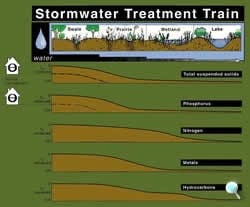
An essential element of the ecological design of the property is the Storm Water Treatment Train that uses a network of storm water swales to direct runoff from yards, rooftops and driveways into and through the prairies and wetlands.
This alternative storm water system reduces the volume of runoff due to infiltration in the native plant communities, and it cleanses the runoff that does occur in order to improve water quality both on-site and in downstream water resources. In fact, the storm water system has already reduced the volume and improved the quality of runoff from the pre-development conditions of the agricultural land.
This is important because the property is perched on the upper terrace of the St. Croix River floodplain. If runoff were piped downstream in a conventional storm sewer system, it would flow directly to the river -- a federally designated Wild and Scenic River. With it would flow all the excess lawn fertilizer chemicals, herbicides, pesticides, sediment, oils, grease and heavy metals from automobile combustion and operation.
The Storm Water Treatment Train manages rainwater close to where it falls, and directs it through surface swales into a series of 15 interconnected wetland biofilter and rain garden detention areas. This allows storm water to soak into the ground most effectively, it helps remove chemicals biologically, and it traps sediments and particulates, thus reducing pollution that could otherwise reach the river.
Source: WWD