New York Governor Calls on Federal Government to Assist Municipalities
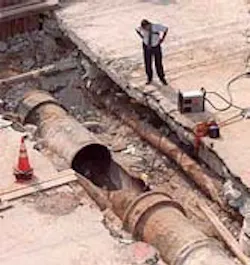
New York Gov. David A. Paterson has announced the formation of an environmental and government collaborative to help tackle a looming water infrastructure crisis facing the state. The Clean Water Collaborative will focus on funding solutions for the state's mounting wastewater and drinking water infrastructure needs. Due to decreasing federal aid, New York communities will have to spend in excess of $50 billion over the next 20 years to make required upgrades to meet federal requirements.
The Department of Environmental Conservation (DEC) estimates that repairs for municipal wastewater treatment systems statewide will be $36.2 billion over the next 20 years, while repairs for drinking water infrastructure could exceed $20 billion over the same period. Additionally, federal support for water infrastructure has plummeted roughly 70 percent over the last two decades, delaying critical maintenance and contributing to Clean Water Act violations. Hundreds of sewage and wastewater treatment facilities have deteriorated.
"Under any economic conditions, the fiscal burden of rebuilding our water infrastructure would be daunting. Rather than wait until they are handed the bill for these required repairs, we need to support New York's municipalities in getting federal funding for needed repairs and upgrades," Paterson said. "This has been ignored for too long. Water quality, public health and municipal finances are all at risk. Systems are failing, and often municipalities do not have the resources to do repairs or upgrades."
The Clean Water Collaborative panel will be co-chaired by Robert F. Kennedy, Jr.--known for his work on environmental issues, particularly those dealing with clean water--and Ross Pepe, executive director of the Construction Industry Council and Building Contractors Association. Additionally, the panel includes a wide array of representatives from environmental, business, labor and state and local government.
Aging wastewater infrastructure is tied directly to the quality of New York State's waters. A DEC study documented the correlation between wastewater infrastructure and water quality, finding that water quality declines when infrastructure is kept in place beyond its design life or is inadequately maintained. Many of New York's sewage and wastewater facilities are past their design lives; 30 percent of the sewer pipes across the state were installed just after World War II, and a quarter of wastewater treatment plants are more than 30 years old. More than 200 state municipalities are facing Clean Water Act violations because of sewage overflows and other problems often related to aging infrastructure.
Meanwhile, federal assistance has plummeted. In 1987, the federal government provided $2.4 billion in loans to states for wastewater infrastructure projects. By 2008, that support plunged to $687 million. In New York, federal assistance fell from $227 million in 1991 to $75.1 million in 2007. A recent U.S. Environmental Protection Agency report stated that funding for the loan program is set to end in 2011. Earlier this year, Gov. Paterson and New York City Mayor Michael Bloomberg wrote to U.S. Senate and House leaders to urge them to continue support of the loan fund.
Source: New York State Department of Environmental Conservation