U.S. EPA Mystic River Report Card: "D"
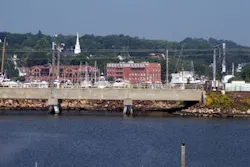
In the second public reporting on the condition of the Mystic River since kicking off a collaborative effort last year to address water quality issues in this urban river, the U.S. Environmental Protection Agency (EPA) has given the Mystic River Watershed a grade of "D." Even with a low grade, however, the EPA believes that prospects for the river are positive, based on the attention now being paid by environmental agencies, organizations and concerned citizens.
The EPA grade for the Mystic River Watershed indicates that over the past year, water quality met swimming standards 46 percent of the time and boating standards 79 percent of the time. The grade is based on bacterial contamination.
In 2007, the EPA launched a focused and aggressive effort to coordinate with state agencies, the communities along the Mystic River and local environmental and community organizations to address water quality issues in the Mystic Watershed. The effort has a goal of improving water quality on the Mystic River and its tributary streams. This means restoring the watershed to both fishable and swimmable conditions based on measurable water quality standards.
This year, the EPA worked with federal, state and local officials as well as nonprofit groups to host the Mystic River Summit, a forum to generate ideas, develop goals and map a strategy. The summit is part of EPA New England’s Urban River Strategy and an important step toward our long-term commitment to improving water quality.
“The Mystic River has played an important role in our local history, and it’s time to give the watershed the attention it needs to thrive once again,” said Robert Varney, regional administrator of EPA’s New England office. “It will take a lot of hard work to restore this river, but along with our partners we are committed to making a cleaner and healthier Mystic.”
"Thanks to our partnership with EPA and local advocacy groups, we are poised to turn the corner and make some significant gains in bringing the Mystic River back," said Glenn Haas, assistant commissioner for Resources Protection at the Massachusetts Department of Environmental Protection (MassDEP). "Despite its current ranking, progress is being made now, with more to come on eliminating illegal connections, stopping sewer overflows and reducing discharges that pollute the river and its tributaries."
While a grade of “D” is the same grade based on similar water quality as last year, much has changed to address water quality issues in the Mystic Watershed. The EPA and MassDEP have implemented a number of enforcement actions in the watershed to compel actions to improve water quality. The government agencies have also undertaken a significant level of outreach, assistance and stakeholder involvement to effect the long-term changes necessary. The EPA expects, during the next year, to continue to lay the groundwork for both near- and long-term improvements in the Mystic Watershed by continuing to increase enforcement, sampling and outreach effort.
The Massachusetts Water Resources Authority (MWRA) has completed a number of projects that have improved water quality in the Mystic Watershed over the years. Most recently, in 2007, MWRA completed and activated the Boston 019 Storage Conduit, located under the Boston side of the Tobin Bridge. "Since March 2007, this facility has prevented over 5 million gal of combined sewage and storm water that would have otherwise discharged to the Little Mystic Channel, degrading water quality," said Frederick A. Laskey, MWRA executive director.
Further, MWRA designs are nearing the final stages for improved sewage infrastructure in East Boston along the Mystic River and Chelsea Creek, and MWRA is planning on moving forward with the much needed Alewife Brook combined sewer overflow projects in partnership with the city of Cambridge.
“While we look forward to a time when the Mystic’s grade is higher and water quality is cleaner, today we celebrate many small victories that have led us to the progress we are seeing in specific areas,” said John Reinhardt of the Mystic River Watershed Association. “While we are happy that time and attention is being paid to the Mystic River Watershed, we need more of both and with the help of EPA and others in doing this, we are confident that the tide is turning in the right direction.”
When assessing water quality to assign a grade to the Mystic River Watershed, the EPA uses similar criteria as for the Charles River Initiative, as follows: A--meet swimming and boating standards nearly all of the time; B--meet swimming and boating standards most of the time; C--meet swimming standards some of the time, and boating standards most of the time; D--meet swimming and boating standards some of the time; and F--fail swimming and boating standards most of the time.
For more information, visit the EPA’s Mystic River website, http://epa.gov/region1/mysticriver/index.html.
Source: U.S. EPA