Madison Installs Rain Gardens to Cut Runoff
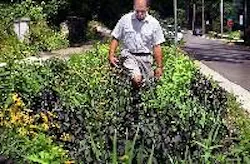
Some residents along Adams Street have new gardens - compliments of the city of Madison, Wis. - that do a lot more than look pretty.
The picturesque prairie plants - purple cone flower, brown-eyed Susan and other native species - are hard at work in the terraces between the street and sidewalk.
Their roots - up to 15 feet deep - are creating channels that let storm water from streets, sidewalks and rooftops flow into the ground and, ultimately, into the aquifer that supplies water for drinking and other uses to city residents.
In Madison, as in other parts of the country, rain gardens are part of a growing movement to sustain the underground water supply and reduce the amount of runoff polluting lakes, rivers and creeks.
John Standridge, who had one of the new rain gardens installed on the terrace of his property at the corner of Adams Street and Edgewood Avenue, is one of nine homeowners along the 1900, 2000 and 2100 blocks of Adams Street, between Edgewood Avenue and Harris Street, who agreed to have rain gardens adjacent to their properties.
Standridge is a retired water microbiologist with the state Laboratory of Hygiene and member of the city's Commission on the Environment, who now does consulting work for Agrecol Corp., a Madison company that grows prairie plants and native grasses, including those used in the Adams Street rain gardens.
The Adams Street project, initiated by Friends of Lake Wingra, was inspired by Seattle's Street Edge Alternatives Project, which uses natural landscaping to soak up water along a street that has no curbs or gutters, said Genesis Bichanich, a water resource specialist with the city's Engineering Division. Friends of Lake Wingra obtained a grant from the state Department of Natural Resources to support the project, which dovetailed with the city's reconstruction of Adams Street.
"Very few cities have done this," Standridge said.
While the Adams Street plantings are the first residential rain gardens sponsored by the city, it has created rain gardens to absorb run-off from paved surfaces at Warner, Olin- Turville and Brittingham parks, with support from Agrecol founder Bill Graham and Sandy Martin through their Graham- Martin Foundation.
Water that would normally be piped from the storm sewer to Lake Wingra is piped to the rain gardens instead.
Storm water flowing down Edgewood Avenue from Monroe Street goes into a curbside grate and is diverted to Standridge's garden, where it bubbles up from a spout.
Sidewalk grates along Adams Street collect and direct water to other rain gardens. Water collected from the roofs of some homes also is piped into the gardens.
If there is more water than the rain gardens can absorb, overflow vents divert the excess back to the storm sewer.
"We've had some rain, and they work," Standridge said, adding that even during the recent deluge that caused flooding nearby, little water had to be diverted from the gardens.
The fierce storm did damage some plants, which will be replaced, Bichanich said.
Along with putting water back into the ground, the rain gardens help in other ways as well. "The silt that used to get into the lake is now collected here," Standridge said, adding, "The number one polluter of our Madison lakes is construction runoff."
The rain gardens also reduce the amount of other pollutants, such as phosphorus, that flow into Lake Wingra, which is "on the edge of being fixable or not," he said.
"That's a significant part of this, too," Standridge said. "We're going to be naturally removing these pollutants as we percolate it through the soil."
Just how much can the Adams Street rain gardens help?
"It's a tiny, tiny drop in a huge swimming pool," Standridge said, adding, "You take 1,000 rain gardens, which is our current goal, and you're making a measurable drop."
And if everyone had one, he said, "It does make a significant difference."
Source: WSJ