Simulator Training: Where We Are, Where We’re Going
“It takes a minimum of 180 to 200 hours of seat time before an apprentice can go onto a job site and operate a machine safely and efficiently. A contractor can’t afford to keep a person
on a million-dollar piece of equipment who’s not able to run it.”
—Harold McBride, executive director, Operating Engineers Training Institute of Ontario
Although earthmoving simulators provide an opportunity for safe and cost-effective training of beginning operators and for seasoned operators to cross-train, upgrade skills, work off bad habits, and become familiar with new technology, the construction industry has been slow to jump on the bandwagon. But the good news is that while manufacturers struggle to sort out the market and iron out kinks in delivery systems, a group of enthusiastic early adopters is applying simulators to a variety of training situations and experimenting with their potential.
While everyone agrees simulators are only one element in operator training, there remains little doubt about their effectiveness. In a study from Simlog, an early developer of what the industry calls “desktop” simulation, operators who did their initial 40 hours of training on simulators were 50% more productive in the field than those who did the same amount of training on live machines.
Marketing director Mike Keffer thinks this is partly a function of Simlog’s emphasis on quality over speed. “It really comes down to the way our simulators teach people to operate and the way skills development takes place. We teach people to work slowly and carefully first, with the emphasis on quality work. Then, as the hours progress, they learn to do things more quickly. This is the opposite of the way people learn on real equipment, where there’s a tendency for speed, because learning to do things carefully takes time, which means more fuel and increased wear and tear on the equipment, not to mention tearing up an asset that might be needed for production.”
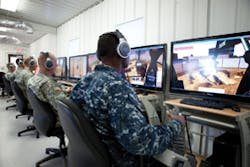
Simlog’s system requires only its software, a PC to run it on, monitor and controls, and at $10,000 it’s the least-expensive way to introduce green operators to a machine. “Before anything else, a beginner needs to learn the core skills,” says Keffer. “Control familiarization, a certain amount of hand-eye coordination, then hand-hand coordination, followed by hand-feet coordination. Our emphasis is instructional design and the depth and scope of the exercises for easy skills transfer in the beginner.”
As part of an effort to reach beyond its traditional market of schools and unions to individual contractors, the company has recently introduced a major upgrade to its flagship hydraulic excavator simulator that features improved graphics, more realism in the simulation, including how the equipment interacts with its environment and the terrain, and the addition of scenarios where the operator is asked to perform combinations of multiple small tasks instead of a series of individual ones, a strategy Keffer says is designed to take skills development to a deeper level of productivity. Additional modules, also designed with contractors in mind, include specialized tasks such as trench crossing and ramp building.
Like Simlog, Caterpillar sees its simulators as a way to teach beginning operators basic hand-eye coordination, basic machine operation, and safety and to validate skills students learn in the classroom and translate them into real-world applications so they can make use of their time on actual machines. Its simulator scenarios, recently upgraded by licensee CSE Software with crisper, improved graphics, are designed to teach “non-branded” industry operations such as using an excavator to dig a trench or set a trench box. System elements are assembled in an H-shaped unit manufactured and distributed by Simfomation that includes a 45-inch front monitor, second screen for rear vision, adjustable seat behind an adjustable steering column, and Cat controls and foot pedals. The current fleet includes an excavator, track-type tractor, motor grader, medium off-highway truck, mining truck, large wheel loader, wheel tractor-scraper, and small wheel loader. Cat’s long-term goal is a matrix of machines by family and industry. (Caterpillar has also developed fully immersive simulators for the mining industry with Australia-based Immersive Technologies).
“Contractors are realizing that productivity boils down to the quality of the operator,” says Larry Estep, Cat’s manager for simulators. “We can spend all kinds of R&D money to design the best machines in the world, and our customers can spend lots of money to buy them, and as soon as you put an operator in the seat, everything can change if he doesn’t know what he’s doing. We’re asking contractors to put pressure on outside training programs to better train operators to be productive day one. And we’re asking the Cat simulator team to be advocates for training in general with these people who train operators.”
A Multitude of Uses
At the city of Kitchener, ON, vehicle and equipment training specialist Jerry Rade is using a refurbished computer equipped with Simlog’s software, a 35-inch monitor, a desk, and an office chair to train aspiring backhoe operators. His one splurge was OEM joysticks, which he says make his simulator feel more realistic.
Faced with increased costs to recruit and train operators, Rade makes the simulator available to city employees interested in upgrading. Potential operators train at their own pace and on their own time. “It’s a way of weeding out applicants and at the same time providing introductory training for those who stick with it. I want them to develop sufficient skill with the controls that when I put them on the equipment, I can actually start to teach them the task.” Rade particularly likes the management software that allows him to track each potential operator’s progress and pick out the one or two he should keep his eye on. The simulator-training program has been so successful he’s considering two new simulators and dreaming up applications such as remedial training.
“The simulator gives operators a chance to work a problem or an issue out without scrutiny, because their performance is scored strictly on a numerical basis-no judgment calls on my part, no verbal assessments. We also use it to get operators ready for jobs they might not be familiar with and help them gain some skills they might not have had to use yet, and for specialized jobs like water course remediation.”
Operator Confidence
Volvo has stepped down from its full-scale hydrologic motion simulator to a less expensive
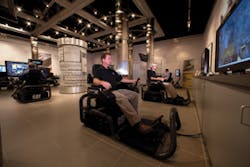
model ($70,000-$75,000) that, along with computer, monitor, seat, steering column, and controls, also features an electric full-motion platform as standard. Like Simlog and Cat, Volvo is marketing focusing is on unions and technical schools. At Pennsylvania College of Technology in Williamsport, PA, diesel and heavy equipment instructor Budd Greevy likes simulators for the way they help beginning operators develop self confidence.
“We had the Volvo wheel loader and haul unit here last year for a couple of weeks, and it really helped my students. You put them on a simulator before putting them into the seat of a live machine, and it makes them feel much more comfortable. They get the feel of the bucket and driving the machine around, which makes them a lot more self confident, and this gets them digging efficiently a lot quicker, especially with the Volvo simulator being full motion. Getting into a wheel loader, you feel kind of uneasy the first time you turn the wheel and the whole thing rolls. So the motion helps.”
Greevy also likes the performance evaluation feedback. “When a student is working on the controls of a live machine, they’re effectively evaluating themselves. They’ll tell you they’re ready, and you have to tell them no, they’re not. With the simulator, real numbers pop up, and when they see what they’re getting is one-third buckets or half buckets, they recognize they have to keep working at it. On a live excavator students basically dig air until they get the feel of the controls, burning fuel at $4 a gallon. The simulator takes pennies an hour to run, and the instructor is able to be right there beside them.”
“About five years ago our customer told us operator training was one of their top concerns,” says Mike Hoeg, senior instructional designer at John Deere, “and they wanted an alternative to machine training, which was too expensive and involved too many safety issues. We took their suggestions to heart and came with a three-level training approach. Level one is online training and DVD videos, which feature self-paced interactive lessons that teach the basics of the machine and have tests associated with them. Level two is the simulators, which we developed with Southwest Research Institute in Dallas. These allow operators to get familiar with controls and learn operator technique, including safe operation. Level three is skills verification where they sit in the seat, feel the dynamics of the live machine, and learn the job site.”
Current simulator models include an excavator, four-wheel drive loader, motor grader and crawler dozer. Next up is a backhoe for late fall 2011 release, and just introduced is a portable, universal motion platform that can be used with any of the Deere models. Motion platform, stand, computer, controls and monitor come in at less than $25,000. Each of the Deere simulator’s 10 lessons comes with a lesson script, useful for situations in which one instructor is handling multiple students. Unique to Deere is a system of budget-based scoring-another customer request-that shows in dollar figures how a student’s performance affects the bottom line.
Motion or no motion remains a debate. Simlog maintains that at the level of beginning operators, motion had little or no instructional value but adds dollars to the system and may make simulators out of reach of contractors or institutions on a tight budget. On the other hand, Hoeg says, customers like it. “They tell us you drive a crawler dozer based on feel, and if you don’t have motion in the simulator, how are they going to learn?”
“It’s a matter of fidelity, says John Hildreth at the University of North Carolina at Charlotte, who keeps an eye on how the construction industry is using simulator-based training. “The more realistic a simulator, the more an operator tends to operate it like he would the real machine.”
Motion aside, Hildreth thinks the effectiveness of simulators is highly dependent on the scenarios built into them, and he worries the industry isn’t clear about its goals for simulator-based training. “Are we trying to get the student proficient with the machine or with the procedure? Are we trying to teach operators to safely operate a specific machine? Or is our goal how to efficiently and effectively produce work? Because there’s a difference. Right now you can purchase simulators that measure the length of time it takes to do a task, how many times a student has to repeat it, but the question is, are the tasks we’re having students perform and achieve proficiency with meeting the goals we’ve set? My sense is we have maybe built the tasks without clearing defining the goals.
“In the current setup, an operator goes through the simulator scenarios and completes the required task, and the instructor gets a pile of information. But how much of this information is useful? How many of those 20 metrics do we want the operator thinking about while he or she is performing an operation? If it’s all 20, great. But I bet it’s not. And I’d guess there are some that aren’t on the list, which is what I mean by, “˜What’s the goal?’ What do we really want the operator doing?”
Hildreth’s ideal would be for simulators to be customized to incorporate a particular contractor’s individual way of doing things, emphasizing typical jobs and obstacles operators are likely encounter. He also argues for a way to “play” with various factors that can affect productivity and demonstrate to students the effects of their responses. “What happens if the soil type changes, for example, if we drop in some unexpected precipitation? If the light changes?”
At Montreal-based CM Labs Simulation Inc., COO Arnold Free agrees. Free thinks that although simulators offer the opportunity to capture objective details about individual student performance in a way that benefits both instructors and students, and student learning retention is higher after these structured reviews of their performances, applying a variety of scenarios that feature unanticipated events leads to more effective learning and a wider operator skill set. “This kind of training goes beyond learning the basics of controls. It’s about how to use that machine in typical work environments, and ideally not only as an operator but also as part of a crew working together. It’s full-mission, full-team training.”
CM Labs developed the multiscreen, full motion, virtual reality simulators that have helped make the crane training program at the Operating Engineers Training Institute of Ontario world renowned, and specializes in immersive simulators for training in the offshore gas and oil industry, where the margin for error is slim to nonexistent. Both Free and Training Institute Executive Director Harold McBride think the same approach would reduce accidents and save money in the dirt-moving industry.
“We want to develop the same type of virtual reality, three-dimensional head tracking system that we have with our crane simulators,” says McBride. “With four, possibly five screens, three in front so you can look down, straight ahead and up, and one on each side, and including the head tracker so anywhere the operator looks, the view is changing. With what’s available now in heavy equipment simulators, the operator can only look ahead and he doesn’t know what’s going on around him.”
“You ask a fighter pilot,” says Free, “what’s the most important thing about flying a mission, he’ll tell you the planning he did before and the review he did afterward. Flying the mission should just be following procedure. There’s no surprises as you do your job. So all of our training begins with a work plan. If it’s in a crew-training environment, the crew should perform that work plan together.
“The three basic steps in this kind of training are: plan your work, then do the work-in the case of the simulator in a simulated environment-then engage in an after-action review, where the operator and instructor go through the mistakes the operator might have made and how the job could have been done better. This post-mission review is one of the most important aspects of training.”
Getting Help to Where It’s Needed
The effectiveness of simulator-based training aside, questions remain about how the benefits can be best delivered. CAT hopes technology will bring the price down to where individual contractors can have them on hand. Hoeg reports Deere has had discussions with the large rental chains but so far without much interest. Another option is for dealers to buy the simulators and make them available to their customers. Which is just what Nortrax Equipment, the largest Deere dealer in North America, did. “We were the first dealership to have simulators and use them this way,” says David Willis, who coordinated the program. “Customers rented the simulators, sometimes for a month or so, to see how their operators would take to this kind of training and whether it would pay off for them to purchase one. Some wanted it to train employees on new technology. Counties and municipalities saw it as a more cost effective way to certify employees than on a live machine and help employees break bad habits and keep insurance rates in line. We also used the simulators at career days and a colleges like the University of Florida, where it was a lot easier, and much less costly, to set up a simulator in an air conditioned classroom than haul in a piece of live equipment.”
Proceeding in the opposite direction, Budd Greevy at Pennsylvania Technical College plans to make his Volvo simulators available to local construction companies. “I haven’t figured out exactly how it’s going to work, but we are we’re going to make it possible for companies to use the simulators for training and evaluation. I brought in some of the companies that hire from us, and they brought their operators and operator-trainers to see what they thought of the simulators. One thing the contractors all liked is they can explain a lot easier where an operator’s faults are and what they have to look at to be more efficient on a simulator than on a live machine. One of the companies on our advisory committee runs haul trucks and recently had an articulated 40-ton truck F series roll over. They realized if the operator had the right kind of training on how to react, the accident might not have happened. At $80,000, it doesn’t take many of those kinds of accidents to pay for the simulator and be safe.”
In Canada, Nuna Training Technologies is bringing simulators and training directly to mines and construction contractors in the northern provinces. The company, which is 51% Intuit owned, has its own fleet of simulators including the full-motion Volvo multi-unit simulator it needed for training on an articulated dump truck and utility loader with pick attachments. The unit can be broken up into two separate versions and is used in the trailer built to haul it in. “We hear all the time that employers are looking for experienced operators,” says Bob Huculak, Nuna Training Technologies training manager. “I tell people, “˜Introduce me to the woman who’s giving birth to experienced operators, and I’ll patent her.’ Everybody needs training. It’s sad that often in the development of their workforce the people making decisions have forgotten where they learned their skills and how. Simulation is a natural. It’s where operators are going to learn the most.
“In a typical training program, we’ll handle, say, four students at one time, so while one individual is in the simulator getting exposed to new experiences, we’re in the classroom with the other three going through basic safety procedures and best practices. Then we put them on the live machines. The fact is, if you use a simulator to its maximum potential, it’s going to pay back immensely in several different ways. For example, simulators generate a reasonably detailed report you and the operator can sign as proof of competency, very important when it comes to emergency response. If an individual has been in that kind of a simulator session, succeeded at the tasks required of them, and then initialed the report, there’s no gray area. Over the past 10 years every individual who took simulator-based training with us and then encountered an emergency said it was easy to respond because they had done it in the simulator.”
Huculak also reminds contractors that regulations are lurking. One of Canada’s western provinces already has legislation requiring a formal training session for anyone operating a machine that’s mobile by wheel or track, and McBride reports that Ontario law now makes employers responsible for operator competency. “Smaller contractors in the construction and dirt moving industries would be extremely wise to be proactive,” says Huculak. “Start looking at simulators now before the legislation comes down the tubes. Being proactive is going to do two things: it’s going to reduce your incident frequency and it’s going to improve your productivity.”
What else is in the offing? “Simulation is still in its very early days,” says Free. “Right now it’s mostly focused on operator training, maybe because that’s an easier problem to solve. Our own simulator framework is scalable not only from desktop to immersive training but also to multiple role-players. In our crane simulators each trainee performs their job as they would on a job site. Besides the crane operator, for example, there’s a rigger who has to inspect the lift gear and a signalman. Each individual has his own screen and avatar that he moves through the 3D virtual worksite to position himself properly and perform his job.
“Simulators also offer the opportunity to do operations planning. A typical end user would be an engineer using the software in a desktop application. His work would then be loaded into a simulator where the operator would complete the job as the engineer planned. They’d both be working together, which makes for a lot of synergy.”
At the University of North Carolina, Hilderth sees a similar vision. “What if you have the ability to program the simulator to do what the military is already doing-build a virtual job site where you could run through an entire operation and improve your opportunity for success the first time around? Obviously the consequences are much greater in a military operation than building a road, but at the same time if a contractor’s got a key operation and it’s a bit different than his folks have done before, maybe he wants to have them run through it before they get on the actual job site.”
Nor are these the only challenges ahead. What if the definition of a well-trained operator changes to reflect an ever more technologically complex job site? John Deere has anticipated this with its recent agreement with Topcon to feature Topcon machine control in its crawler simulator. “We had a customer make the request,” says training specialist John Goodney. “So we got together with Topcon and are making it happen. It’s not enough just to know how to operate a machine. You have to able to use the tools that are available. To train an operator on grade control, the instructor almost has to be up in the cab, and this can be dangerous. With these simulators, the instructor can sit with the student and show him how to use the different menus in a quiet and safe environment. And you’re not burning fuel.”
Simulators run a wide gamut as far as quality,” says Carl Johnson, heavy equipment apprentice training coordinator for BP Refinery in Texas City, TX, which has purchased crane and heavy equipment simulators from CM Labs. “The first thing is to do your due diligence and define how you’re going to use the product, then assess the quality of what’s available. The more money you’re willing to spend, the better your graphics are going to be, the better the training scenarios, the better the depth perception.”
“When I used to take the simulators to trade shows,” says Willis, who is himself a heavy equipment operator, “I would tell operators they provide 75% to 80% of the experience of actually being in a machine. Yes, it’s an initial cost upfront, but in the long run it’s going to keep your costs down.”