High-tech lighting and control systems are playing a leading role in saving energy and boosting productivity in commercial and industrial applications. The reasons are easily summed up in one word: efficiency. That’s an explanation that sounds simple enough, but dig beneath the surface, and you’ll find a convergence of several key technologies driving huge savings in the lighting marketplace. That means lighting that requires less energy, produces better light quality, heightens workplace comfort, lowers maintenance, spurs huge gains in functionality, all with surprisingly short payback times.
With so many benefits, it’s more than fair to describe the current state of affairs as nothing less revolutionary, according to Alex Do, director of product marketing, Adura Technologies, San Francisco, CA, a provider of wireless lighting controls and energy management systems.
“I will say that the lighting industry is getting upended on several fronts,” says Do. “It’s due to more access to controls and improvements to fluorescent and LED [light-emitting diode] technology. The other part of the revolution is the fact that the codes and standards bodies have caught on, and also voluntary standards organizations such as the US Green building Council and LEED [Leadership in Energy and Environmental Design] programs. On the mandatory side, there are standards such as ASHRAE [American Society of Heating, Refrigerating and Air Conditioning Engineers] standard 90.1 and California’s Title 24 standards that are energy conservation codes related to new construction or large renovations and require lighting controls that meet their criteria.”
Major metropolitan cities are contributing to the global revenue by promoting energy conservation with efficient lighting technology, as evidenced by programs such as Sacramento Municipal Utility District’s (SMUD) Advanced Lighting Controls (ALC) Incentive Program, funded through SMUD by a US Department of Energy Smart Grid Infrastructure Grant. The program encourages businesses in the Sacramento area to adopt lighting controls and makes $1 million available for energy efficiency incentives at 30 cents per kilowatt-hour saved-up to a maximum of $100,000, or 80% of the total cost of the project.
Incentives and legislation are the major factors driving overall lighting industry growth, according to Pike Research. The marketing and research firm says that lighting represents about 17.5% of all global electricity consumption, but only a small percentage has advanced beyond anything more sophisticated than an ON/OFF switch. In the Pike report, “Intelligent Lighting Controls for Commercial Buildings,” the firm predicts office and education buildings will be the largest markets for intelligent lighting controls over the next several years, with retrofits accounting for 73% of the installations. Overall, global revenue for lighting controls is anticipated to increase from $1.3 billion to $2.6 billion by 2016.
New lighting technologies and control systems are benefitting environments from factories to offices to libraries, but what about lighting in restaurants, museums, fountains, and other facilities that depend on artistic lighting to provide customers with an entertaining experience? Glass fiber optic systems offer unique benefits, according to Gersil N. Kay, AIA, HRC, Chief Executive Officer of M. Newmark & Bro. Inc., Philadelphia, PA, and the founder of Building Conservation International.“We worked with fi ber optic systems all over the country,” says Kay, “from hospitals to museums, to science labs to restaurants, to all kinds of things. These systems require one light source which should be centralized so you can send up to 32 light guides out from either direction, and you can cover a linear distance of about 90 feet. You can bring the light guides just like copper wires that would use to wire regular lighting through the walls, ceilings, and fl oors, or through pieces of furniture to reach the point where you want the light to emerge at the end of the light guide.”
Because fiber optics transmit only light, heat isn’t an issue within the illuminated areas, and through the use of filters, colors and Kelvin ratings can be controlled from the central light source (one metal-halide bulb); making fiber optics ideal for ultraviolet-sensitive environments, such as museums and galleries, or heat sensitive locations such as restaurants.
“We did the pool room of the Four Seasons restaurant in the Seagram’s building in New York,” says Kay, “and they have different colors for special events such as red for Valentine’s Day; green for St. Patrick’s Day; and red, white, and blue for Fourth of July. With 68 points of light in the water we can change the colors to suit the event.”
For the future, Kay sees new opportunities to combine fi ber optics with emerging technologies. “Organic LEDs are the most exciting lighting that has come up so far, and they are going to revolutionize architectural lighting and interior design,” says Kay. “You can put them on to flat or curved surfaces, so it really is amazing. Right now it’s only for ambient or general light, but if you combine the organic LEDs with the glass fiber optics which can give you directional light like a spotlight, you have the best of both worlds.”
Networking: Links Without Wires
Satisfying the growing numbers of codes and incentive programs requires more than just efficient lighting and controls. There’s also the need for network communication. With a network lighting control system, each light fixture has its own individual address, allowing for a level of control that’s independent from the hardware that is physically wired and powered.
“That’s really important in high-performance commercial buildings,” explains Do. “For example, you might have a situation where you’d like to control all the fixtures along the windows of a wall to use daylight or for some sort of scheduling strategy. In the past, you would have had to make sure the wiring was done in a certain way, but in the new world you can program these individual fixtures to respond to daylight within certain parameters. And that’s something that’s very difficult to achieve with traditional wired control systems because they aren’t flexible to reconfiguration. But today in a network situation you can reconfigure the lights however you want them.”
A reconfigured networking strategy was the key to allowing the Pleasanton Public Library to participate in the California Energy Technology Assistance Program (ETAP). Adura supplied the library with a system and fixture retrofit that reduced lighting energy consumption by 46% while enhancing user comfort and safety. The library is a 30,300-square-foot facility built in 1987. Libraries have a reputation as challenging environments for lighting upgrades, because occupancy sensors typically have to be hardwired to fixtures, and tall shelves can interfere with their effectiveness. Even with skylights and large windows, the library had to run its entire system of 661 lights about 13 hours a day, seven days a week. Adura’s solution involved a lighting control system and a smart wireless mesh network.
The network allowed Adura to deploy strategies that are becoming commonplace in lighting efficiency upgrades, including daylight harvesting with photocells that communicate through the wireless mesh network and dim fixtures when daylight is detected. Occupancy detection, Smart scheduling, and task tuning (new lamps were set at 80% of maximum, but can be adjusted as fixtures age and light output depreciates) were also made possible with the upgrade. According to Chris Rizzoli, Pleasanton supervisor of support services, watching the library’s lighting energy use fluctuate from between 3070% throughout the day allows for tracking usage patterns and makes for a great diagnostic tool.
World’s Largest LED Retrofit
Companies willing to commit to an LED retrofit can expect savings, according to Jeff Bisberg, CEO, Albeo Technologies, Boulder, CO. Albeo Technology manufactures the solid-state industrial and commercial LED lighting utilized in a recent upgrade at a Caterpillar engine manufacturing building located in Lafayette, IN. In April 2011, Caterpillar announced that it completed an upgrade of 750,000 square feet of manufacturing space at its Lafayette Engine Center, making it the largest in the world to adopt an advanced, fully recyclable lighting system with LED fixtures.
“LEDs were invented in 1965, and every 18 to 24 months they double in efficiency and fall by 50% in price,” says Bisberg. “If you recall the history of the microprocessor and Moore’s Law, you’re aware of the amazing changes that exponential technologies deliver, and LED technology is one. A lot of the experts believe that in the next two years we’re going to hit that point where LED is the choice from a cost and efficiency standpoint rather than just in efficiency.”
For Caterpillar, efficiency and flexibility were advantageous because the LED products were highly configurable to the exact lumen and lensing package required to simplify the installation.
“There are a couple of critical components that differentiate fixtures in their performance,” explains Bisberg. “One is thermal, the next is the total lumen package, and the other is the lensing. The fixtures have a lens similar to eyeglasses, and it takes light and distributes it smoothly. You want large uniform coverage, and lensing achieves that uniformity over a large area. Our lensing is changeable in the field, so if Caterpillar wants to reconfigure they could take off the lens and clip on new ones to change the light distribution. It allows them a degree of configurability to optimize their work areas without having to move those light fixtures and spend a lot of money.”
Fluorescent Technology Continues to Improve
The use of lenses and innovative fixture designs has also boosted the performance of fluorescent lighting, according to Larry Leetzow, president, Magnaray International Division World Institute of Lighting and Development Corporation, Bradenton, FL. “We have experience with multiple lamps because for some lamps wattage and intensity are related to the length of the source,” says Leetzow. “Typically, we use a 50-watt lamp which is about 16 inches long and an especially designed reflector that magnifies the image, so when you look at the reflector you don’t see silver, you see the lamp; you see light because of the magnification lamp’s image that tells us that were using the whole surface area. The light is spread over the entire surface area, so it’s much more than a point source. We don’t have diffusers-just a lens to protect the lamp from dirt.”
When combined with lights rated at higher-color rendering Kelvin temperatures in the range of 4,100 K to 7,000 K, customers get a light that’s white to blue in tone. The result is a greater visual comfort, reduced glare, and visual acuity, adds Leetzow. For example, the Thumb Correctional Facility in Lapeer, MI, recently upgraded its security lighting system by replacing 400-W High-Pressure Sodium (HPS) Flood Lights with Magnaray 4-foot arrays. Guards report that the whiter light provides greater visual comfort, reduced glare, and better overall visibility. The system relies on standard twin T5 lamps that deliver more than 48,000 hours of life, while maintaining 90% lumen performance. Overall savings amount to 55% in energy costs for lighting the perimeter system, while the parking lost system saves 78%.
The US Department of Energy (DOE) is a major supporter of T5 fluorescents, and specifies them as replacements for a phase-out program of most older T12 fluorescents lights as part of the 2009 DOE General Service Fluorescent Lamp Legislation. The program has created an opportunity for companies that specialize in T5 retrofit equipment, such as the Express T5 Retrofit Kit Series, from LUXADD, Miami, FL. Other suppliers include, Green Products Co. in Fort Lauderdale, FL, and Calex Global, United Kingdom. The DOE predicts that despite replacement costs, the new legislation will save money and contribute to overall energy conservation by saving roughly 3.83 to 9.94 quads of British thermal units of energy over 30 years. Greenhouse carbon dioxide (CO2) emissions should drop between 175 and 488 million tons.
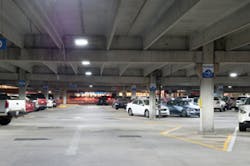
Currently, there isn’t any legislation specifically targeting metal-halide and high-intensity discharge fixtures commonly found in warehouses and large parking lot structures. However, simple economics are bringing early retirement to these technologies. For example, Cooper Lighting, Peachtree City, GA, recently replaced 4,342 metal-halide fixtures at the Hartsfield-Jackson Atlanta International Airport, with Cooper’s McGraw-Edison Valet LED fixtures. The savings in wattage is substantial.
The retired metal-halides required 210 W, while the new LEDs need just 80 W, and the lighting quality is much better, notes Tim Hill, director, Marketing and Product Management-Outdoor, Cooper Lighting.
“Certainly the quality of light is better and they had pretty good lighting,” says Hill, “but that’s not always the case, and that technology has limitations in controlling the light that comes out of the fixture, so in those instances we can improve the quality of light an order of magnitude of about 10 times.”
With HPS lighting, the improvements are even better, because the blue daylight spectrum of LEDs offers better visual acuity than the yellow cast of sodium. But the real benefit of LED technology is in the control and management of the light source.
“It boils down to the ability to put light where it’s needed,” says Hill. “If you take the typical shoebox fixture, the light is exiting the fixture and going in places where we have no ability to control it. Certainly, in the airport’s case, putting efficient light where it’s needed makes for a safer environment and sound economics. According to the City of Atlanta’s Office of Sustainability, the decision saves almost half a million dollars in annual energy costs, and the carbon reduction is equivalent to taking 500 cars off the road.”
Obviously, the latest technologies have great potential to save money and benefit the environment, but getting the maximum return on investment requires a proper assessment of the customers system and needs, says John E. Noel, president and founder of Energy & Environment in Atlanta, GA. Noel has been in the energy efficiency field for over 10 years and has supervised hundreds of lighting retrofits and energy audits in over 30 states. In his experience, audits are the first step in the complex task of doing a successful lighting retrofit.
“A good audit is essential, because it will tell you the quantity and quality of what you have and what you should change,” declares Noel. “A good one will do it in a line item fashion, with a very detailed room-by-room approach. So for example, a corner office might have three incandescent can lights, and fluorescent lights and some decorative lighting over paintings. So, that corner office may be considered as a very efficient lighting system, but audits can discover in the case of something like a medical building there were inefficient lighting fixtures and also find lights that were just running all day even though they’re not needed.”
Faster Paybacks
With the proper audit and retrofit, the savings can be substantial. Noel and company conducted an energy audit at Palm International headquarters, Nashville, TN, and retrofitted lighting in four main areas, including: offices, a main chemical plant, a large warehouse, and a truck repair facility. The cost of the improvements were recouped within one year for the offices, two years for the chemical plant and the large warehouse, and three years for the truck repair facility. Palm’s lighting energy consumption in the chemical plant alone dropped by about a 30%, from 322,947 kWh to 104,833 kWh.
Fast paybacks are getting more common as businesses assess their staff’s lighting needs, says Rodney Heller, lead designer and managing partner of Energy Performance Lighting (EPL), McFarland, WI. In a recent retrofit project for Universal Silencer, EPL encountered a building with a computer aided design (CAD)-intensive environment, and achieved a 74.5% lighting energy reduction, resulting in a simple payback of 2.7 years. The annual dollar savings amounted to $47,900. Moreover, the staff has experienced a boost in performance and efficiency.
“The response so far is that they love it,” says Heller. “They can work longer periods of time with less eyestrain, and some of them even say they sleep better at night. Existing buildings were designed with paper-based tasks in mind and everybody uses computers now. When you get into CAD, you have people looking at computer screens for eight hours a day so you want the light level in the office to be low. It’s like going to a movie-not that we want to go totally dark, but in lower light the computer screen has better contrast, and there’s less eyestrain so it’s easier to read. But on the flipside of it, when you’re in a dark space or time, your melatonin can be flowing. So, based on a Department of Energy study, I can get 50% melatonin suppression at 26 foot-candles with 8,000 K lighting.”
The 8,000 K lamps provided greater visual comfort and increased productivity. Heller also increased the fixture efficiency by replacing paracube lenses with prismatic lenses for greater light distribution and installed new reflectors that allowed a lamp reduction from four lamps to one lamp per fixture.
“The old fixtures trapped so much light and were only about 40% efficient,” explains Heller. “So we put in a curved white reflector in this particular case, and instead of multiple lamps, we use one. If you have more than one light in the fixture, the light bounces between the two lamps and into each other, and that’s inefficient. So we’re getting 40 to 50% savings by adjusting the light levels to the task, and another 20 to 30% because of the higher volume of light coming from the fixture. It will take a fixture’s efficiency from 63% up to 78%. At the last LIGHTFAIR [International] conference, I saw some new fixture designs that are 87% efficient.”
