The New Three R’s: Remove, Reuse, Recover
The holy grail of stormwater management is preventing pollutants from ending up in surface water in the first place, but that is not always possible. Removing pollutants such as nitrogen, phosphorus, and heavy metals is another challenge entirely and often expensive. It may not always be that way, however.
A Northwestern University-led team of researchers recently designed nanocoating for common sponges that could be used to effectively and inexpensively clean up oil spills, turning the household sponges into smart sponges. But even more unique, the oil can be recovered and the sponges can be reused over and over. Research is already underway to design a coating that would allow for the removal and recovery of nitrogen and phosphorus from surface water, and there may be even more applications in the future.
Dr. Vikas Nandwana, research associate in material research and engineering at Northwestern University, co-founder of the startup MFNS Tech, and the first author of the team’s research paper, spoke with Stormwater about the team’s work to develop the smart sponge coating.
Stormwater: Could you give us a little bit of background on yourself and how you ended up in this field?
SW: What about some background on this research and the development of the smart sponge? What sort of problems were you and your colleagues hoping to address with its development?
VN: I have been working in the field of nanotechnology for the last 15-plus years, and during my PhD I synthesized a lot of nanostructures; those have unique properties. During my PhD I was working with very small-scale synthesis, where you can generate only micrograms of particles and milligrams of particles—that’s one of the big issues in nanotechnology. People can generate very fancy structures, but then you cannot use it for practical applications because the yield is very low. About three years ago, I developed a flow reactor where I can produce these nanostructures in large quantities and at a very high quality. That was the turning point for when we started looking for large scale, gigaton-problems where we can use these nanostructures to solve major critical problems. My goal was to use this nanostructure to solve two major global issues—energy and the environment.
For the environment, we found that one of the key issues is oil spills—oil-based pollution, water pollution, that’s what we wanted to address. When we did a bit more research, we found there are typically four methods that are currently used for oil spill cleanup. The first one is simply burning—in the case of an oil spill, they just burn the oil, which is really dangerous for the environment; it increases the carbon footprint a lot.
The second one is dispersant—it’s a chemical, and they basically pour this chemical on the area of the oil spills. It just breaks the oil apart into small oil droplets so that it can settle down through the water; it’s not cleaning up the oil, it’s just breaking it apart. But this combination of oil and dispersant is quite deadly for marine life, it’s really dangerous. During the Deepwater Horizon oil spill, they used a lot of dispersants to quickly control the oil spill. But it resulted in a large loss in marine life—researchers have found that it was quite toxic, this combination of dispersant and oil. It was more toxic than the oil itself.
Those are the two major/main methods for controlling large-scale oil spills and both are harmful to the environment. The third method is skimming—they just skim the oil [off the water] using a pump. Then the issue is that you skim oil and water, and then you need to separate it out again. It needs a pretty good set up—you need to set up a boat and you need to have a boom set up—so it’s quite complicated. And it doesn’t work in rough waters or if the oil layer is very thin; it only works with a thick layer of oil.
The fourth option is sorbent packs” These are just absorbent pads and they’re specific for oil also and universal also. But what happens with these sorbents is that they’re one-time use—you just throw them in the water and then collect them—and that generates a lot of physical waste. Since most of them are made of polymers, then it becomes a landfill issue. You need to store it, transport it, and then burn it or somehow dispose of it. That transport increases the oil spill cleanup cost.
We saw these disadvantages and we tried to find a solution which does not have any disadvantages. We just tried to have this environmentally friendly solution.
SW: The smart sponge that you and your colleagues designed uses nanotechnology in order to absorb the oil from an oil spill. How does that work?
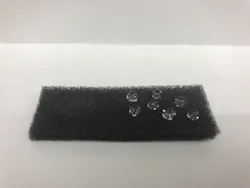
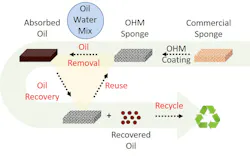
VN: The smart sponge has two parts. One is the base sponge—this is basically a kitchen sponge, or a cushion that you find in your furniture or insulation—that’s a polyurethane or cellulose sponge. And then what we do is put a coating on it of nanostructures. Those nanostructures are functional nanostructures, so they have specific properties. In this particular case, we have a thin layer of coating which is almost as thick as your hair or a little less. Once you have this coating, it specifically has an affinity for oil and it resists water. The name of the sponge is OHM; it’s oleophilic (that means it loves oil), it’s hydrophobic (that means it resists water), and then it is also magnetic, so that is an additional capability.
Even without the “M” part, if you just put this sponge in the oil spill area, it selectively absorbs oil. Then you can take the sponge and recover the oil—just put it through the wringer or squeeze it out—and you can reuse the sponge again. The advantage of this kind of technology is that we’re not harming the environment, there’s no carbon footprint increase, and there’s no danger to marine life. You are also recovering the oil and reusing the sponge, so all these properties make the sponge quite unique compared to the other deployed methods.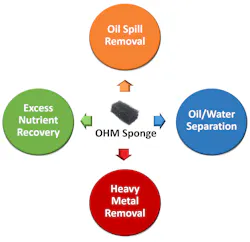
SW: Particularly for the sponge itself to be reusable and for the oil to be recoverable—those are both very unique properties. What kind of tests did your team do to verify that the sponge worked in the way you wanted it to?
VN: We started developing the sponge in the lab. In the research lab, we had all sorts of different kinds of oils, so we tested those, and it worked perfectly fine. But then we started reaching out to the industry, they said we needed to start testing this with crude oil.
Initially, it was very difficult to get a sample of crude oil because most of the oil you get or buy on the market is processed oil. But we requested some of the oil companies send us a sample of crude oil and we got five different kinds of crude oil, from low viscosity to very high viscosity—so very thin oil to very thick oil. We were able to test those and found that the sponge can absorb all sorts of oil. This is a unique ability of the sponge compared to the sorbents. For sorbents, porosity is not very high, so they cannot absorb thick oils. But we have tested OHM on Azerbaijan oil, which has an extremely high viscosity and is very thick, and we were able to absorb almost 15 to 30 times the sponge’s weight of oil, depending on the viscosity of the oil. So, if it’s a one-gram sponge, you can absorb 15 to 30 grams of oil. We tried west Texas oil, which has low viscosity, and the absorption capacity was lower. For Azerbaijan oil, it was pretty high.
In addition to the different types of crude oil, we also tested this in different salinities of water. Because the ocean salinity is different than lake water, we tested this from zero to 2 molar salinity, and we found that the absorption capacity of the sponge does not change. Ocean salinity is about 0.6 molar, but we went even higher than that. And similarly, we also tested different pHs of water. From acidic water to basic water, the sponge still worked in the same manner.
SW: I wouldn’t necessarily have thought to check if the salinity or the pH of water would affect the sponge, but your sponge achieved the same good results regardless. Are there particular applications you expect or hope to see the sponge used in?
VN: What we are envisioning is that this is the concept of a smart sponge, where the OHM sponge is the first in a series. The magic happens in the coating, so if you modify or tune the coating for a different pollutant, we could catch other pollutants as well. For example, research is already going on in our lab for removing and recovering excess nutrients that come from agricultural or municipal runoff. What we’re developing is a sponge specifically for capturing excess nutrients such as nitrates and phosphorus. We’ve already recovered 95% of the excess nutrients in our lab capacity, and that is from a Chicago Department of Water Management sample. We were able to recover 95% phosphorus and we’re working on the nitrates.
And at the same time, we can do heavy metal removal, in case there are wastewater treatments or in case of oil spills, even—they also come with toxic metals, not only oil is leaked. We are also planning to have some sort of multicolor sponge with multifunctional properties, not only one. You could have two types of coating on the sponge—one to catch oil and the second to catch toxic metals.
Finally, the technology is not limited to only water. Looking at the bigger picture, it could be used to clean pollutants from the air, or even soil. You could have a coating that can catch particulate material—you could have some sort of mask for pollution, and we could even design something antimicrobial in nature. You could have a cloth mask and coat it with a nanostructure coating that could catch a virus and actually kill it. The mask we’re proposing is called “CARE mask”—cloth-based, antimicrobial, reusable mask. That is the same concept as the sponge, but that’s the beauty of the research; it doesn’t need to be a sponge. You can put this material on any kind of substrate—it could be a sheet cloth or a membrane—and then produce different lines of products.
SW: Especially for our audience, the ability to take nutrients and other pollutants out of soil and runoff is of particular interest. How do you envision the soil-based solution working?
VN: A couple of oil companies contacted us and said oil spills are not only issues offshore, but also onshore, where it contaminates the soil. They asked, “Can you clean this kind of soil?” We came up with the concept of some sort of a membrane or sponge ball, which you can bury in the sand or soil and then leave for some time. During this process, the sponge balls or the sheets can absorb the oil that is present in the soil. Then you can just take it out, recover the oil, and reuse the sponge or sheet again.
Find the full interview with Dr. Nandwana at www.stormh2o.com/2115561. The team’s research paper can be found in the journal Industrial Engineering and Chemical Research and online at www.pubs.acs.org/doi/10.1021/acs.iecr.0c01493.