Albuquerque stormwater project shows lessons from a desert treatment train
Key Highlights
- The treatment train consists of five interconnected areas designed to manage stormwater and enhance water quality in a fully developed watershed with limited infrastructure options.
- Initial vegetation efforts faced challenges due to low rainfall, but over time, seed mixes and slope stabilization measures led to a greener landscape and community use.
- Maintenance lessons included redesigning debris screens for easier cleaning and replacing damaged slope stabilization with more durable materials like grouted rock.
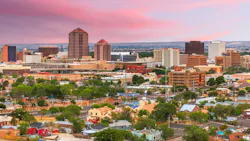
A stormwater treatment project in Albuquerque, New Mexico, is demonstrating how green infrastructure can mature over time while also providing lessons about maintenance, construction and design in an arid environment.
Patrick Chavez, stormwater quality engineer with the Albuquerque Metropolitan Arroyo Flood Control Authority (AMAFCA), discussed the Lower Bear Tributary Water Quality Treatment Train during a StormCon 2026 session titled “Lower Bear Tributary Water Quality Treatment Train: Post Project Highlights.” Chavez previously presented the project at StormCon about five years ago and returned to discuss how the system has performed since construction.
The project consists of five treatment “cars,” or individual treatment areas, designed to work together to manage stormwater and improve water quality. The system was constructed in a fully developed watershed where opportunities for new stormwater infrastructure were limited.
A major driver was the Albuquerque Bernalillo County Water Utility Authority’s aquifer recharge project downstream. During storm events, the utility would close a valve to prevent stormwater from entering the recharge area because of concerns about water quality. AMAFCA developed the treatment train in part to determine whether stormwater could be treated sufficiently upstream to potentially support aquifer recharge.
Designing for an arid environment
One of the project’s biggest challenges was establishing vegetation in a location that receives less than 9 inches of rain annually. Irrigation was considered, including use of a nearby nonpotable water line, a cistern and water trucks, but those options were ultimately removed from the project because of cost.
Instead, the project relied on seed mixes, slope stabilization measures and time.
Chavez said the vegetation initially did not provide the results project staff hoped for. Several years later, however, the treatment train has become significantly more established, creating a much greener landscape without dedicated irrigation.
The project has also become a community amenity. The adjacent soccer field is regularly used by local and out-of-state teams, while residents use the area for walking and recreation.
Maintenance shaped the design
The treatment train also provided several lessons about designing green infrastructure around long-term maintenance needs.
The first treatment area included large debris screens intended to capture material from stormwater. The screens were designed to be moved and accessed by maintenance equipment. After only a few storms, however, staff found that the screens were becoming clogged too quickly.
The screens were subsequently rotated parallel to the flow, allowing the system to continue providing some water quality benefits while reducing maintenance requirements.
Other components required more substantial modifications. Articulated concrete blocks used for slope stabilization in two treatment areas were damaged by high flows and had to be removed. AMAFCA replaced them with grouted rock placement using cement and mortar.
The project also incorporated access ramps to allow crews to remove accumulated sediment.
Chavez emphasized that maintenance considerations were incorporated early in the project, including ensuring that maintenance equipment could access each treatment area.
Monitoring stormwater quantity and quality
AMAFCA installed pressure transducers to measure water levels and developed a rating curve to estimate flow. An automated sampler was also installed in the fifth treatment area to collect stormwater samples during qualifying events.
The sampling system is triggered when rainfall reaches 0.25 inches within the watershed. Chavez noted that localized rainfall can make sampling difficult because a storm may produce significant rainfall in one part of Albuquerque while producing less than the qualifying amount across the project watershed.
The Lower Bear project was also part of a larger AMAFCA effort to collect flow data at 13 locations across eastern Albuquerque. The agency used 26 level loggers, rotating them among sites to collect data that could help calibrate a regional runoff model.
That work is intended to improve understanding of both water quantity and where future stormwater and water quality projects could provide the greatest benefit.
PFAS adds a new monitoring challenge
More recently, AMAFCA and the Water Utility Authority have begun sampling for PFAS at the Lower Bear site. The partners have detected PFAS in samples but have not yet determined the source or whether the compounds are associated with rainfall events.
The agencies are sharing sampling efforts and laboratory costs, which Chavez said are roughly $500 per sample.
The PFAS work adds another layer to a monitoring program that already includes parameters such as E. coli. Albuquerque's stormwater program operates under a watershed-based permit, with compliance monitoring conducted in the Rio Grande rather than at individual stormwater facilities.
That approach creates a challenge when attempting to identify the source of pollutants because stormwater can move through multiple jurisdictions before reaching the river.
A long-term payoff
Chavez's presentation underscored that the Lower Bear project did not immediately deliver the visual or performance results its designers expected. Initial monitoring showed E. coli concentrations increasing through the treatment train, while several physical components required modification.
The project's vegetation also took years to establish in Albuquerque's dry climate.
Five years later, however, Chavez said the community has embraced the site and the treatment train has developed into the type of green infrastructure landscape the project team originally envisioned.
For stormwater professionals, the project offers a practical example of the importance of designing for maintenance, adapting infrastructure after construction and giving nature-based systems time to mature — particularly in challenging climates where vegetation establishment cannot be expected to happen quickly.
About the Author
 Alex Cossin
Alex Cossin
Associate Editor
Alex Cossin is the associate editor for Waterworld Magazine, Wastewater Digest and Stormwater Solutions, which compose the Endeavor Business Media Water Group. Cossin graduated from Kent State University in 2018 with a Bachelor of Science in Journalism. Cossin can be reached at [email protected].