Michigan Senate advances dam safety bill, EGLE details tougher flood standards ahead
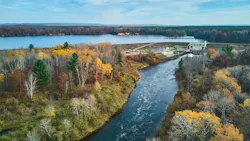
The Michigan Senate passed legislation Thursday raising the flood flow capacity dams must be able to withstand, part of a broader package tightening dam safety standards statewide. Some of Michigan's highest-risk dams were stressed to the brink of failure this spring, as flooding on several rivers exceeded even a 500-year flood event.
Senate Bill 947, sponsored by Sen. Mallory McMorrow, D-Royal Oak, now moves to the Republican-led Michigan House of Representatives. The House took action Thursday night on a companion measure, House Bill 5485, sponsored by Rep. Bill Schuette, R-Midland, though that measure has not yet passed a floor vote, Michigan Public reported.
Under current law, high-hazard dams must be able to pass a 200-year flood. The legislation would raise that standard to the probable maximum flood, a theoretical worst-case event, Luke Trumble, dam safety program supervisor for the Michigan Department of Environment, Great Lakes and Energy, told Stormwater Solutions.
"Right now most high and significant hazard dams only have to pass a 200-year flood event, where this new legislation would increase those capacity requirements to, for high hazard dams, the probable maximum flood," Trumble said.
That standard applies to dams the state classifies as high hazard, a rating based on the consequences of failure rather than a dam's physical condition. Trumble said the inventory includes about 90 high hazard dams, 150 significant hazard dams and roughly 700 low hazard dams.
"Hazard potential rating doesn't have anything to do with the condition of the dam or the likelihood of the failure," he said. "It's only just under the assumption that if the dam were to fail, what would be the downstream impacts."
Engineers separately assign each dam a condition rating of satisfactory, fair, poor or unsatisfactory after inspection. Trumble said 15-to-20 percent of the state's dams fall into the poor or unsatisfactory categories.
The legislation would raise inspection frequency for high hazard dams from once every three years to annually, and for significant hazard dams from once every four years to once every two years, Trumble said. Low hazard dam inspections, currently required every five years, would not change.
Trumble said the state currently lacks authority to require the higher flood standard, even for dams in otherwise good condition.
"We could potentially have a dam that's in very good structural condition, very good, been maintained very well, that can only pass a 200-year flood, and it leaves it susceptible to failure during a large flood," Trumble said.
Trumble pointed to April flooding on the Cheboygan, Manistee and Au Sable rivers as evidence of that gap. Flows on those rivers exceeded even a 500-year flood event, he said, citing U.S. Geological Survey stream gauges.
"Those flood flows, as recorded on the USGS gauges, were well in excess of a 500-year flood," Trumble said.
The dams on those rivers are federally regulated hydropower dams already required to meet the probable maximum flood standard, which Trumble said helped them withstand the April flooding better than state-regulated dams built to lower standards.
Similar legislation was introduced in 2021 after the failure of the Edenville and Sanford dams in Midland County but did not make it out of committee, Trumble said. He said the current bills predate the April flooding but gained momentum because of it.
"Some of our high and significant hazard dams were stressed right to the brink of failure, and so I think it's got us in the dam safety industry, and even the legislature and other locals, thinking about, if these floods are going to happen, is it appropriate that our high and significant hazard dams are being stressed right to the point of failure," Trumble said.
The legislation would also require dam owners to register their structures and demonstrate they have adequate funding for maintenance and repair, addressing what Trumble described as decades of underinvestment in dams built primarily between the 1930s and 1960s.
"If they have been planning and they have financial capability to invest in rehab or replace the dam before it becomes an issue, then they should be able to get a registration, no problem," Trumble said.
The bill would establish a permanent dam safety emergency fund, replacing a version created through budget appropriation that is set to expire. Trumble said the legislation does not include new appropriation dollars, meaning funding would still depend on future budget decisions.
"It will remain the dam owners' responsibility to figure that out," Trumble said. "It just might be a little bit tougher, they'll have a few less resources at their disposal for assistance, if those programs aren't funded in the future."
Estimates of the statewide cost to bring dams into compliance vary widely depending on scope. Trumble cited a 2023 American Society of Civil Engineers infrastructure report card estimating $225 million to $400 million over 20 years to address dams currently in significant, poor or unsatisfactory condition. He said a more recent Association of State Dam Safety Officials study put the cost of bringing all of Michigan's dam infrastructure into satisfactory condition at closer to $1 billion.
"I don't think it's one of those things where we have to invest a billion dollars next year, or the majority of the dams in the state are going to fail," Trumble said. "It's that we have to start working towards that number and try to figure out a way to match the pace of deterioration with the pace of investment."
He said the cost of upgrading dams is far lower than the cost of a failure, pointing to the roughly $200 million in structural damage caused by the 2020 Edenville Dam failure.
"The cost of accepting or tolerating the risk that comes with having lower design standards far outweighs the potential cost of what it might take to improve the design," Trumble said.
About the Author
 Sarah Kominek
Sarah Kominek
Head of Content, Stormwater Solutions
Sarah Kominek is the head of content for Stormwater Solutions at Endeavor Business Media, a division of EndeavorB2B. Kominek graduated from Wayne State University in with a Bachelor of Arts in Journalism and a minor in Communication with post-baccalaureate studies in biology. She has worked as a journalist for eight years covering the medical plastics industry and technology, plastics pollution and regulation, the automotive industry, public policy and community news.