The rise of the on-site pretreatment plant for industrial stormwater
Key Highlights
- On-site pretreatment offers customized solutions tailored to the specific pollutants and operational conditions of each industrial site.
- Engineered treatment systems can combine multiple stages, such as physical separation, filtration, and chemical removal, to address complex contaminant loads.
- Monitoring system performance is essential to ensure treatment effectiveness and to identify potential issues early, supporting regulatory compliance.

Rainfall can turn an industrial site into a moving pathway for pollutants, carrying contaminants from exposed areas toward drainage and discharge points. Managing stormwater runoff becomes more demanding as discharge requirements tighten and pollutant loads become harder to address with conventional controls alone. These conditions are driving greater interest in on-site industrial stormwater treatment that gives facilities more control over pollutant removal.
Why on-site pretreatment plants are on the rise
Industrial facilities face varied demands when managing stormwater, from sector-specific pollutants to tighter expectations for discharge quality. The Multi-Sector General Permit from the Environmental Protection Agency (EPA) covers 29 industrial sectors, and each one is associated with different pollutants and stormwater control measures. Greater variation in treatment demands, combined with regulatory pressure, is driving stronger interest in dedicated pretreatment.
Tighter discharge limits raise treatment expectations
Tighter discharge requirements encourage facilities to add treatment when existing controls cannot consistently achieve the expected discharge quality. EPA's industrial stormwater guide includes monitoring provisions that help facilities evaluate the effectiveness of their stormwater controls.
When monitoring identifies problems with pollutant levels or control performance, facilities may need to review their existing measures and take corrective action. Sometimes, existing controls do not adequately manage a pollutant. Additional treatment can address the shortfall before runoff reaches the discharge point.
Industrial runoff can carry complex pollutant loads
Industrial runoff can pick up oils, chemicals and debris as rainfall moves across exposed areas. The pollutants and their concentrations can vary across industrial operations and storm events, leading to different treatment requirements for facilities.
Conventional best management practices (BMPs) remain effective for managing sediment, runoff volume and other common stormwater pollutants. However, more concentrated or chemically complex contaminants can push treatment requirements beyond the capabilities of general-purpose controls. In these cases, facilities would need to add engineered treatment with specific pollutant-removal capabilities.
On-site treatment offers greater control
Dedicated treatment provides a controlled stage before discharge. System configuration, capacity and processes follow the facility's pollutant profile, drainage network and operating conditions. Stormwater control for industrial plants can consequently incorporate treatment designed around the site's actual discharge requirements.
Industrial stormwater management may also involve containment systems to prevent accidental leaks and landscape features that filter runoff before it reaches water bodies, adding further layers of control across a facility. These measures work alongside dedicated treatment as part of a broader approach to managing runoff across an industrial site.
How industrial facilities are approaching stormwater treatment
Industrial stormwater treatment now involves engineered systems that bring multiple functions together within a facility's existing drainage and operating environment. System design must account for the relationship between pollutant characteristics, hydraulic conditions and treatment performance throughout a storm event.
Moving from general controls to targeted treatment
Industrial facilities may turn to contaminant-specific treatment when conventional BMPs cannot adequately address particular pollutants or concentrations. Different technologies can target different contaminants, depending on the characteristics of the runoff.
Some industrial stormwater carries pollutant concentrations that require approaches beyond conventional stormwater controls, including technologies that industrial wastewater treatment commonly uses. For example, air stripping removes volatile contaminants such as ammonia by exposing the water to an airstream that draws them out. Packed-tower systems typically improve contact by moving water and air in opposite directions.
For ammonia removal, factors such as pH and temperature can also influence treatment effectiveness, making operating conditions an important part of treatment design.
Combining treatment stages for broader pollutant removal
Industrial runoff may contain multiple types of pollutants that require different treatment processes. A system might combine physical separation for larger solids, filtration for suspended material, and a specialized process for a particular dissolved or volatile contaminant.
Each stage handles a defined part of the pollutant load, while the overall system addresses the facility's combined treatment requirements. The number, sequence and capacity of the stages depend on the pollutants present and the required level of removal.
Designing around variable stormwater conditions
Industrial stormwater arrives at changing rates and with various pollutant concentrations. A short, intense rainfall event can produce substantially different hydraulic conditions than a prolonged period of lighter precipitation.
Treatment systems must account for these changes because flow affects factors such as hydraulic loading, contact time and treatment capacity. A process that performs adequately under one flow condition may require different sizing, staging or operational controls when peak runoff increases. Variable flow conditions are an important consideration when designing stormwater control for industrial plants, particularly where treatment capacity must accommodate peak runoff.
Building monitoring into treatment
Monitoring system performance is also important in ensuring an on-site pretreatment plant consistently meets its treatment objectives. Sampling can show whether pollutant concentrations are changing and whether treatment is achieving its intended purpose.
Monitoring can also reveal problems that may not be immediately visible, such as declining treatment efficiency or changes in the pollutant profile entering the system. Operators must track equipment condition, maintenance requirements and ongoing performance as part of managing a dedicated treatment system.
Practical considerations for on-site pretreatment
On-site pretreatment gives industrial facilities more control over pollutant removal, but it also introduces practical demands on system design, operation and long-term performance. Facilities need to consider site conditions, pollutant variability and the resources that keep treatment systems functioning as intended.
- Higher design complexity: Treatment systems must match pollutant characteristics, expected flow rates, available space and discharge requirements. A mismatch between system capacity and site conditions can limit treatment performance.
- Capital and resource requirements: On-site treatment requires investment in equipment, installation and supporting infrastructure. Facilities also need personnel and resources to operate, maintain and monitor the system over time.
- Ongoing maintenance: Filters, media, pumps and other treatment components require upkeep to maintain performance. Sediment and captured pollutants also need appropriate removal and disposal.
- Routine inspection: Regular checks help facilities assess the condition and effectiveness of stormwater controls. Operators should also inspect catch basins to ensure sediment buildup remains below 60% of the sump depth or 6 inches from the outlet pipe.
- Monitoring and operational demands: Dedicated treatment needs facilities to track system performance, review sampling results and respond when treatment does not achieve the expected results. Operators must also account for equipment condition and changes in the site's pollutant profile.
The growing role of on-site pretreatment
On-site pretreatment is becoming a more relevant part of industrial stormwater management as facilities face varied pollutant loads and greater expectations for discharge quality. Engineered treatment provides facilities with another layer of control, with processes and system configurations tailored to site-specific treatment requirements. When conventional controls reach their practical limits, on-site pretreatment can provide the additional capacity to manage more demanding industrial discharges.
Related
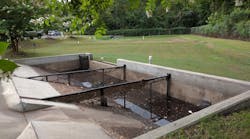 ESCS bioretention receives high volumes of runoff, infiltrates, adsorbs, and reaerates turf roots in Huntersville, North Carolina.
About the Author
Emily Newton
Editor -in-chief
Emily Newton is editor-in-chief of Revolutionized. Newton can be reached at [email protected].