About the author: Paul Iorio is senior project engineer for StormTree. Iorio can be reached at [email protected].
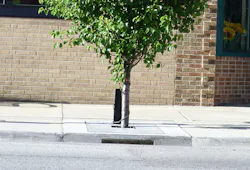
The curb inlet allows runoff to enter the tree filter frame, providing storm water management and tree irrigation.
In streetscape applications, when trees are expected to provide aesthetic appeal and function as a storm water management solution, the trees must provide the requisite pollutant removal. The city of Big Rapids, Mich., installed tree filter systems for a recent downtown commercial district revitalization project. The Michigan Economic Development Authority provided funding as a Downtown Infrastructure Grant. A “Go Green” initiative included the desire to capture storm water to reduce contaminant loading and water newly planted trees.
The StormTree tree filter system combines a precast concrete frame with engineered soil designed to collect and treat storm water runoff and provide a healthy tree growing environment. The frame is open sided with a filter media area allowing for unrestricted tree root growth.
The Callery pear trees showed healthy growth from May 2016 to July 2017.
Installation
For the project, a 5-by-7-by-4-ft concrete frame with an interior pretreatment sump design was selected to integrate with the newly installed sidewalks and curbing. On the front side of the frame is a 4-in.-high-by-24-in.-wide curb opening or “throat” entry point for storm water runoff collection. The frame was positioned so its curb reveal matched the 6-in.-high curb that faced the poured sidewalks. All site locations initially were assessed for underground utilities, with none determined to impact the tree filter excavations.
Excavation for the tree filters was completed to a depth of approximately 5 ft below grade. Because the concrete frames weighed less than 8,000 lb, excavation was completed with a mini excavator. Washed stone was placed in the excavation to an elevation accounting for the height of the concrete frame and finished grade. The engineered media then was backfilled into the interior of the frame to a height of approximately 10 in. below surface grade and the base of the frame’s sidewalls. Media also was installed in an extended area beyond the frame.
Storm water runoff enters the unit through the throat and collects in an interior sump. Sand, sediment and trash associated with the water is segregated and retained within the sump. The water rises and flows over a baffle wall that separates the sump from the media chamber. The storm water collects in the chamber and infiltrates through the media where physical, chemical and biological processes take place, which allows nutrients such as nitrogen, phosphorus and metals to affix to media particles becoming immobilized and are made available for tree uptake and a food source for soil microbes.
Infiltrating water continues downwards and outwards, and enters the stone base beneath the media layer. This stone base doubles as support for the concrete structure, while also serving as a collection basin for treated storm water. A perforated underdrain pipe within the stone layer conveys this water to a downgradient facility such as a catch basin or manhole, or it even is daylighted to an aboveground swale or retention area. This underdrain pipe is connected to a vertical overflow or bypass pipe within the media chamber that is designed to evacuate and discharge excess water collecting within the system during intense or prolonged rain events.
The open design frame provides structural support and allows for unrestricted tree root growth.
Start at the Roots
Of the several street tree options, Callery pear trees were selected for the Big Rapids StormTree systems. Although traditional cast iron or steel tree grates are appropriate, American Disability Act-compliant fiberglass tree grates were selected for the project. These grates fully support pedestrian loading and can be cut on site, which allows for selecting a specific location for the tree and opening. The flexibility in locating the tree position is a benefit should there be setback requirements or passerby clearance allowance. The fiberglass grating covers both the tree filter media area and the interior pretreatment sump.
Tree root growth is naturally depressed below sidewalk elevation, reducing and eliminating the possibility of pavement upheaval. This tree well characteristic allows for greater irrigation due to an enhanced collection area. The tree filter system's ability to capture surface runoff from the surrounding impervious surface allows it to better withstand periods of intense heat and drought or minimal rainfall events, due to the additional quantity of water that the system receives.
The city’s Department of Public Works is performing regular maintenance of the tree filter systems. The yearly maintenance includes removing the grating, which allows for the removal of accumulated sand, sediment, leaves and trash from the sumps.
Seeing Results
The Big Rapids tree filter systems have been evaluated the three years subsequent to the fall 2014 installation with positive performance results. The pretreatment sumps within the tree filters have effectively contained quantities of sand and debris. The trees have exhibited greater caliper dimension and overall growth compared to sidewalk trees of similar height planted within the same time frame.