Low-impact stormwater strategies: Bridging the gap in a failing infrastructure system
Key Highlights
- U.S. stormwater infrastructure is underfunded and aging, necessitating innovative, localized solutions to meet increasing demands.
- Low-Impact Development strategies focus on managing water at its source, reducing runoff, and supporting groundwater recharge through natural landscape elements and engineered systems.
- Porous pavements and water containment systems can be customized to site-specific conditions, improving infiltration, reducing flood risks, and supporting environmental health.
Across the United States, stormwater infrastructure is struggling to keep pace with increasing demands. The American Society of Civil Engineers’ (ASCE) 2025 America’s Infrastructure Report Card gave municipal stormwater systems a grade of D, underscoring the urgent need for intervention. Aging pipes, detention basins and sewer networks, originally designed decades ago, are now under pressure from an increased frequency of extreme weather events and rapid urban expansion that replaces pervious landscape with impervious surfaces made of concrete and asphalt. When heavy rains hit, these systems often fail, leading to flooding, erosion and damage to communities.
The numbers paint a stark picture of the scale of the challenge. The U.S. Environmental Protection Agency’s (EPA) 2022 Clean Watershed Needs Survey estimates that over the next 20 years, municipal stormwater systems will require $115.3 billion in investment to meet the nation’s needs. This is a fivefold increase over the $23.8 billion identified in 2012. However, federal programs, including funding from the previous administration’s Infrastructure Investment and Jobs Act and the Inflation Reduction Act, cover less than half of this projected need.
The gap in funding and the inadequacy of existing infrastructure systems highlight the importance of local, site-specific solutions. Low-Impact Development (LID) strategies, which focus on managing water at the point where it falls, offer a practical and scalable approach. Rather than funneling stormwater through pipes to distant treatment facilities, LID emphasizes decentralized systems that capture, treat and infiltrate water on-site. By combining engineered solutions with natural landscape elements, LID can reduce runoff volumes, mitigate flooding and support groundwater recharge while complementing existing municipal infrastructure.
Reimagining stormwater management with LID strategies
LID represents a shift in how professionals approach water management. At its core, LID works with the land’s natural hydrology instead of forcing water through engineered conduits. This approach preserves sensitive areas, including slopes, wetlands and mature trees, which naturally slow runoff and provide infiltration opportunities. Applications can include rain gardens, vegetated swales and porous pavements. These act as buffers, protecting downstream waterways from excess runoff while simultaneously supporting local flora and fauna.
A core tenet of LID is that the more water that can return naturally to the ground, the less pressure communities face during storm events. Achieving this begins with reducing impervious surfaces wherever possible. Traditional asphalt and concrete surfaces force water to flow rapidly into storm drains, overloading municipal systems and exacerbating flood risks. By contrast, porous pavements allow rainwater to infiltrate directly into the ground, lowering peak flow rates and reducing runoff volumes. This infiltration not only eases the burden on municipal infrastructure but also replenishes groundwater, helping to address long-term water supply challenges in many urban areas.

The role of porous pavements in managing stormwater
Porous pavement solutions are highly adaptable. They range from concrete blocks with permeable joints, porous concrete, and asphalt to plastic porous pavers that can be filled with gravel or vegetation. Incredibly versatile, these systems can be applied in a variety of contexts, from walkways and fire lanes to parking lots, heliports and even stadium grounds.
What allows these systems to infiltrate stormwater is void spaces, which are pockets within their structure that permeate water. The higher the void space ratio, the higher the infiltration rate. For instance, flexible plastic porous pavers can achieve up to 92% void space, enabling infiltration rates of nearly 32 inches of water per square foot per hour. Whereas porous concrete or asphalt systems typically provide 15–25% void space, translating to drainage capacities around 6.4 inches per hour. These performance differences can give stormwater management professionals flexibility to match the system to the hydrologic demands of a site.
When vegetation is incorporated, the pavement system adds another layer of benefit, using local flora to trap larger particles and support natural bioremediation. The versatility of these systems allows stormwater professionals to tailor LID interventions to the specific needs of a site, ensuring effective performance while preserving functionality.
Pairing water containment systems with porous pavers to optimize LID performance
Porous pavements are most effective when paired with water containment systems and designed as complementary components of a unified LID strategy. While the surface and base course manage immediate infiltration and structural demands, water containment systems extend the capacity of the site to store and control stormwater, whether in detention systems or retention systems.
A water detention system works by temporarily holding stormwater runoff from developed surfaces such as parking lots and buildings. When integrated underground, beneath porous parking lots, recreational surfaces or landscaped areas, detention systems allow the stored water to gradually infiltrate into the soil, reducing both the volume and velocity of runoff. This helps control downstream flooding and erosion on the surface. Additionally, the infiltration process recharges the groundwater table, which in turn helps counteract the long-term challenges of land subsidence and saltwater intrusion into freshwater aquifers.
Conversely, a water retention system is designed to store stormwater for a longer period of time. Instead of infiltrating, this stored water is pumped out and reused for non-potable purposes such as irrigation or toilet flushing. By reusing stormwater on site, retention systems reduce demand on municipal drinking water supplies and contribute to broader water conservation goals.
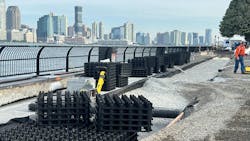
A variety of containment solutions exist, including tanks, concrete vaults and modular, stackable plastic systems. Among these, modular plastic systems often provide unmatched flexibility. Their lightweight construction allows for faster and easier installation than concrete alternatives, while their modularity enables them to adapt to irregular footprints, varying depths or phased installations. This adaptability makes them especially well-suited for constrained urban sites or infill developments. Leading modular and stackable plastic chambers can hold more than 7.45 gallons of water per cubic foot, with depths that can reach up to 8 feet.
By comparison, modular concrete vaults also offer structural rigidity and can support heavier loads, making them suitable for deep installations, sites with significant vehicular traffic or poor soil conditions. However, concrete systems are heavier, require cranes and more staging space, and can be slower and more costly to install. These differences can influence water storage efficiency, infiltration potential, excavation requirements and long-term maintenance.
It is important to consider these aspects when selecting the appropriate water containment system. After all, the decision will directly affect the effectiveness of stormwater management per square foot of excavation, project costs and the ability to meet site-specific regulatory and sustainability goals.

Factors to consider when specifying LID systems
Successfully implementing LID strategies requires careful consideration of both site-specific conditions and project objectives. Soil type and permeability are critical, as well-draining soils enhance infiltration, while dense clay or shallow bedrock may require supplemental storage. Topography and slope influence water flow and accumulation, guiding the placement of porous surfaces, swales and containment systems.
Hydrologic analysis is essential to match system capacity with expected rainfall, including extreme weather events. Porous pavements and water containment systems vary in void space and storage capabilities, so understanding site-specific runoff volumes ensures effective performance. Functional priorities also shape design choices. For example, in dense urban areas, underground detention or retention water systems paired with surface-level porous pavements maximize stormwater runoff storage without sacrificing space for parking, walkways or recreation, while open suburban sites may support overground solutions like rain gardens or retention basins.
Regulatory compliance is another critical factor. Local codes and ordinances often dictate impervious surface limits, treatment requirements and opportunities for stormwater reuse or credits. Material selection is equally important. Porous pavements must balance load-bearing strength with infiltration capacity, and containment systems differ in modularity, the way water enters it and storage efficiency.
For optimal performance, integrating multiple LID strategies on a single site is often the most effective approach. Combining rain gardens, porous parking lots and modular underground water containment systems creates a layered, complementary framework. Here, each system supports the others in slowing, capturing and infiltrating stormwater while improving water quality and supporting site biodiversity. This strategy enables stormwater management professionals to strategically reduce peak flows, minimize flooding risks and increase resilience against extreme rainfall events more efficiently. Taking such an approach transforms every site into a functional, more environmentally friendly hydrologic asset that complements municipal infrastructure.
About the Author
Olivia Harris
Olivia Harris is the president of Invisible Structures, a leading designer and manufacturer of porous paving and stormwater management solutions.