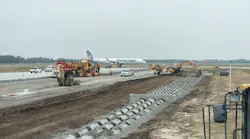
When stormwater meets aviation: Lessons learned designing bird deterrent systems for airport-area stormwater ponds
Key Highlights
- Coordinate with airport and local requirements early to identify wildlife deterrent needs.
- Compare life-cycle costs, not just initial installation prices.
- Use durable materials and minimize unsupported cable spans to reduce sagging and weather-related failures.
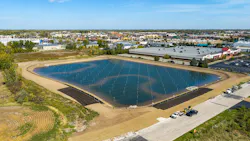
Stormwater ponds are among the most common and effective tools available to municipalities for managing runoff, reducing downstream flooding, and improving water quality. Yet when these facilities are located near airports, engineers must also consider wildlife management.
Open water attracts waterfowl, particularly Canada geese, ducks, and other birds that can create significant hazards to aviation operations. As a result, many airport-adjacent developments require stormwater facilities to include wildlife deterrent measures. One of the most common approaches is the installation of overhead bird wire systems, often coupled with perimeter fencing. While the concept seems straightforward, implementation can be surprisingly complex.
Through recent work in the Town of Grand Chute, Wisconsin, and review of previous installations within the Appleton International Airport buffer area, several valuable lessons have emerged regarding design, cost, constructability, and long-term performance.
Understanding the challenge
The area surrounding Appleton International Airport includes regulatory requirements intended to minimize wildlife hazards to aviation. Stormwater ponds located within approximately 10,000 feet of the airport may require measures to discourage birds from feeding, resting, or nesting. County guidance documents identify overhead grid systems and perimeter fencing as effective methods for limiting bird access to stormwater ponds.
The challenge for engineers is that stormwater ponds are designed to hold water, while bird deterrent systems must effectively prevent birds from accessing that same water surface. The solution requires balancing hydraulic performance, safety, aesthetics, maintenance requirements, and overall project cost.
What appears to be a simple bird deterrent system can quickly become a complex engineering challenge involving material durability, maintenance access, constructability, permitting requirements, and long-term costs.
Early approaches: Fluorocarbon line systems
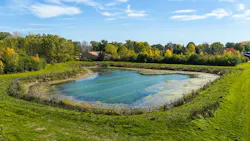
One of the earliest bird deterrent approaches utilized fluorocarbon fishing line suspended in a grid pattern above the pond surface. These systems were appealing because they were relatively inexpensive and could be installed using conventional fence posts and supporting hardware.
For the pond project in Grand Chute, the original overhead grid system relied on fluorocarbon line spaced above the permanent pool. The system represented a practical attempt to meet permitting requirements while maintaining affordability. Initial pricing for the overhead grid made it financially attractive compared to more robust alternatives being considered at the time.
However, operational experience revealed several challenges. Long unsupported spans allowed lines to sag toward the water surface. During Wisconsin winters, ice loading, snow accumulation, and weather exposure accelerated deterioration. In addition, prolonged exposure to ultraviolet (UV) radiation caused gradual degradation of the fluorocarbon material, reducing line strength and increasing the likelihood of breakage over time. Maintenance became an ongoing concern as damaged or sagging lines required periodic inspection and replacement to maintain effectiveness. Later guidance specifically advised against permanent installations utilizing monofilament or fluorocarbon materials because of their limited service life and susceptibility to environmental deterioration.
The lesson was clear: an inexpensive solution can become costly when long-term maintenance requirements, material degradation, and replacement needs outweigh the initial savings.
The cost of durability
As regulatory expectations evolved, attention shifted toward permanent overhead grid systems utilizing stainless steel cables, tensioning hardware, structural support posts, turnbuckles, and perimeter fencing. Guidance documents emphasized the importance of durable materials capable of maintaining tension, resisting weathering, and minimizing sag over long spans. Stainless steel cable and Kevlar-based systems emerged as preferred alternatives.
The challenge, however, was cost.
During evaluation of alternatives for the earlier pond design, a contractor estimate for a more robust cable-supported system exceeded the cost of the original fluorocarbon installation by more than fivefold.
That cost differential highlights a common dilemma faced by municipalities and developers. While permanent systems offer improved longevity and reduced maintenance, the initial capital investment can be substantial, particularly for ponds with large surface areas.
For engineers, this reinforces the importance of evaluating life-cycle costs rather than focusing exclusively on initial construction expenses.
Applying lessons learned
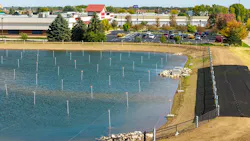
Recent planning efforts for the large regional stormwater pond in Grand Chute incorporated many of the lessons learned from previous installations.
Instead of relying on fishing line, the design specifications focused on more durable materials, including Type 316 stainless steel cables and Kevlar-based alternatives. The design incorporated structural fence posts, stainless steel hardware, turnbuckles for tension adjustment, UV-resistant reflective flags, and perimeter fencing intended to discourage birds from entering beneath the overhead system. Recommended spacing ranged from approximately 20 feet, with provisions for additional support where needed to reduce cable sag.
One particularly important design consideration involved support spacing. Earlier systems experienced performance issues when long unsupported cable lengths sagged toward the water surface. By incorporating intermediate posts and more robust support systems, engineers can improve reliability while reducing maintenance requirements.
The result is a design that better aligns with current wildlife-management guidance while maintaining constructability and long-term durability.
Beyond materials: Designing for maintenance
A successful bird deterrent system must be maintainable.
Even the most durable cable system will require periodic inspection. Tension hardware may need adjustment. Reflective markers can degrade over time due to ultraviolet (UV) exposure. Storm events, ice accumulation, and seasonal temperature fluctuations can also affect system performance and long-term reliability.
Designers should therefore consider maintenance and constructability during the planning phase. Features such as perimeter access routes, accessible tensioning points, and replaceable hardware components may appear minor during design but can significantly reduce operational costs throughout the life of the facility.
Recent planning efforts also demonstrated the importance of integrating site constraints into the overall support system design. Geotechnical investigations identified areas of elevated groundwater that would have made traditional spread-footing support structures difficult and costly to construct without extensive dewatering and underdrain systems. Rather than simply replicating previous designs, the project team evaluated alternative support approaches through a value engineering process that considered constructability, long-term maintenance, and future pond operations.
Particular attention was given to future sediment removal and dredging activities. Traditional support systems had the potential to increase maintenance complexity and significantly increase future rehabilitation costs. By incorporating a more adaptable support framework and strategically locating structural elements outside anticipated maintenance areas, the design minimized impacts to future dredging operations, reduced construction complexity, and lowered anticipated life-cycle costs compared to earlier concepts.
Similarly, designers should coordinate bird deterrent systems with pond maintenance activities such as sediment removal, vegetation management, and inspection of outlet structures. Wildlife deterrent features should complement, rather than complicate, routine stormwater maintenance. Considering how facilities will be inspected, repaired, and maintained decades into the future often proves just as important as selecting the deterrent materials themselves.
The result is a system designed not only to discourage waterfowl, but also to support long-term operation, maintenance, and asset management objectives.
Recommendations for future projects
Based on recent project experience, several recommendations emerge for airport-area stormwater pond design:
- Understand local airport and zoning requirements early in the design process.
- Evaluate life-cycle costs, not just construction costs.
- Favor durable materials such as stainless-steel cable or Kevlar systems for long-term installations.
- Minimize unsupported spans to reduce sagging and weather-related failures.
- Incorporate perimeter fencing and reflective markers as part of a comprehensive deterrent strategy.
- Design the system with future maintenance in mind.
- Consider constructability and contractor availability during design development.
Conclusion
Stormwater engineers are increasingly required to solve multidisciplinary challenges. Airport-area detention ponds are an excellent example, requiring a balance between hydrologic performance, regulatory compliance, wildlife management, and fiscal responsibility.
Experience in Grand Chute demonstrates that bird deterrent systems continue to evolve as agencies, municipalities, and engineers learn from previous installations. While no single solution is appropriate for every site, careful consideration of materials, support structures, maintenance requirements, and long-term costs can significantly improve project outcomes.
Ultimately, successful designs recognize that stormwater management is about more than moving and treating water. In some locations, it is also about protecting aircraft, passengers, and the surrounding community by ensuring that the infrastructure we create does not unintentionally attract wildlife hazards.