Virginia Beach builds tide gates to hold back the ocean before storms hit
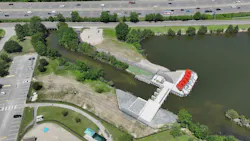
For coastal municipalities across the United States, improving stormwater infrastructure has become a priority as larger storms are occurring more frequently. Virginia Beach, a city where the Atlantic Ocean meets an intricate network of tidal creeks, has an ambitious $567.5 million stormwater prevention program that includes 45 drainage projects.
As a low-lying tidal community, the city's key drainageways, Thalia Creek and London Bridge Creek, experience oceanic inflow twice daily. This tidal rhythm creates what Stormwater Program Manager Mike Mundy and his team identify as a critical storage deficit: when heavy rainfall occurs during a high tide, the natural drainage capacity that would normally accommodate stormwater is already occupied by seawater. The problem intensifies during extreme weather events.
A portion of the city's drainage infrastructure is divided by Rosemont Road into two distinct basins: Windsor Woods to the west and The Lakes and Princess Anne Plaza to the east. Under normal conditions, these systems operate independently. However, during hundred-year storm events, water levels can rise sufficiently to merge these basins, overwhelming the existing infrastructure and flooding residential and commercial areas.
Water levels in Lake Windsor fluctuate by 2 to 2.5 feet based on tidal cycles. When high tide coincides with a storm event, available storage capacity essentially vanishes, leaving the stormwater with nowhere to go but into streets, homes, and businesses.
The basin and pump approach
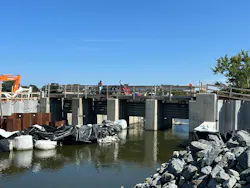
The design team at engineering firm Michael Baker International has worked with the City of Virginia Beach for the past seven years developing what has proven to be a simple yet highly effective strategy. If natural storage is insufficient, it is created artificially. The "basin and pump" approach relies on two elements: the use of tide gates to prevent ocean water from entering the creek system, and pumping stations to actively draw down internal water levels before storm events arrive.
The logic is straightforward but requires precise execution. By closing tide gates at low tide prior to a predicted storm, the city prevents the normal tidal influx that would otherwise occupy valuable storage volume. Pumps then work to further reduce water levels, creating additional capacity. When the storm arrives, this manufactured storage space can absorb rainfall that would otherwise flood vulnerable neighborhoods.
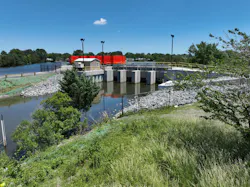
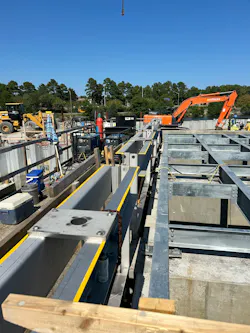
The Windsor Woods Tide Gate Project is the first combination strategy implemented in the City of Virginia Beach. The structure has four HydroGate® slide gates, each measuring 10 feet wide by 5 feet tall, fabricated from 316 stainless steel and operated by electric actuators. The installation also includes interim stormwater pumps with a capacity of 50 cubic feet per second, which will eventually be replaced by a permanent pump station capable of moving 800 cfs.
Why slide gates
Virginia Beach evaluated approximately half a dozen gate configurations before selecting the HydroGate slide gate design. The decision takes into account the operational environment and lifecycle cost. The brackish water environment is notoriously corrosive, and gate systems that remain submerged can face continuous degradation. The slide gate design offers a crucial advantage: the gates can be lifted completely out of the water when not in operation, dramatically reducing saltwater exposure and extending the structure's operational lifespan.
The HydroGate HG-561 Slide Gate has a stainless steel frame and slide construction, comprised of precision brake-formed custom profiles, channels, and plates welded and assembled at Henry Pratt's manufacturing facility in Kimball, Tennessee. The gate's sealing capacity is achieved through engineered rubber and ultra-high-molecular-weight polyethylene seals and guides that seal against the stainless steel slide. The combination of precision manufacturing and a seal design that self-adjusts to its environment allows the slide gate to provide a reliable seal under a wide array of bidirectional loading environments.
Theory meets reality
Infrastructure projects are designed to perform during extreme events, but the true test comes when theory confronts actual storm conditions. The Windsor Woods installation faced this test soon after completion when a near-hurricane system approached the coast in August 2025.
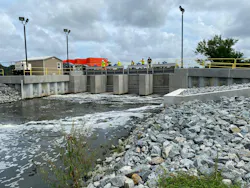
The city began preparations 36 hours before the storm's projected arrival, closing all four HydroGate slide gates to seal the system from oceanic surge. Over the following 24 hours, temporary pumps worked continuously to draw down the protected water level to 0.5 feet below sea level, creating substantial storage capacity for anticipated rainfall. When the permanent pump station is completed, it will take about eight hours to remove that amount of water, giving the city a much quicker response time.
With the ocean-side surge reaching elevations between 4 and 4.5 feet, the protected side remained at the targeted 0.5 feet below sea level. The gates successfully maintained a head difference of 4.5 to 5 feet with negligible leakage, an excellent demonstration of structural integrity and seal performance under significant hydraulic pressure.
Fortunately, the storm's rainfall component proved less severe than anticipated, meaning the created storage capacity was not fully utilized. However, the test validated that the slide gate could withstand intense pressure preventing water from entering the basin.
The path to 2031
The Windsor Woods success has provided Virginia Beach with the confidence to proceed with an ambitious expansion of additional tide gate installations planned at northern and southern locations on London Bridge Creek in The Lakes and Princess Anne Plaza project area.
These subsequent phases present greater complexity because ocean water can enter the project areas from multiple directions. The South London Bridge Creek Gate, currently in design, will span 60 to 70 feet and incorporate four gates. A planned pump station installation on a wider section of North London Bridge Creek will include a gate requiring eight or nine individual gates. By 2031, Virginia Beach expects to have an additional 12 to 13 gates installed beyond the Windsor Woods gates.
The city is also using water level sensors upstream and downstream to provide continuous monitoring, ensuring that gate and pump operations never inadvertently worsen flooding in adjacent areas.
This project demonstrates that passive acceptance of periodic flooding is neither inevitable nor acceptable when engineered solutions exist. The material choices, operational protocols, and performance monitoring integrated into the Windsor Woods installation are an important step toward protecting the City of Virginia Beach from rising sea levels and more frequent extreme weather events.
About the Author
 Spencer Magladry
Spencer Magladry
Spencer Magladry is a technical sales engineer for Mueller Water Products. Magladry has been with Mueller for over 5 years. He helps customers across the Eastern Seaboard and Southeast, and abroad, to control and manage water flow for large infrastructure projects.