Study: Future snowmelt to vary across North America
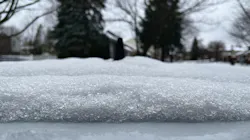
Climate change and warmer conditions have altered snow-driven extremes — one study from the University of New Hampshire has explored how future snowmelt incidences in North America could vary greatly by the late 21st century.
According to the research team, snowmelt would decrease over the continental U.S. and southern Canada but increase in Alaska and northern Canada. Areas with increased snowmelt would experience larger flooding vulnerabilities and major societal and economic consequences, including costly infrastructure failures.
“Estimation of future floods can be a tricky business and yet it is important information for those planning future infrastructure,” said Jennifer Jacobs, professor of civil and environmental engineering. “For instance, if a region primarily has floods occurring during the winter, then this work could really help build infrastructure that can handle those future conditions. And, if the floods are decreasing, then the design values should also decrease rather than over design.”
Their study, recently published in the journal Geophysical Research Letters, looked at previous study predictions of change in snowpack, snowmelt, and runoff, with the goal of translating it into information that would be helpful for water resources managers, engineering designers, and the general public.
The researchers used historical maps and regional climate model (RCM) simulations that focused on North America. They found that in the West Coast Mountain areas, such as Northern California and the Pacific Northwest, there could be greater risk of rain-on-snow flooding because these areas are predicted to warm and produce more rain. This could increase the melting of any existing snowpack and lead to larger runoff potential, increasing flooding risk.
But predictions differed in extreme cold regions like Alaska and northern Canada. Researchers found warmer temperatures in these areas could increase the opportunity for moisture that could likely lead to more winter precipitation like snow.
“These findings can be important in helping to develop or modify federal and state governments’ long-term policies for climate adaptation,” said Eunsang Cho, a former UNH doctoral student, now postdoctoral researcher at NASA’s Goddard Space Flight Center, and lead author of the study. “For example, the current U.S. government standards for water-related infrastructure design are based on liquid precipitation data with very limited guidance on snow or snowmelt information.”
This information can help engineers design infrastructure to anticipate future conditions. In their previous research, Jacobs and Cho created a map that accounts for snowmelt across the continental U.S. They say this information is already being used by the state of California in their relicensing process.