Keeping kitchen FOG out of the storm drain: a source-control blind spot for MS4 programs
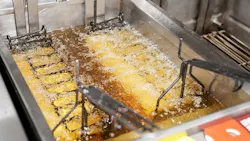
For most stormwater professionals, fats, oils and grease register as a sanitary-sewer problem: the domain of the pretreatment program and the grease interceptor. And that is where most of a commercial kitchen's FOG belongs: captured by a properly sized interceptor and hauled off before it ever reaches the collection system. But a meaningful share of restaurant grease never goes down an indoor drain at all. It reaches the storm drain and that makes it a Municipal Separate Storm Sewer System problem hiding in plain sight.
Under the illicit discharge detection and elimination provisions of a Phase I or Phase II MS4 permit, any non-stormwater discharge to the storm sewer system is presumptively prohibited unless specifically exempted. Grease is not on anyone's exemption list. Yet at commercial kitchens across virtually every municipal program, FOG finds its way to the curb inlet through a handful of predictable, preventable pathways. Here is where it comes from, and the source controls that keep it out.
Pathway one: outdoor used-oil storage.
Every kitchen that fries generates used cooking oil, stored outdoors in a bin or caddy until a renderer collects it. When those containers are overfilled, cracked, or left with lids open in the rain, oil weeps onto the pad and if that pad drains to a storm inlet rather than to a sanitary connection, the next storm carries it straight into the MS4. The fix is straightforward source control: intact, lidded, leak-proof containers; secondary containment or a bermed, covered enclosure; and siting the storage area so its pad drains to sanitary, not to a storm drain. It is worth confirming during inspections that the used-oil enclosure and the dumpster pad are not plumbed to the storm system, a surprisingly common legacy condition.
Pathway two: dumpster and pad washdown.
Kitchens hose down their trash enclosures and grease-stained pads, and that wash water loaded with FOG, food solids and detergent, sheets across the lot to the nearest inlet. This is a textbook illicit discharge. Source control here means directing washdown to a sanitary connection or a dedicated wash pad that captures and conveys the water for proper disposal, and training staff never to send enclosure washwater to the storm drain.
Pathway three: exterior pressure washing.
Hood-cleaning and pad-cleaning crews generate the single greasiest wastewater a restaurant produces. When a crew pressure-washes an exhaust fan on the roof or a grease-caked pad out back and lets the runoff find a storm inlet, the MS4 receives a concentrated slug of FOG and cleaning chemicals. Reputable crews contain that wastewater -- with booms, berms, mats or vacuum recovery and haul it for disposal at an approved facility. For a stormwater program, the contractor's containment practice is as important as the restaurant's own housekeeping, and it is a fair question to ask during outreach.
Pathway four: the neglected interceptor that backs up outdoors.
When an indoor grease interceptor is not serviced on a schedule matched to the kitchen's volume, it overflows and the overflow does not always stay indoors. Backups migrate through floor drains, cleanouts and doorways to the exterior, where they reach the storm system. The prevention is the same discipline pretreatment programs already champion: interceptors pumped and cleaned before accumulated grease and solids reach roughly a quarter of the unit's depth, with service records kept on file. A well-run interceptor program is also a stormwater control.
Why this matters for the MS4 is the same reason it matters for the sanitary side: FOG does not disappear. In the storm system it coats pipes, fouls inlets and reaches receiving waters, where it contributes to the oil-and-grease and floatables loads that impair urban streams. And unlike many stormwater pollutants, kitchen FOG has a clear, identifiable source and a small set of well-understood controls, which makes it one of the more tractable illicit-discharge problems a program can take on.
The practical opportunity for stormwater managers is coordination. Commercial-kitchen FOG sits at the intersection of the pretreatment program, the solid-waste hauler, the used-oil renderer and the IDDE program: four functions that rarely talk to one another. A restaurant might have a compliant indoor interceptor and still be discharging grease to the MS4 from its dumpster pad, because no single inspector owns the outdoor side.
Programs that fold a few FOG-specific questions into routine commercial inspections: Where does your used-oil storage drain? Where does your dumpster washwater go? Does your hood-cleaning crew contain its wastewater? close the loop with almost no new infrastructure.
For the restaurants themselves, the same coordination pays off. A single service partner that handles used-oil collection, grease-trap service and hood cleaning can align the schedules, keep the outdoor storage compliant, and contain its own wastewater, consolidating four fragmented vendor relationships into one accountable chain of custody. That is easier for the operator and cleaner for the watershed.
FOG will always be, first and foremost, a sanitary-sewer story. But the fraction that reaches the storm drain is not an accident of chemistry. It is a source-control failure with a name, a pathway and a fix. For MS4 programs looking for high-yield, low-cost illicit-discharge targets, the back of the restaurant is a good place to look.
About the Author
Buddy Klovstad
Buddy Klovstad is the founder of Grand Natural Inc, a nationwide company that collects used cooking oil and provides grease-trap, hood-cleaning, and FOG services for commercial kitchens.