Storms overwhelm Missouri drainage systems, close 38 roads, trigger water rescues
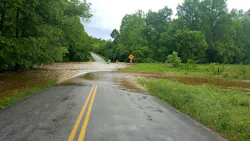
Severe storms that moved across Missouri and Kansas from April 25-27 dropped months' worth of rain in hours, flooded major highways, triggered more than a dozen water rescues and led both states' governors to declare emergencies.
The National Weather Service Kansas City office issued a flash flood warning for the Kansas City metropolitan area beginning shortly before 6 a.m. on April 27, citing reports of flash flooding already occurring across the warned area, including on small creeks, highways and underpasses with poor drainage. The NWS warning noted that between 2 and 4 inches of rain had already fallen across the region, with additional rainfall possible.
The National Weather Service reported that 3.2 inches of rain fell in a six-hour period ending shortly before 7 a.m. at Kansas City International Airport. NWS Storm Prediction Center meteorologist Evan Bentley said temperatures approaching 80 degrees Fahrenheit were contributing to "atmospheric instability," the Associated Press reported.
Kansas City Fire Department Battalion Chief Riley Nolan said in an email to the Associated Press that the department responded to 11 water rescues from vehicles beginning shortly before 6 a.m., with most occurring in the city's typical high-water areas following heavy rain. Nolan said no boats were required and no injuries were reported.
The Missouri Department of Transportation's traveler information system showed 38 roads closed due to flooding across the state as of April 29, spanning 14 counties. Among them, MoDOT reported Missouri 10 closed in Carroll County, Missouri 23 closed near the Blackwater River in Johnson County, and Interstate 70 eastbound closed in Saline County at Davis Creek. MoDOT also reported Missouri 37 in Barton County closed until further notice due to roadway damage.
In northeastern Missouri, MoDOT reported that U.S. Route 36 eastbound was closed between Macon County and Clarence and Missouri Route 151 was closed north of U.S. 36 as of the morning of April 27.

The storm system also brought significant hail damage to southwest Missouri on April 28, part of a four-day severe weather outbreak that the National Weather Service Springfield office documented in an official storm summary. Springfield-Branson National Airport said in a social media post that approximately 1,500 vehicles in its parking lot were impacted, with airport spokeswoman Ren Bishop Lubbering telling KY3 that two to three-inch hail struck all 3,300 acres of airport property. "If you have a car that was parked here at the airport, it was likely impacted and received hail damage today," Bishop Lubbering said. Missouri State Highway Patrol Troop D also reported damage to its patrol vehicles in a social media post.
Hail also compounded storm damage across parts of Kansas. Golf-ball-sized hailstones struck Salina after midnight on April 27, damaging vehicles and structures, according to KWCH. Storm-caused roof damage at Salina's Central Mall prompted its closure that day. Saline County Emergency Management urged residents to use caution while assessing damage. "Watch for broken glass, structural issues, and other hazards around your property," the agency said. "If it is safe to do so, document all damage with photos before making any temporary repairs, and contact your insurance provider as soon as possible to begin the claims process."
In Kansas, the Kansas Department of Transportation reported that Zeandale Road was closed between KS-177 and KS-99 due to flooding. The Riley County Police Department said in a statement to KSNT that drivers should avoid the 5800 block of Zeandale Road and that the closure would remain in effect until water levels dropped enough for safe travel.
"Due to the severe storms and flooding that has impacted the state, I've declared a disaster emergency to ensure state assistance is readily available if needed," Kansas Gov. Laura Kelly said in a press release from the Kansas Adjutant General's Department.
Kelly issued a verbal state of disaster emergency on April 27 at 9:50 a.m., citing severe thunderstorms, tornadoes and flooding that impacted the state during the period of April 25-27, according to the release. The Kansas Division of Management activated the State Emergency Operations Center to a Level 2 partial activation to monitor the situation and assist counties and local responders if requested.
In Missouri, Gov. Mike Kehoe signed Executive Order 26-12 on April 17, declaring a state of emergency in preparation for severe weather forecasted across most of the state, according to a press release from the governor's office. The order activated the Missouri State Emergency Operations Plan, enabling state agencies to coordinate directly with local jurisdictions to expedite assistance, and was set to expire May 17, 2026.
"This Executive Order is a proactive step to ensure our emergency management teams are fully prepared should these storms require immediate action to protect Missourians," Kehoe said in the release.
About the Author
 Sarah Kominek
Sarah Kominek
Head of Content, Stormwater Solutions
Sarah Kominek is the head of content for Stormwater Solutions at Endeavor Business Media, a division of EndeavorB2B. Kominek graduated from Wayne State University in with a Bachelor of Arts in Journalism and a minor in Communication with post-baccalaureate studies in biology. She has worked as a journalist for eight years covering the medical plastics industry and technology, plastics pollution and regulation, the automotive industry, public policy and community news.