Minnesota road salt research highlights long-term chloride impacts and alternatives
Key Highlights
- Road salt can remain in soils for years, gradually leaching into groundwater and impacting water quality long after application.
- Permeable pavement shows promise in reducing salt runoff and improving winter road safety, especially in residential areas.
- Alternative deicers like potassium acetate and magnesium chloride perform better at lower temperatures but require careful environmental consideration.
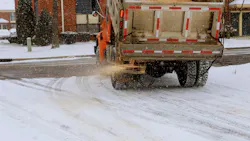
Road salt applied during winter can remain in soils for years, continuing to affect groundwater and surface waters long after its use has been reduced, according to Andy Erickson, research manager at the University of Minnesota’s St. Anthony Falls Laboratory.
Erickson presented “A Summary of Road Salt Research from Minnesota” at StormCon 2026, highlighting more than two decades of research into chloride impacts, winter maintenance practices and alternatives to conventional sodium chloride.
His presentation focused on five key questions: whether Minnesota has a road salt “legacy” problem, whether permeable pavement can reduce salt use, how alternative deicing chemicals affect the environment, the costs associated with salt and whether nonchemical approaches could provide safer winter surfaces.
Salt can persist in soils
Research conducted at the University of Minnesota found that chloride does not simply pass through soils immediately after application. In laboratory experiments, researchers loaded three common Minnesota soil types with salty water representing spring snowmelt and then flushed them with clean water representing summer precipitation.
The soil retained some of the chloride during the initial loading period. When clean water was introduced, chloride continued to emerge from the soil for an extended period, creating what Erickson described as a long “tail” of salt release.
The research suggests that an average winter's road salt application can require at least an average summer or more of precipitation to flush most of the chloride from soil, and not all of the salt is removed.
Field sampling supported the laboratory findings. Soil cores collected near roadways showed chloride accumulating below the surface later in the summer, indicating that salt was moving downward toward groundwater.
For stormwater and water quality managers, the finding means reducing road salt applications may not immediately eliminate chloride impacts.
“We do have a legacy problem,” Erickson said, noting that decades of accumulated salt can continue moving into groundwater and potentially returning to surface waters through groundwater-fed streams and lakes.
Permeable pavement could reduce salt use
Erickson also discussed research into whether permeable pavement can provide winter safety while reducing the need for deicing salt.
The research examined pavement temperature and winter performance, with the broader goal of determining whether permeable pavement could be used without conventional salt applications.
Erickson said permeable pavement offers several potential benefits, including reduced runoff and improved water quality. In winter, it also can provide smoother driving conditions and reduce hydroplaning and spray.
The presentation noted that permeable pavement is currently used most extensively in residential applications, such as driveways and residential streets, but could also have applications in parking lots.
Erickson also pointed to heated permeable pavement as a potentially promising approach, although he noted that the Minnesota research presented did not specifically evaluate that technology.
Alternative chemicals come with tradeoffs
Replacing sodium chloride with liquid brine or other deicing chemicals does not automatically eliminate environmental concerns, Erickson said.
Researchers evaluated several alternatives, including magnesium chloride, potassium acetate and propylene glycol. Performance varied depending on temperature.
At approximately 23 degrees Fahrenheit, the tested products generally performed well. At 5 degrees Fahrenheit, researchers still observed measurable benefits from brine. At approximately minus 13 degrees Fahrenheit, sodium chloride provided little benefit, while several alternatives continued to perform.
At even lower temperatures, around minus 31 degrees Fahrenheit, potassium acetate and propylene glycol performed particularly well. Magnesium chloride also provided some benefit, although switching to calcium chloride at such temperatures would not resolve the underlying chloride problem.
The research also examined the environmental consequences of potassium acetate. At recommended application rates, acetate itself was not found to be toxic in the scenarios tested. Researchers also examined biochemical oxygen demand because organic chemicals can consume oxygen as they break down.
However, potassium exceeded some toxicity thresholds at the application rates evaluated. Erickson said the research team therefore recommends limiting potassium acetate to critical locations and severe storms rather than broadly applying it, particularly in parking lots where overapplication can be common.
He encouraged stormwater managers evaluating alternative products to ask manufacturers what environmental testing has been conducted before switching materials.
The hidden cost of salt
Erickson also challenged managers to consider the full cost of conventional road salt rather than looking only at its purchase price.
He cited estimates putting the cost of salt at approximately $100 per ton, while corrosion, road maintenance, tree damage and other infrastructure impacts can add roughly $3,000 per ton. Environmental impacts can add further costs, with estimates approaching $10,000 per ton when ecosystem impacts are considered.
Overall, the presentation estimated the combined annual cost of salt, infrastructure damage and ecosystem impacts at approximately $5.2 billion.
Alternative deicers can be substantially more expensive upfront. Erickson said some organic products can cost roughly 16 times more per ton than conventional salt, while switching equipment and application systems adds capital costs.
However, alternatives that are less corrosive can reduce long-term infrastructure costs. Erickson said potassium acetate, for example, can have substantially lower infrastructure and environmental impacts, potentially resulting in significant long-term savings despite the initial investment.
Heated sand offers another option
The research also revisited the use of abrasives as an alternative to chemical deicing.
Conventional dry sand performed poorly in testing, providing little more friction than bare ice. Erickson compared dry sand applied to ice to “marbles on ice,” noting that much of it can be displaced from roadways while also creating maintenance problems when it enters storm drains and catch basins.
Researchers examined a technique used in parts of Europe, particularly Scandinavian countries, that involves applying heated, wetted sand. The sand is warmed above freezing and contains some moisture when applied to the roadway.
The heated material partially melts into the ice and then refreezes, effectively creating a rough, sandpaper-like surface. It also adheres better to the roadway than dry sand.
Testing found that heated sand did not perform as well as bare pavement but provided substantially better friction than the other abrasive approaches evaluated.
The University of Minnesota is working with a truck manufacturer to explore bringing the technology to the United States for testing by public works agencies.
Reducing salt will take time
Erickson concluded that there is no single solution to the chloride problem. Reducing salt application remains critical, but managers also need to account for the legacy chloride already stored in soils.
Permeable pavement, alternative deicers and heated sand each offer potential ways to reduce reliance on conventional road salt, but each comes with different performance, environmental and cost considerations.
For stormwater professionals, the research points to a long-term approach: reducing chloride at the source while recognizing that improvements in water quality may lag behind reductions in application because decades of accumulated salt remain in the environment.
About the Author
 Alex Cossin
Alex Cossin
Associate Editor
Alex Cossin is the associate editor for Waterworld Magazine, Wastewater Digest and Stormwater Solutions, which compose the Endeavor Business Media Water Group. Cossin graduated from Kent State University in 2018 with a Bachelor of Science in Journalism. Cossin can be reached at [email protected].