Inside Bangalore International Airport's water positive design strategy
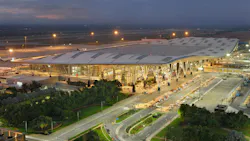
Airports are among the most water intensive infrastructure systems, requiring significant volumes of water for passenger services, cooling, landscaping, and firefighting. At Bangalore International Airport (BIAL), located in one of India’s fastest growing metropolitan regions, rising demand combined with increasing regional water scarcity created an urgent need for a more resilient water strategy.
Rather than relying solely on external water sources, Walter P Moore worked with BIAL to develop a water positive approach that captures and reuses rainfall across the airport’s expansive surfaces while supporting groundwater recharge for the surrounding region.
Opportunity at scale
Airports present unique opportunities for rainwater harvesting. Runways, taxiways, and aprons create vast impervious surfaces that generate substantial runoff during rainfall events. At BIAL, this scale allowed rainfall, traditionally treated as a loss, to be reconsidered as a reliable resource.
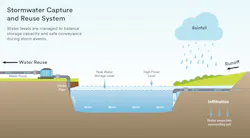
The design team helped design a coordinated system of storage ponds, bioswales, and underground tanks that captures runoff and integrates it into the airport’s operational water supply. In doing so, the approach reduces pressure on municipal water sources, supports aquifer recharge, and improves onsite stormwater management.
Engineering strategy
The design process began with a detailed assessment of the airport’s multiple drainage catchments to understand how water could be captured, stored, and reused across the site. Historical rainfall data and hydrologic modeling were used to estimate rainwater harvesting potential under dry, average, and wet conditions, helping optimize system sizing and performance.
To address future uncertainty, projections such as SSP5-8.5, a high‑emissions climate scenario, can be applied separately to assess long-term variability and water supply risk by calculating climate change factors for unique design storms. Together, these analyses informed a stormwater management strategy that redirects runoff into storage and recharge systems while safely conveying excess flows. The result is a system designed to perform reliably under present conditions and evolving climate pressures.
System innovation
Simplicity and efficiency guided key design decisions. Gravity-fed connections between storage ponds reduce reliance on pumps and mechanical controls, lowering energy demand and operational complexity. Storage capacity was further enhanced using riser weirs, allowing ponds to serve multiple functions without expanding their footprint.
These strategies enabled dynamic use of available storage while maintaining operational reliability, supporting both day-to-day water needs and long-term resilience.
Stewardship in action
Today, BIAL meets a substantial portion of its water demand through harvested rainwater and recharged groundwater, significantly reducing dependence on municipal supplies. The system lowers operational costs, strengthens water security during dry periods, and contributes to improved groundwater levels in surrounding areas benefiting nearby communities.
The collaboration between BIAL and Walter P Moore demonstrates how large airports can evolve into water positive systems through strategic planning, engineering innovation, and climate adaptive design. Rooted in stewardship, the project balances operational needs with ecosystem health while setting a benchmark for water resilience that can inform future projects globally.
Learn more by downloading the Stewardship Report Living with Water: Insights int Impact and Resilience.
About the Author
Rashmi Kamble
Rashmi Kamble, IGBC AP, is a Principal and Head of Water Resources in Walter P Moore’s Pune, India office. She can be reached at [email protected].