Wetland Channels Reduce Storm Water Runoff Pollution in South Dakota City
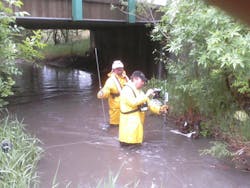
Wetland channels constructed in downtown Rapid City, S.D., effectively reduced many pollutants in storm water runoff, according to a recent U.S. Geological Survey (USGS) report.
Measurements collected by the USGS during 2013-2014 showed that concentrations of total suspended solids, metals, nutrients and bacteria decreased in runoff to Rapid Creek when storm water was routed through wetland channels in downtown Rapid City. However, chloride concentrations increased, likely due to the movement of salts deposited during prior runoff events.
“Water quality is important because the portion of Rapid Creek that flows through Rapid City is a valuable spawning area for trout, is used for recreation and is a seasonal municipal water supply for the city,” said Galen Hoogestraat, a USGS hydrologist and the author of the report. “Controlling sediment from construction sites and urban land use is critical for maintaining healthy water quality in the creek.”
The USGS monitored water quality of storm water runoff in the following three Rapid City drainage basins:
- Arrowhead, including the Arrowhead Country Club and Meadowbrook Golf Course in southwestern Rapid City, from 2008 through 2012;
- Meade-Hawthorne near Creek Drive in south-central Rapid City from 2010 through 2012; and
- Downtown Rapid City near 1st, 2nd and 3rd Streets during 2013-2014.
“The largest reductions of total suspended solids and lead measured between wetland inlets and outlets were greater than 40%,” said Hoogestraat. “This significant percentage highlights the overall success of using wetland channels to improve water quality in Rapid City.”
Bacteria concentrations decreased by about 21% at the 1st Street wetland channel and 36% at the 2nd Street channel, but did not decrease at the 3rd Street channel. Total nitrogen, phosphorus, copper and zinc concentrations were reduced by at least 20% at all three wetland channels.
A total of 357 water-quality samples were collected during 2008-2012 at monitoring sites within the Arrowhead and Meade-Hawthorne drainage basins. Results indicated substantial sediment and bacteria transport from these basins into Rapid Creek.
Water-quality effects differed between open vegetated channels in the Arrowhead drainage basin and concrete channels and conduits in the Meade-Hawthorne drainage basin.
“Concentrations of total suspended solids and bacteria typically were about two times greater at the Meade-Hawthorne outlet compared to the Arrowhead outlet,” Hoogestraat said. “The presence of more vegetated channels in the Arrowhead drainage basin allows for natural treatment of storm water.”
Storm water runoff from urban lands harms surface water resources by increasing stream velocities, destroying natural habitat and increasing pollution in receiving waters. As runoff flows over the land or impervious surfaces such as roads and parking lots, it picks up debris, chemicals, sediment and other pollutants that could adversely affect water quality if discharge is not treated.
Source: USGS