From fairway to floodplain: Hidden Valley Golf Course restoration
Key Highlights
- The project increased stream sinuosity and floodplain benches to slow water flow and improve flood capacity, reducing erosion and safety hazards.
- A pond was converted into wetlands, providing better sediment filtration and nutrient uptake, enhancing water quality and ecological value.
- Design choices prioritized golf course safety and sightlines by selecting native plants under five feet tall and avoiding overgrowth that could impair visibility.
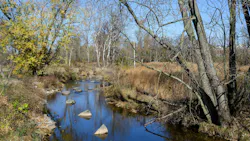
For the managers of Hidden Valley Golf Course in Delaware, Ohio, a small, unnamed tributary had become a significant liability. What was once a scenic water feature had devolved into a deeply entrenched, "flashy" stream that posed safety risks to golfers and acted as a major conduit for nonpoint source pollution.
During a recent presentation at the 2026 Ohio Stormwater Conference, Crystal Scales and Elsa Saelens, EI, of Burgess & Niple detailed how they transformed this struggling urban waterway into a functional, aesthetically pleasing stream and wetland complex. Their experience offers a blueprint for balancing high-visibility recreation with aggressive environmental restoration.
The challenge: Urban flashiness and "ball-eating" banks
The project site – a busy nine-hole course seeing 15,000 annual visitors – presented a unique set of constraints. The 62-acre drainage area is 99% developed and 25% impervious, leading to rapid, high-velocity runoff.
Existing impairments included:
-
Severe entrenchment: High flows caused the stream to down-cut, creating steep, unstable banks that "sloughed" off into the water.
-
Safety hazards: Erosion threatened the fairways, making some areas dangerous for golfers and maintenance equipment.
-
Sediment loading: An on-site pond had become a "muck-filled" sediment trap, losing its aesthetic and ecological value.
-
Nutrient pollution: Runoff from upstream urban areas and on-course fertilizers flowed directly into the Delaware Run without filtration.
The design: Natural channel priority
Saelens emphasized a Natural Channel Design (NCD) approach, specifically targeting a combination of Priority 1 and 2 restorations. The goal was to move away from "hard armoring" like riprap and instead reconnect the stream to its natural floodplain.
-
Increasing sinuosity: The team increased the stream length from 1,133 feet to 1,347 feet. Adding curvature naturally slows water velocity and increases flood capacity.
-
Floodplain benches: By cutting down the banks (in some places by three feet) and raising the stream bed, the team ensured that high-water events would spill onto a managed floodplain rather than carving into the fairways.
-
Strategic planting: Riparian seed mixes were selected based on height. To maintain sightlines for golfers, the team avoided species that grow over five feet tall, proving that restoration can be "golf-friendly."
-
Pond-to-wetland conversion: The failing pond was replaced with a series of meandering wetlands, which provide superior nutrient uptake and sediment filtration.
Lessons from the field
Even the best-laid designs face the reality of the landscape. Saelens shared two critical takeaways for stormwater professionals:
-
Variable substrate sizing: Initial calculations for riffle substrate were based on the average slope of the entire stream. However, a steeper gradient in the first third of the reach caused the rock to wash downstream during early floods. The team had to recalculate and install larger material for the steeper upper section.
-
The "maintenance" of natives: In an urban setting, invasive species like cattails can quickly dominate new wetlands. While they filter water, they grow too tall for golf course sightlines, requiring ongoing maintenance and management to keep the site functional for its primary use.
Funding the vision
The restoration was made possible through the Ohio 319 program, administered by the Ohio EPA. This program provides federal grant funding for nonpoint source pollution reduction but requires a robust "Nine-Element Plan" to qualify.
By integrating flood management, water quality improvements, and recreational safety, the Hidden Valley project proves that even the most "developed" streams can be returned to a state of ecological health.
About the Author
 Alex Cossin
Alex Cossin
Associate Editor
Alex Cossin is the associate editor for Waterworld Magazine, Wastewater Digest and Stormwater Solutions, which compose the Endeavor Business Media Water Group. Cossin graduated from Kent State University in 2018 with a Bachelor of Science in Journalism. Cossin can be reached at [email protected].