Kenyan School Designed to End Water Wars
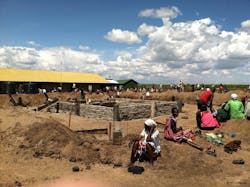
The Waterbank School, conceived and designed by U.S. based non-profit PITCHAfrica, demonstrates the dramatic potential of rainwater harvesting in semi-arid regions and aims to put an end to water wars. Enabling schools to harvest, store and filter water in large quantities as part of a community-integrated approach to rainwater harvesting is a powerful concept, particularly in regions where ground and surface water resources are already under stress, says PITCHAfrica’s Founder and Director, Jane Harrison.
PITCHAfrica is building this first school in collaboration with The Zeitz Foundation, a locally based NGO with funding from Guernsey Overseas Aid. In a region with an annual rainfall of 600 mm, the Waterbank School’s 600-sq-meter-roof catchment area can harvest more than 350,000 liters annually and will mean that the 200 plus students who will attend the school will receive 5 liters a day year round. This access to clean water will mean a reduction in illness and malnutrition, fewer school absences, improved study results, encourage development and thus lead to a reduction in youth unemployment in the future. But most importantly the school will achieve greater gender equality as the girls in the community who typically spend hours collecting water will be able to attend school and do homework instead. Every child will be able to learn about economically and environmentally sustainable rainwater harvesting, water filtration, sanitation and agricultural practices while at school. The Waterbank School embodies the very knowledge the children need in order for them to survive and improve their circumstances.
The area of accommodation, provided by the Waterbank School, is more than double that provided by a standard linear four-classroom rural school building. “The exciting fact and major breakthrough of the design” says David Turnbull, PITCHAfrica’s design director, “is that we are building this for the same cost as a conventional school, using local materials and a local workforce.” In addition to four full-sized indoor/outdoor classrooms the Waterbank School includes protected vegetable gardens for the children, four teacher’s rooms, community spaces and workshop, a courtyard theater and a 150,000 liter water reservoir with integrated water filtration. The workshop spaces can be used for health projects and other local initiatives that strengthen the school and local community.
This is a breakthrough in school and institutional design that could have major ramifications for construction in semi-arid environments. A vast proportion of the 300 million people on the African continent who are trying to survive without access to safe water, live in regions where the rainfall is in excess of 600 mm. Waterbanks can work effectively in regions with 300mm or more.
The opening of the Waterbank School will be held at the Uaso Nyiro Primary School, near Depatas on Nov. 24. As part of their ongoing Waterbank initiative, PITCHAfrica will be assisting other organizations in building Waterbanks in their communities.
Source: PITCHAfrica