Biochar guidance gives stormwater engineers a roadmap for BMP integration

To date, no comprehensive guidance has been available for integrating biochar into stormwater best management practices. Biochar can improve pollutant removal, increase infiltration into underlying soils, and support healthy plants in stormwater BMPs, but designers and engineers have had to reinvent the wheel for each project, limiting broader deployment.
A new set of guidance materials, Biochar in Stormwater Best Management Practices, were developed to support the broader use of biochar in stormwater filtration and green infrastructure BMPs. The materials include detailed specifications for biochar, fact sheets documenting its use in different BMP types, key pollutants that are and are not effectively removed by biochar, and a literature review supporting the recommendations.
The guidance is intended to help stormwater professionals, including managers, engineers, designers, and regulators, confidently deploy biochar in stormwater filtration and green infrastructure BMPs.
Stormwater filtration media
Stormwater filtration and green infrastructure BMPs are expected to filter pollutants, infiltrate and detain runoff, and support healthy plant growth. As regulatory requirements become more demanding, performance expectations for filtration and bioretention soil media have increased as well.
In many parts of the country, stormwater media is expected to remove a broad range of pollutants including particulate matter, total suspended solids, metals, nutrients, traditional organic pollutants such as hydrocarbons, and emerging contaminants including per- and polyfluoroalkyl substances and 6PPD-quinone, a toxic compound derived from tire dust. At the same time, some commonly used media components, such as compost, can contribute pollutants including metals and nutrients, solving some water quality problems but contributing to others.
In green infrastructure systems, stormwater media also needs to support healthy plant growth, which is key for both system performance and public acceptance.
Within this changing landscape, stormwater professionals have been working to identify advanced media components, such as biochar, that improve overall BMP performance without significantly increasing costs.
Biochar's unique offering
Biochar is a granular material similar to charcoal. It is created when waste biomass, such as wood waste or nut shells, is heated above 1,000 degrees Fahrenheit in the absence of oxygen under pyrolysis or gasification conditions. The resulting material is chemically stable and resistant to biological degradation, with reactive surfaces that can effectively adsorb pollutants including metals, organic compounds, and some nutrients.
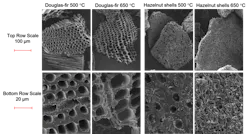
Biochar is highly porous, sometimes described as a 'microscopic sponge,' with a honeycomb-like structure that retains the cell wall structure of the original biomass and a specific surface area of up to 400 square meters per gram. To put that in perspective, 1 gram of biochar contains the equivalent surface area of roughly two tennis courts. That porosity allows biochar to remove particulate pollutants while also retaining water and nutrients to support healthy plant growth. The material properties of any given biochar depend on the feedstock, production conditions, and post-processing such as sieving.
Biochar's role in stormwater BMPs
The guidance materials focus on bioretention with and without underdrains, filter strips, flow-through media filters, green roofs, vegetated swales, and dry ponds. Biochar is almost always used in blended media, though it can also be used on its own as part of a treatment train approach.
In flow-through media filters where pollutant removal is the primary goal, biochar can serve as a lower-cost replacement for high-cost media such as granular activated carbon. In practice, its slightly lower sorption capacity results in equal real-world performance at a lower cost, because media filters typically fail due to clogging rather than sorption exhaustion.
In vegetated green infrastructure BMPs, biochar removes pollutants, supports healthy vegetation, retains water in sandy bioretention media between storms, and can improve infiltration rates into underlying soils.
Specifications
The guidance recommends using only woody biochar in stormwater BMPs, primarily because it is the type with the most available data and remains the most widely available option commercially.
Beyond feedstock, the specifications focus on particle size distribution, nutrient concentrations, and concentrations of other pollutants including heavy metals and certain organic compounds. Specifications are broken down by BMP category: high-flow media filters, bioretention with underdrains, green roofs, and BMPs in which stormwater does not pass through media and back into surface waters.
The guidance notes that the majority of commercially available wood biochars meet all required pollutant concentration thresholds and pose little risk of negative water quality outcomes. It recommends assessing pollutant concentrations based on total concentration analysis rather than available or water-soluble concentrations, because laboratory methods for the latter are not standardized. Analysis methods for total pollutant concentrations are standardized under ANSI S668: Methods for the Analysis and Testing of Biochar.
Particle size distribution is a key determinant of biochar effectiveness. Biochar with a high proportion of fine particles is not suitable for higher-flow BMPs such as flow-through media filters, bioretention with underdrains, and green roofs. Sourcing biochar that meets specific particle size requirements can be challenging, though it is available nationally, and more producers are adding capabilities to meet these specifications.
Applying the guidance to stormwater projects
Biochar is ready for broader deployment in stormwater management projects. Including it in stormwater filtration and bioretention soil media improves pollutant removal, increases infiltration into underlying soils, and supports healthy plant growth. In some areas, such as Washington state, additional local or regional materials are available to support biochar use in these practices. The full guidance, including BMP fact sheets and specifications, is available through the Center for Watershed Protection and the American Biochar Institute.
About the Author
Myles Gray
Myles Gray, P.E., is the Executive Director of United States Biochar Initiative, a non-profit focused on developing markets and standards for biochar. He has been working in biochar for 15 years in academia, consulting, industry, and the non-profit sector, and is a professional water resources engineer. He previously worked in stormwater engineering and consulting, focusing on stormwater green infrastructure and filtration systems including projects that used biochar. He holds a B.S. in Earth Science from Cornell University and a M.S. in Soil Science and Water Resources Engineering from Oregon State University. He lives with his wife and children in Portland, Oregon.