The Roman Empire was known for many remarkable engineering achievements, including roads that straddled continents and aqueducts capable of conveying life-sustaining water into ever-growing cities at the heart of the empire. Researchers tracing the history of Roman influence in Great Britain, however, long wondered how one critical, remote outpost in the northern part of the country could have maintained itself and persisted for decades without a source of water. With no streams or springs within its walls and no connection to aqueducts, Hadrian’s Fort, at a strategic point on the monumental Roman defensive barrier known as Hadrian’s Wall, held a garrison of up to 800 troops. According to a recent study, the stonework fortress happens to be situated in a location that precludes access to springs and waterways, and the area’s topography, although advantageous in military terms, made the prospect of supplying it via aqueduct impracticable. Yet the fortress is believed to have housed and sustained a mighty force, sent to the region to pacify the locals and protect Roman colonists seeking to turn the plains of England into an extension of Caesar’s realm.
Here researchers recently have uncovered evidence believed to be the ruins of a massive rainwater harvesting system. They believe the rooftops of each of the key buildings in the fortress were designed to capture and collect rainfall. Nearby were also found a number of stone-lined tanks, each capable of storing 2 cubic meters of water. The researchers believe that between two and six of these tanks would have been associated with each of the major buildings of the fort. Estimating the rainfall totals for the Roman era, they surmise the system could have provided the 800 soldiers manning the fort with 10 liters of water per capita per day during their deployment. According to Peter Beaumont, the author of the study, the success of the ancient system helps make a strong case for increasing the use of rain harvesting systems in the present day.
The Roman system took a tremendous amount of foresight and drive. Roman officials would have had a keen awareness of the need for a water source fitting with military strategy, and it helped sustain an empire. The average American today, fortunately, doesn’t have to manage water based on an emperor’s dreams of conquest. However, water is just as critical a resource for our society, and many experts say the task of ensuring sustainable water sources is overlooked by too many.
“Most Americans feel we have an endless source of water, but we don’t,” says Mike Ruck, co-owner of Rainwater Solutions of Raleigh, NC. Tapping new sources of water requires careful planning, even if the source is ubiquitous like rainwater.
An Era of Complexity
Ruck says that a system for harvesting rainwater from a rooftop for potable use can become quite complex. Every detail of the path the water takes must be considered as critical to the system’s performance, starting with the roofing material itself. He outlines a simplified sketch of a potable rooftop rainwater harvesting system. “When you talk about potable rainwater, you have to design the whole system taking into account where that rain hits first. What’s the roofing material? A smooth surface like a baked painted metal roof is the best. The slicker the surface, the better, because not as many contaminants are going to settle on that roof.” Next in line in Ruck’s hypothetical simplified system would be flush diverters, designed to channel away the most contaminated water released during the first flush of a rainstorm; collection begins only after this water has been directed away from the potable system. Once collection begins, he recommends filtration down to 280 microns to remove particulates.
Equally important to ensure quality is an efficient storage system. He recommends designing that system to keep the water in the tank as calm as possible to avoid agitating any sediment that may get past the filter system and settle at the bottom of the tank. To avoid disturbing sediment, he explains, the rainwater storage tank must be filled via a calming inlet so that “the water is not just dumped into the tank as it falls, but is rather piped to the very bottom of the tank and then enters through a turned-up pipe so that it doesn’t stir the sediment in the bottom.”
He adds, “When extracting water from the tank, you draw from the top of the water column with a floating extractor, and then it goes through a series of filters and then through a UV sterilization procedure. Finally, you have that water tested, and you’re good to go as long as that test comes back saying it’s safe to drink.”
Rome’s best engineers would never have imagined the need for such sophistication, and it is unknown to what standards they aspired to satisfy the thirst of their legions. It’s possible they believed what doesn’t kill you makes you stronger. That philosophy, of course, won’t do in today’s world. However, rainwater harvesting can deliver practical value even when it is not held to potable standards. In fact, the work Ruck’s firm specializes in, “focusing on community rain barrel programs,” targets a hunger for knowledge rather than the thirst for conquest. In community rain barrel programs, he says, “The rain barrel is used as an educational tool helping meet the MS4 requirement that cities have to educate their citizens on stormwater and water quality.”
Mike and Lynn Ruck have deep family roots in harvested rainwater, having fallen in love with a rain barrel early in their partnership. “My grandfather had a rain barrel, and it’s been passed down through my family. It was first built for my grandmother down in Texas,” he says. “When my father gave it to us, my wife said, ‘Great, that is so cool.’ I was skeptical at first.”
It didn’t take long for him to change his perspective. “We were newlyweds; we had just bought our first house and we were really into gardening, so I thought, ‘Wow, a free source of water—this is great.’ That was in the early nineties. By the late 1990s, we were making rain barrels for friends and selling them locally and eventually turned our hobby into a full-time business.
“We focus on non-potable uses of rainwater—uses of water that don’t have to have a high degree of cleaning or a high level of purity for the water. Plants don’t mind the extra bits of organic material in the water that obviously the city would take out to make sure we don’t get sick drinking the water.”
He adds, “There are two drivers for rainwater harvesting—either drought or flooding—and on the flooding side you have water-quality concerns.”
A Garden Attraction
Ruck says his company has completed rainwater harvesting systems ranging in size from a 13,000-gallon catchment, built to serve a greenhouse and small farm, to individual rain barrels providing water for homeowners’ backyard gardens. He said the payback for a system depends on the scale of the project. He estimates that the 13,000-gallon system he installed for the greenhouse and several plots of cropland allows the farmer to avoid the expense of a municipal water connection for crop irrigation and has likely paid back twice its cost in the 10 years since it was installed.
For homeowners, it’s not so much the monetary savings that make rain barrels attractive. He notes that the economic return is not particularly dramatic. According to Ruck, a typical homeowner using water collected in 55-gallon rain barrels and a rainwater collection system to water the grass “would be looking at 10 to 12 years before they see that breakeven point.” For that reason, he says, “We see it not so much as a payback but as a way to protect their landscape investment.”
Dana Nichols, manager of the Conservation Department at San Antonio Water and Sewer (SAWS), says that in San Antonio the issue with water is not so much one of scarcity but of timing. With homeowners seeking ways to irrigate lawns and flowerbeds during the particularly dry months of July and August, residents have fallen in love with rain barrel distribution programs promoted by SAWS, and her agency has had tremendous success distributing rain barrels to local citizens. The focal point of her agency’s work over the past 20 years has been conservation. “The first ten years we spent converting 300,000 toilets to low-flow models by turn-keying every hotel and school restroom with pre-1992 fixtures,” she says.
“We tried helping for-profit businesses with cisterns and potable water capture, but it’s tough to make them work well. There are too many moving parts,” says Nichols. “Sometimes you get a situation where a new owner doesn’t want to pick up all the upkeep of a system that was installed by a previous owner.”
She says she was at first skeptical about the prospect of success for a rain barrel program in San Antonio, “but because we have been in water conservation for 20 years, we get a good uptake for our projects.” In association with nonprofit partners, SAWS completed what Nichols believes has been the largest one-day rain barrel distribution project in the US during the fall of 2017, distributing 6,000 rain barrels provided by RainHarvest among 3,000 households in the agency’s service area.
Ruck says the barrels protect the environment while serving as a visceral visual educational tool that demonstrates the value of capturing water: “The homeowner can understand how much water is coming off that roof.” He says that a 1-inch rainfall on a 1,000-square-foot impervious roof yields 600 gallons—more than 10 times what a barrel holds—yet Ruck believes when people see how quickly the barrel fills, they can understand firsthand the impact their actions have on the environment.
Make, Take, Buy, Borrow, or Deal
Nichols notes that there are many ways to implement rain barrel initiatives. These include providing subsidies for purchase, free distribution, and make-and-take programs. Each has its own advantages and drawbacks.
Although a single rain barrel might not have a big effect on water quality, large numbers of people making optimal use of rain barrels can make a difference by reducing peak flows. A survey performed in the Chesapeake Bay watershed indicated that 80% of residents could install a rain barrel but only 14% have actually done so. More importantly, only 10% have the barrel connected and keep it drained between storms.
The survey also revealed that although only a small percentage of watershed residents are civically engaged in environmental issues, that could expand to 43% who could see themselves doing so.
“We believe when people are running a make-and-take program, the interest drops off quickly,” says Lynn Ruck. Another disadvantage is that the demographic interested in a make-and-take program may be limited to do-it-yourself clientele confident in their handyman skills, leaving out the majority of homeowners. “Our goal is to make it easy,” she says.
The SAWS rain barrel program was supported by a $162,000 subsidy, and the city sold 6,000 rain barrels to the public. According to EPA, one rain barrel can save 1,300 gallons of water per year; 6,000 barrels amount to 7.8 million gallons of the scarce resource that the water department doesn’t have to supply.
Mike Ruck has some tips for implementing non-potable use systems. “One of the biggest challenges is filtration from asphalt shingled roofs,” he notes. “Composite roofs are like a big chunk of sandpaper, and the rougher surface, the more contaminants it can hold—whether its animal waste from birds, or pollen, or if you live on a dirt road and there’s a lot of dust. We advise that if you’re going to be watering edibles that you do not harvest off a roof unless it’s less than a year old. If it’s older than that, we recommend watering the area around the plants and not the edible parts of the plant itself. Let the ground act as the filter to take out any of those contaminants.”
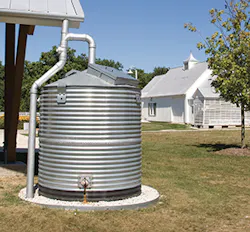
Industrial-size rain water collection container
Bigger Than a Barrel
Although rain barrels require minimal technical skill to implement effectively, they do require some level of commitment. To be most effective, they must be drawn down after each storm so they’re ready to capture water from the next one. Ruck says that although rain barrels are great in the spring, in August when insects may become a problem they require a little more attention. While there is no guarantee that rain barrel owners will make the best use of them, some programs such as the one in Santa Monica, CA, provide support for users. Santa Monica’s program requires recipients of rain barrel rebates to make a written commitment to operate and maintain their barrels for a specific period of time after installation. Surveys indicate that 85% of the people who bought the product were still using it.
Neal Shapiro, watershed and urban runoff coordinator for Santa Monica, says for the homeowner a rain barrel is often just a first introduction to the idea of harvesting precipitation for use. He says aside from making sure there is adequate funding—in Santa Monica’s case from a stormwater parcel fee—a few helpful questions should be asked when deciding how to structure a rain barrel program, such as “Do you want to give out rain barrels or make the customers buy them and install themselves?” Santa Monica opted for a more streamlined approach. “By offering a retail rebate program, we don’t have to pick out a vendor or organize distribution; the customer takes care of that. People apply for a rebate and buy the model of their choice,” says Shapiro. “They submit an online application stating that they intend to use and maintain it for at least three years. A general issue we have is when someone is selling their home or moving and wants to know what they should do with their old barrel. We collect them and find new homes for them.”
In addition to a robust homeowner rain barrel distribution program, Santa Monica has initiated some larger-scale rainwater harvesting projects. “Southern California has an ongoing and critical need for alternate water resources,” says Shapiro. Efforts include a project to install rainwater-fed flush toilets at a branch of the public library, a 55,000-gallon storage unit at Los Amigos storm drain to be used for park irrigation, and an offsite stormwater collection and harvesting system.
Although water is harvested from winter snows on the Sierra Nevada, Shapiro says, “It’s just not sustainable to continue intensifying the use of imported water. You’re taking water from other regions. Rainwater harvesting is a way to reduce our dependence on imported water. In California, if you can use local water you can avoid the huge expense of pumping large volumes of water over the mountains.” Harvesting local water for use becomes even more sensible when factoring in not just the infrastructure and operating costs of importing water, but also the tremendous energy expenditure and the attendant greenhouse gas emissions generated by the pumps. Sourcing water locally mitigates environmental harm on a broader scale.
Santa Monica has set a goal of water self-sufficiency by 2020, and Shapiro is at the center of that effort. He observes that although there are distinctions between stormwater and rainwater, the dividing line is somewhat arbitrary and might serve to confuse matters and place practitioners in silos isolated from counterparts doing closely related work. For instance, the American Rainwater Catchment Systems Association takes the position that what lands on a roof and is collected before it reaches the ground is rainwater, and what lands on grade is classified as stormwater. While Shapiro concedes that roofs can generally be expected to be cleaner than impervious surfaces on grade, such as roads, he says there are exceptions, such as old decaying rooftops and rooftops used for parking. He believes more precise language would help make regulations and implementation projects uniform, clear, and comprehensible, and that clear and consistent terminology would encourage rather than discourage people from getting involved.
“The definition that I promote is what lands on your parcel and stays there is your water—rainwater. If it leaves your property, it is stormwater,” says Shapiro. For the municipality, “The more you keep on people’s property, the less you have to deal with and treat.”
He also says there are two kinds of water harvesting, but they should perhaps be given a more equal footing. “One is collecting precipitation for indirect passive use, like a rain garden, and the other type is a more direct or active mode—putting it in storage unit for potable or non-potable uses later on.”
Codifying Challenges
Another challenge facing the market for rainwater harvesting is plumbing codes and tradespeople’s lack of familiarity with newly developed water harvesting technologies.
According to Shapiro, some municipalities are not familiar with dual plumbing systems and the installation of dual plumbing and treatment systems for using rainwater. “It’s a challenge for traditional building inspectors to accept them. They say, ‘Show us an example where it’s working,’ and because it’s new, it’s hard to find examples. And when you do find one, the inspectors are quick to point out why that situation is an exception, such as a different climate. But our city wants to be a leader in this.”
Henry Graumlich, manager of strategic planning for the Municipal Water District in Thousand Oaks, CA, says his region gets 15 inches of rain per year, but that it comes in brief bursts and varies so dramatically from year to year that on a practical level, “You never really get an average year. Some years there is lots of rain, and then there can be a couple of years in a row when there is very little rain.”
In this climate, he says, the frequency with which contaminants mobilize is very variable, as is their concentration. “So it’s very different from Ohio, where rainfall is distributed more evenly throughout the year and there is less variability from year to year.”
Furthermore, he notes, California has just emerged from a five-year drought. On the positive side, the drought has inspired indoor conservation efforts, resulting in greater water efficiency and new initiatives, including water reuse and efficient fixtures and appliances. This has brought about a 30% reduction in wastewater flows. “It’s not expected that these wastewater flows are going back up, and as low-flow fixtures become a part of mandated plumbing code, we’ll probably see flows that go down even further,” he says. In addition, new technologies will continue the trend toward lowering the wastewater volume that reaches the treatment plant.
However, that means there is unused capacity at treatment plants, and as the flows have decreased, the concentration of contaminants in those flows has increased. It’s ironic, he says, but he thinks it’s time to consider intentionally mixing stormwater with wastewater. This, of course, is contrary to the practice of trying to keep stormwater out of the sewer system in places prone to combined sewer overflows. He says managed rainwater harvesting presents an opportunity for wastewater agencies to work with stormwater agencies for the introduction of stormwater into wastewater collection and treatment systems. This, he says, could help accomplish a series of goals. It could keep treatment plants running at capacity, it could reduce the concentration of problematic contaminants in effluent, and it could significantly reduce the salt concentration in recycled water.
The goal would be to impound stormwater in a distributed fashion throughout a watershed. Following a storm event, the water could be tested to ensure it wouldn’t disrupt the wastewater treatment process and then could be introduced slowly into the wastewater system, thereby improving the quality of the wastewater effluent and the quality of the resulting recycled water that would be distributed as a product at the other end.
According to Graumlich, the most common deficiency of recycled water is high salt concentrations that limit its use for landscape irrigation and other sensitive uses. The addition of rainwater, which is relatively free of salts, to the recycled water production cycle would result in reduced sodium concentrations, making it a more attractive product. Since recycled water is a commodity that is metered and sold, Graumlich maintains that a program to mix rainwater with wastewater could create “a cash nexus to work out between the wastewater and stormwater agency to pay for projects.”
There are issues to overcome, however. For instance, drinking water systems and wastewater systems have a long history of regulation and water-quality standards. “With stormwater, we’re in the relative infancy of managing quality. Since stormwater is not confined to a pipe but is spread across the landscape, it’s coming from diverse areas, and water-quality issues come to the fore as it is discharged from one body of water to another. That would be a concern for wastewater agencies having flows introduced into their systems.”
Harvested Rainwater Top to Bottom
Eddie Van Giesen, national sales manager for Watts Water Technologies, believes in the fit-for-purpose design concept. From an engineering perspective, he says, whether water lands on the roof or on the pavement, “It’s all stormwater, but we decided to make a distinction between water on roofs and water at grade. The distinction is important because those areas at grade are more likely to have contaminants than the roof.” Nonetheless, he says, “It’s not so much the presence of pollutants but the concentration of these things that matters.”
He said building codes in Georgia, where Watts Water is headquartered, are gradually coming of age in the sphere of rainwater harvesting. “When I worked there, there was nothing in the plumbing code that allowed you to do it. Now you can do a rainwater system even for potable water.”
Drought, he says, was the motivation. “Atlanta was a large metro area with a reservoir that was not big enough.” He says when the drought came, there was a scramble to figure out what to do. “The state hashed out what would work in Georgia and eventually put together a manual” that encompassed rainwater harvesting, following in the footsteps of Hawaii and Texas, which had the first rainwater harvesting manuals. These included guidelines that, when referenced by code, give them the force of law.
“We started to see flush toilets using rainwater, then saw other non-potable uses, and finally rainwater was allowed even in the sacred envelope of the building,” says Van Giesen. “Most of the code is not prescriptive, telling people what they have to install, but rather it tells what the end quality needs to be.”
He adds, “Different people do different things to the water; you have to rely on the people designing the system.” He notes that parts sourced from unrelated vendors often don’t fit together or interface properly into a functioning system. Furthermore, it is a relatively new discipline, and contractors are often learning on the fly. “The key is documentation; know what you are doing and don’t piece the work out.”
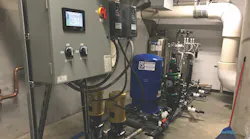
His company provides a top-to-bottom solution for rainwater harvesting, custom-designed for the client’s requirements. The components include a pre-filter, a storage device, and a skid-mounted filtration system. “There can be relative degrees of sophistication of 800 moving parts. We manage all of that. We have the ability to send this information to the building automation system informing engineers when the tank is empty and full, usage rates, chlorine levels, UV intensity, pH, and turbidity,” he says.
Most systems Watts Water designs for customers have a five- to 10-year return on investment. A recent project at the Rita Hollings Science Center at the College of Charleston in Charleston, SC, deployed a system with a 4,900-gallon rainwater capture tank in the basement as a component of the building’s HVAC system for sensitive laboratory ventilation. According to the engineer on the project, using harvested rainwater provided one of the best options to achieve the goal of isolating the laboratory, with its potential for generating hazardous outputs in its ventilation gases, from the public.
Harvested rainwater has many uses, and making optimal use of rainwater means finding the right partners. The challenge is getting people with different priorities to work together.
“Water suppliers have the least interest in stormwater when water is plentiful,” says Graumlich. The irony is that when rainfall is scarce, there is little that harvesting and storage can do to change the balance sheet.
Dana Nichols of SAWS believes harvesting rainfall is an important part of an overall water conservation strategy. “Conservation should always be seen as a water source, even where you think you have an apparent source of abundant water.