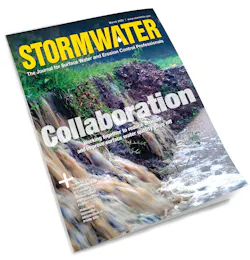
In the quest to preserve water quality and minimize erosion, creativity is often needed. Budgets are always limited and there’s always more to do—but how? In the stories we’ve brought you in this issue of Stormwater, companies, communities, and universities joined forces to share resources and find creative solutions to promote surface water quality, manage erosion, and protect communities.
In response to concerns that recent graduates faced a steep learning curve when they entered the workforce, Virginia Tech’s Land Development Design Initiative aims to expose students to real-world challenges and better prepare them to hit the ground running after graduation. In “Virginia Tech Expands Land Design and Development Program” (pg. 14), Virginia Tech educators discuss how the LDDI program addresses student and industry needs, and how industry sponsorships have helped the program extend its offerings to students.
For public departments, working with private interests to maintain stormwater infrastructure can be a challenge. Check out our Q&A (pg. 27) with Jason Schmidt, environmental specialist with the Bureau of Environmental Services in Portland, OR, who discusses how the Bureau provides education and technical assistance to property owners performing maintenance on their own stormwater infrastructure.
A massive fish die-off in Colorado’s Cache la Poudre River in 2018 was the impetus for a partnership between Colorado State University, Fort Collins, and In-Situ to better monitor water quality in the river. In “A Quality Collaboration” (pg. 18), city officials and university professors discuss plans to share data and engage the community to protect the river.
After the Holy Fire, Riverside County Flood Control and Water Conservation District played many roles in the post-fire response of the City of Lake Elsinore, CA. In “First Fire, Then Flood” (pg. 8), Rebekah Guill explains how in addition to working with first responders to update evacuation maps and perform community outreach, the District worked to protect the community from post-fire debris flows and designed and implemented a water quality monitoring study. The data the District gathered from the study will help it and other stakeholders protect water quality in the area.
When stakeholders work together, their impact can be so much greater than if each worked alone. Collaboration often results in unique ideas, detailed data, and shared responsibility for a project’s success—whether that project is the health of a river, the success of students, or the safety of a community. Send your stories of collaboration and cooperation to [email protected].
About the Author
Rachel Sim
Editor
As the editor of Stormwater magazine from June 2019 to December 2020, Rachel Sim created and curated quality content addressing the challenges faced by surface water and erosion control professionals, focusing on cutting-edge technology and the latest environmental research.