Green Education
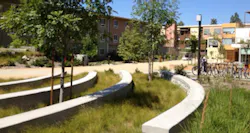
In 2001, Pitzer College in Claremont, Calif., reimagined its campus. The institution committed itself to expanding in an environmentally responsible fashion and proving that green blueprints could shrink carbon footprints. Its 2003 Housing Master Plan proposed new residence halls designed with both architectural flair and eco-friendly features. Phase 1 of the project, Atherton Hall, was so green it achieved LEED Gold certification.
For Phase II of the project—the construction of the Mosbacher/Gartrell Center for Media Experimentation and Activism—the school set its goals even higher: LEED Platinum certification. More than 40 sustainable features—including a green roof, solar panels, permeable concrete and a greywater system to collect and treat water to be used for irrigation—were incorporated into the design of the buildings.
Contech helped the college meet its goal by providing two storm water infiltration systems to capture runoff and store the water until it can be slowly released into the surrounding native soil, recharging the aquifer. Both systems use 60-in.-diameter galvanized, perforated CMP. The first system uses 197 lf of CMP to store 5,684 cu ft of runoff, while the second system uses 126 lf to store 9,400 cu ft of runoff. The two systems were enclosed in a nonwoven geotextile to prevent clogging of the perforations and backfilled with crushed limestone.
“This was beyond green design,” said Omar Maciel, engineer at Mia Lehrer and Associates. “There was no storm drain infrastructure on site; the underground detention was necessary for the project to move forward.”
Infiltration is a common low impact development (LID) practice. By utilizing subsurface infiltration, space is preserved for development, runoff is reduced or eliminated and groundwater recharge can occur. Contech CMP infiltration systems can be sized and shaped to meet site-specific needs, and they are available fully or partially perforated. CMP detention and infiltration systems are available in all AASHTO M 36 types, with various coatings to achieve 75 to 100 year design service life.
In 2012, Phase II of the project earned LEED Platinum certification from the U.S. Green Building Council.