Q&A: SwiftComply CEO on acquiring ComplianceGo and the future of stormwater compliance software
Pleasanton, California-based SwiftComply, a cloud-based compliance management platform, announced the acquisition of ComplianceGo on June 4, adding field inspection tools for commercial stormwater programs to its existing municipal compliance suite.
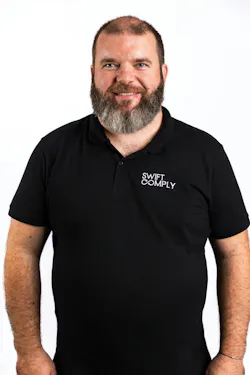
Integration of ComplianceGo will let municipalities and the contractors they regulate work from the same stormwater compliance data, Mick O'Dwyer, founder and CEO of SwiftComply told Stormwater Solutions.
The deal follows SwiftComply's 2025 acquisition of CloudCompli and brings the combined company's customer base to more than 700 customers across North America, a news release said.
O'Dwyer said CloudCompli was built around the municipal MS4 and permitting side, while ComplianceGo brings stronger field inspection tooling for the commercial side of stormwater programs. Combining the two, he said, lets contractors and the municipalities that regulate them pull from one recorded data set per site, rather than each side keeping its own. The aim, he said, is to cut down on the siloed, bad-quality data that comes from systems that don't talk to each other.
What does the ComplianceGo acquisition actually change for stormwater compliance teams? Stormwater Solutions asked O'Dwyer, along with what's ahead for ComplianceGo customers and what he thinks the industry has overlooked.
Q: What happens to ComplianceGo customers' data once the platforms are combined?
O'Dwyer: We're early in figuring that out from a technical perspective. From a vision perspective, we now have full life-cycle capability, so we can serve both the municipal and the field inspection, or commercial side, like a construction site or construction company. We connect both sides. The idea is that there's one site, one set of data recorded, and the contractors and the municipality can access the same data set for that site. In practice, that means an integration story.
We're not changing anything for the customers right now. We're currently doing deep-dive technical work on the actual process for connecting these systems and providing a better experience on both sides of the permit. Really, that's about removing data silos, consolidating around a single source of truth, and putting more tools in the hands of the customers. We want to help with data transparency and data quality around stormwater inspections in particular, and surface that for MS4 programs.
Today, a lot of it's reconciled by hand when the systems aren't connected. We believe the data, whether through an API or just one system, can connect both sides, anchored around the construction site.
Q: Where are your customers still using spreadsheets and manual processes?
O'Dwyer: A big part of the reason customers buy SwiftComply is to move off legacy tools. Often that's spreadsheets and paper forms. Some will have their own tooling, but the administrative burden gets passed along because of the way it's architected today. In most cases, there's unnecessary administrative burden because the systems aren't connected. My vision is to solve that by connecting the systems and having the technology do the work, whether that's automation, smart tooling, or a rules-based system, and making it accessible on either side of the permit. For a net-new customer, it's often coming from a manual, spreadsheet-based system, or it could be a work order system, or a GIS system.
Q: How many of your customers are managing MS4 permit renewals and PFAS source control requirements?
O'Dwyer: In total, we have about 700 to 750 customers, approximately. About 300 of those are what we call stormwater customers, and in addition we have approximately 150 MS4 programs. In that range. But with this acquisition we're now in 50 states, which brought us into the final four states we weren't in before. We're excited about that full U.S. coverage. We also serve the Canadian market.
I'm excited about the PFAS source control angle too, because we have an industrial pretreatment module. When an industrial discharger is connected to, or touches, a stormwater outfall, both programs can see that in one place. There are really interesting cross-module connections we can leverage there, and that's fully our intention with the product. It's another value add from the acquisition. Overall, about half of our customers are in the stormwater segment, but on the municipal side it's more like 35 percent for the program management side.
Q: What compliance programs would you say are still missing from the platform? You have backflow, pretreatment and stormwater.
O'Dwyer: Our product excels where there's a third party being regulated. That's field compliance or registry compliance programs that cities and municipalities run: restaurants for FOG, industrial pretreatment, construction sites for stormwater.
We do have some interesting crossover pieces. We talked about PFAS, and that's an interesting area. We also have things like dental amalgam compliance, which is a subset, almost a parent-child relationship with industrial pretreatment. Ultimately, we see it as regulatory compliance: a report going from the city or municipality to the EPA. We can generate that report more efficiently, reduce the administrative burden, and increase compliance. That's why we exist. Everything we do is anchored around those two goals, and that's how we measure our own success.
We have a path to keep adding modules within an overall connected platform, and I'm excited about that. Stormwater was a big leg of the platform as we thought about bringing water, wastewater and stormwater together, and we're building out in each of those directions.
Q: You come from an engineering background in wastewater. You built this to solve a problem you had yourself. What part of that problem still isn't solved?
O'Dwyer: I was a FOG program manager initially, and I built the FOG product first, then gradually expanded into backflow, industrial pretreatment and stormwater. I did some stormwater work way back when, as an early graduate engineer, so this is a bit of a full-circle moment for me. I was doing stormwater inspections back in the day.
It's not fully solved, for sure. I think we've come on leaps and bounds, and there are some good companies serving these customers. For various reasons, municipalities have been slow to adopt new technology, but that's changing. But technology itself is changing. If you look at what's happening in AI right now, the next phase is automating more of the steps, making the system smarter, improving the quality, and doing that in a sustainable way that serves the end user and customer safely and securely.
Right now we've got a strong foundation and good coverage in the market, but we still have work to do on the product side. We're constantly improving and innovating within the products. The area I'm most excited about is what I said at the start: working on both sides of the permit. I think that's a really interesting way to approach the problem, because companies often serve their customer without thinking about the downstream effects. But in compliance and regulation, the customer's customer is also impacted by the decisions we make in the product. To be a true platform, I wanted to solve that for all the users of our platform. I think that's the right thing to do.
Q: Is there anything about the stormwater side of the business we haven't covered that you think is worth mentioning?
O'Dwyer: I think stormwater inspection, and the software serving it, is a really interesting space that's been overlooked. There's a predictive analytics angle here that I think we should be leaning into as an industry. Software should be drafting and funneling inspections, flagging where stormwater discharges, creating corrective actions, and pre-populating annual reports, with humans involved in approving those. We've shipped our first tools in this space around automating forms.
My opinion is that MS4 programs don't need more data. They need the next action, and systems that make it easy to acquire that data and know what to do next. That's the top-level thing we're building toward. I always come back to the same idea: operating on both sides of the permit. I don't think anyone else is doing that, and I think it opens up more opportunities for better outcomes for everyone, and ultimately better compliance, so better environmental outcomes.
About the Author
 Sarah Kominek
Sarah Kominek
Head of Content, Stormwater Solutions
Sarah Kominek is the head of content for Stormwater Solutions at Endeavor Business Media, a division of EndeavorB2B. Kominek graduated from Wayne State University in with a Bachelor of Arts in Journalism and a minor in Communication with post-baccalaureate studies in biology. She has worked as a journalist for eight years covering the medical plastics industry and technology, plastics pollution and regulation, the automotive industry, public policy and community news.