Stormwater professionals urged to plan for PFAS, aging infrastructure and climate resilience
Key Highlights
- Stormwater professionals must adopt broader, proactive strategies to address PFAS, infrastructure aging and climate variability, emphasizing prevention and collaboration.
- Minnesota is implementing new regulations, permits and educational initiatives to reduce PFAS entry into the environment and manage stormwater more effectively.
- Aging stormwater infrastructure requires significant investment; Minnesota's projects aim to mitigate flooding, improve water quality and adapt to more intense weather events.
Stormwater professionals will need to take a broader, more proactive approach to water management as communities face PFAS contamination, aging infrastructure, more volatile weather and growing demands on water supplies, according to Katrina Kessler, commissioner of the Minnesota Pollution Control Agency (MPCA).
Speaking at the StormCon 2026 keynote, “Weathering the stormwater: Challenges and opportunities in 2026 and beyond,” Kessler outlined Minnesota’s efforts to address several challenges facing stormwater and water resource professionals, while emphasizing the importance of prevention, collaboration and long-term planning.
PFAS requires a comprehensive approach
Kessler described PFAS as a statewide challenge that extends well beyond drinking water. Minnesota is approaching the issue across air, wastewater, landfills and stormwater, with an emphasis on preventing PFAS from entering the environment in the first place.
The state has enacted restrictions on PFAS-containing products, including a 2020 ban on the use of aqueous film-forming foam for training and subsequent restrictions on PFAS in products and firefighting foam. Minnesota’s 2023 “Amara’s Law” establishes a phased approach that will eventually prohibit PFAS-containing products from sale in the state unless a currently unavoidable use exemption applies.
For stormwater professionals, Kessler highlighted new requirements in Minnesota’s industrial stormwater permit. The permit covers about 3,000 entities, with roughly 2,000 certified as having no exposure. Of the 41 industrial codes covered by the permit, MPCA identified 29 as likely to involve PFAS.
Facilities in those categories must collect four samples during the five-year permit term in areas where PFAS-containing activities or products are likely to occur. The permit establishes thresholds for six PFAS compounds. Facilities exceeding those thresholds must work with MPCA on a source reduction or treatment plan.
The agency is also preparing a new municipal separate storm sewer system (MS4) permit that will address potential PFAS sources. Kessler said the state has identified firefighting foam and pesticides as two areas where municipal operations are particularly likely to encounter PFAS.
Rather than immediately relying on regulation, Kessler said MPCA has emphasized education, technical assistance and source prevention.
“We're really focused on education, outreach and prevention at this point,” she said.

Aging infrastructure meets more intense weather
Kessler also pointed to the growing gap between the condition of stormwater infrastructure and the demands being placed on those systems.
She cited national estimates showing the average U.S. stormwater system is about 50 years old, while about half of stormwater utilities report significant infrastructure needs. The nationwide cost of addressing stormwater infrastructure needs was estimated at more than $115 billion in 2025, according to figures Kessler presented.
Minnesota faces similar challenges. The state’s 2026 project priority list includes more than $108 million in stormwater projects. Nearly 200 communities that responded to the state’s water infrastructure needs survey reported a need for stormwater replacement, while 126 have planned projects seeking funding for water quality or flood mitigation.
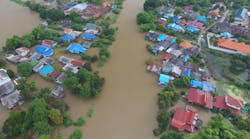
At the same time, Kessler said communities are experiencing more intense rainfall events alongside drought conditions.
“That’s a challenge that we’re all facing as the infrastructure continues to get older and the needs continue to compound,” she said.
Kessler encouraged communities to make the case for investment by highlighting the consequences of failing infrastructure, including flooding, backups and wet-weather overflows that can affect downstream communities.
Using climate data to improve stormwater planning
Kessler highlighted Minnesota’s partnership with the University of Minnesota to provide localized climate projections that can help communities design infrastructure for future conditions.
The Climate Adaptation Partnership produces dynamic, downscaled projections at approximately the 2.5-mile scale. Kessler said the information can help engineers determine appropriate design conditions for stormwater and wastewater infrastructure.
The goal, she said, is to avoid both undersizing and oversizing systems as communities plan for future rainfall patterns.
Minnesota is also developing resilience metrics to help communities measure progress toward climate goals. Kessler argued that plans are most useful when they are accompanied by measurable objectives that can support implementation and funding decisions.
She pointed to a state climate adaptation cost study that estimated Minnesota could face $18 billion in annual costs by 2050 and $100 billion annually by the end of the century if greenhouse gas emissions remain on their current trajectory and the state does not increase investments in climate adaptation.
The study also found that every dollar invested in climate resilience could generate $8 to $10 in savings, according to Kessler.
Grants support local flood mitigation
Minnesota has attempted to turn those planning principles into projects through state funding.
A $100 million grant program established following the state’s 2023 climate investments has supported planning, GIS improvements, modeling, capital projects and other resilience efforts. Kessler said MPCA has funded 151 projects using $95 million of the available funding.
Projects have included flood mitigation, stormwater infrastructure, water storage and green infrastructure.
In Austin, Minnesota, a $78,000 MPCA grant was combined with other funding to implement a long-term flood mitigation plan that included berms in agricultural areas upstream of the city.
In Minneapolis, flood mapping and assessment work helped prepare the city for funding that supported large underground stormwater storage facilities beneath streets in the Cleveland neighborhood.
In Moorhead, Minnesota, GIS analysis helped identify locations for green and gray infrastructure and community green spaces. The resulting project is designed to benefit 90 homes, five university buildings and several intersections.
Kessler emphasized that communities should have plans and data ready before funding opportunities become available.
Reuse connects stormwater, wastewater and water supply
Kessler also encouraged stormwater professionals to look beyond conventional boundaries between stormwater, wastewater and drinking water.
Water reuse, she said, can help communities manage both drought and flooding while protecting water supplies and aquifers. Minnesota’s MS4 permit allows permittees to use reuse projects to help meet water quality requirements, including by capturing and treating nutrients rather than discharging them downstream.
Examples presented during the keynote included 10 reuse projects in Hugo, Minnesota, that have saved as much as 14 million gallons annually for irrigation, along with reuse systems at sports facilities and a system serving three neighborhoods in Waconia.
Kessler said reuse can also help communities address stormwater and water-supply challenges associated with new development.
Data centers create new water planning opportunities
One emerging issue Kessler highlighted was the rapid growth of hyperscale data centers and their potential impacts on water and energy infrastructure.
Minnesota has seen proposals for roughly 20 hyperscale data centers, she said, although only one had reached the MPCA preliminary permitting process at the time of the keynote.
Kessler encouraged communities to approach data center development as an opportunity to address existing infrastructure needs rather than simply accommodate new demand.
Potential approaches include incorporating water reuse systems, requiring closed-loop cooling and using development negotiations to advance local water infrastructure improvements.
She also encouraged local officials to consider their existing capital improvement plans and identify projects that could be incorporated into agreements with developers.
“If you represent a community as a consultant, or as a public works official, or you represent the economic development part of the community, think about your capital asset management plan,” Kessler said. “What's on your plan for the next five to 10 years? And is there a way to ask for those things?”
For stormwater professionals, Kessler’s message was ultimately one of integration: PFAS prevention, infrastructure replacement, climate adaptation, flood mitigation, water reuse and new development should not be treated as separate challenges.
The communities best positioned to respond, she suggested, will be those that combine long-term planning with measurable goals, strong partnerships and a willingness to identify opportunities before infrastructure needs become emergencies.
About the Author

Alex Cossin
Associate Editor
Alex Cossin is the associate editor for Waterworld Magazine, Wastewater Digest and Stormwater Solutions, which compose the Endeavor Business Media Water Group. Cossin graduated from Kent State University in 2018 with a Bachelor of Science in Journalism. Cossin can be reached at [email protected].