When the pipes can't keep up: What a New York flood reveals about aging infrastructure
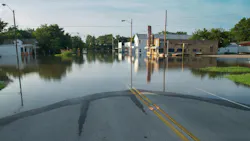
On July 29, 2026, communities across New York's Capital Region and Hudson Valley woke up to something far beyond an ordinary summer storm. Historic rainfall inundated portions of eastern New York, flooding homes, washing out roads, overwhelming drainage systems and forcing emergency responses across multiple counties. In the town of Schodack in Rensselaer County, rainfall totals exceeded nine inches in some locations. Castleton-on-Hudson, a small Hudson River village within Schodack, found itself directly in the path of the flooding. The event should be viewed as more than another extreme storm.
For small municipalities across upstate New York, it is a warning about what happens when increasingly intense runoff meets stormwater infrastructure that may have been installed generations ago.
A storm that overwhelmed communities
The July 29 storm delivered rainfall at extraordinary intensity. The Times Union reported rainfall totals approaching 10 inches in portions of eastern New York, with rainfall rates reaching approximately one to two inches per hour during the morning. Homes flooded, motorists became stranded, roads washed out and storm sewers overflowed.
Schodack was among the hardest-hit communities. More than seven inches had already been recorded there by approximately 6:40 a.m., and later reports indicated totals exceeding nine inches. By the afternoon, Muitzeskill Road, Schodack Landing Road, Van Hoesen Road and Schodack-Nassau Road were among the roads closed in the town.
Nearby Castleton-on-Hudson faced its own emergency. Residents along Main Street were advised to seek alternate plans as flooding continued, while a local shelter was opened for residents and evacuees from Schodack Island State Park. A property along Route 9J near the convergence of the Muitzes Kill and Schodack Creek was photographed underwater.
These are not simply drainage complaints. They represent disruptions to transportation, public safety, homes, businesses, utilities and emergency response. And while virtually no municipal stormwater network can economically be designed to eliminate flooding from every extreme rainfall event, storms of this magnitude expose weaknesses that may remain hidden during ordinary conditions.
The infrastructure beneath our feet
One of the challenges facing older communities throughout New York is that much of their infrastructure was constructed for another era. In historic villages and towns, buried drainage networks may include older clay or terra-cotta pipe, masonry structures, undersized culverts, aging catch basins and systems that have been repaired or extended incrementally over many decades.
Some infrastructure may still perform remarkably well. Other components may be cracked, separated, obstructed by sediment, invaded by roots, partially collapsed or simply too small for the runoff now reaching them. The problem is not necessarily that clay pipes are inherently incapable of carrying stormwater. Many sections of old pipe remain functional after decades underground. The concern is the condition, capacity and connectivity of the system.
A pipe can appear functional during a routine rainfall while having substantially reduced hydraulic capacity because of sediment accumulation, displaced joints or root intrusion. A culvert designed decades ago may remain structurally intact but no longer have sufficient capacity for the drainage area contributing to it.
Development adds impervious surfaces. Roads expand. Parking areas increase. Roof runoff becomes concentrated. Drainage patterns change. Then an event like July 29 arrives. Water finds every restriction.
Castleton and Schodack are not alone
Castleton-on-Hudson and Schodack provide a useful case study because they represent the type of community found throughout upstate New York: established neighborhoods, historic roads, streams and tributaries, older infrastructure and municipal budgets that must cover an enormous range of public needs.
Both communities already recognize stormwater as an important responsibility. Schodack is a New York State Department of Environmental Conservation-designated Municipal Separate Storm Sewer System operator, or MS4, and maintains a stormwater management program. Castleton-on-Hudson similarly provides stormwater information and operates within MS4 requirements as a Hudson River waterfront community. Rensselaer County has also been updating its Hazard Mitigation Plan, specifically identifying flooding among the hazards communities must prepare for.
The issue, therefore, is not a lack of concern. The challenge is turning stormwater compliance and emergency response into long-term infrastructure resilience. Small municipalities cannot simply replace every pipe beneath every street. They need to know where failure is most likely, what happens when it occurs and which improvements provide the greatest reduction in risk per dollar invested.
Start with assessment, not replacement
The response to an extreme storm should not automatically be miles of new pipe. It should begin with information. Municipalities should use events like July 29 as real-world stress tests. Every flooded intersection, surcharged catch basin, washed-out shoulder, overflowing culvert and eroded channel provides information about how the watershed behaves when the drainage system reaches or exceeds capacity. The first priority should be comprehensive stormwater infrastructure assessment and mapping.
Existing records can be compared with field observations. Catch basins and manholes can be inspected. Pipe networks can be evaluated with CCTV equipment. Culverts can be measured and condition-rated. Outfalls can be located and documented. Sediment accumulation, structural deterioration, root intrusion and pipe separation can be identified.
Modern survey and GIS technology can then connect those individual assets into an understandable drainage network. That is particularly important in older communities where knowledge of the system may be scattered across historical plans, municipal employees, highway departments and institutional memory. You cannot effectively manage infrastructure you cannot see. And you cannot prioritize investment without understanding how the pieces connect.
Follow the water
Stormwater management must also extend beyond the pipe. Every stormwater system begins with a watershed. Water travels downhill regardless of municipal boundaries, property lines or road ownership. When runoff reaches a catch basin, that inlet is merely one component of a much larger conveyance system.
Communities should evaluate the entire drainage path: upland runoff, roadside drainage, catch basins, pipes, culverts, open channels, streams, detention areas and eventual receiving waters. In some locations, replacing an undersized pipe may be the answer. Elsewhere, the better investment may be increasing upstream storage, restoring a floodplain, creating a detention area, improving an open channel, replacing a culvert, stabilizing an eroding outfall or using green infrastructure to reduce peak runoff before it reaches an aging pipe network.
The strongest stormwater programs are solution-agnostic. The objective is not to install more concrete, more pipe or more green infrastructure. The objective is to manage water.
Maintenance is infrastructure investment
Some of the most cost-effective improvements may already exist underground. A pipe operating at 60 percent of its intended capacity because of sediment or debris does not necessarily need replacement. It may need cleaning. A clogged inlet does not need redesign. It needs maintenance. An eroded outfall may require stabilization before the erosion undermines the pipe and creates a much larger structural repair. Municipalities should establish repeatable inspection and maintenance programs around known problem areas, particularly before and after major rainfall events.
That means moving from reactive maintenance, responding when residents call about flooding, toward preventative stormwater asset management. Small problems are almost always cheaper to address before they become emergencies.
The funding opportunity
The encouraging news is that New York is investing heavily in water infrastructure. In June 2026, the state announced $425 million in grant funding to help municipalities modernize water and sewer infrastructure as part of a broader $3.75 billion commitment in the enacted state budget.
The DEC also announced more than $78 million in funding through the Water Quality Improvement Project program and the Non-Agricultural Nonpoint Source and MS4 Planning Grant program.
The program includes projects supporting water quality, flood-risk reduction and climate resilience. Planning assistance matters just as much.
New York's Environmental Facilities Corporation offers engineering planning grants designed to help communities develop the engineering reports necessary to advance infrastructure projects and pursue Clean Water State Revolving Fund financing. EFC's Community Assistance Teams are specifically available to help municipalities, including small, rural and disadvantaged communities, navigate infrastructure funding.
For communities with limited staff, that assistance can make the difference between knowing a problem exists and developing a fundable project to solve it.
From emergency response to resilience
The aftermath of July 29 will require cleanup, repair and recovery. But eventually the water will recede. Roads will reopen. Debris will be removed. That is when the most important work begins. Municipalities across Rensselaer County and throughout upstate New York should document exactly what failed, what overflowed and where water traveled during this storm.
Inspect the infrastructure. Map the system. CCTV older pipes. Evaluate culvert capacity. Document sediment and obstruction. Identify recurring flooding areas. Evaluate upstream detention and downstream conveyance. Then rank improvements according to public safety, structural condition, hydraulic capacity, environmental impact and consequence of failure.
The goal should not be to design a community where flooding can never occur. Extreme weather will always test infrastructure. The goal is to know the system well enough so that its vulnerabilities are understood before the next storm exposes them.
A wake-up call for small communities
Castleton-on-Hudson and Schodack are small communities compared with the major metropolitan areas that dominate infrastructure discussions. But that is precisely why this storm matters. Across America, thousands of towns and villages maintain infrastructure inherited from previous generations while facing modern development, limited budgets and changing rainfall patterns. Underneath some of those streets are systems whose exact condition may not be fully known until something goes wrong.
July 29 demonstrated the consequences when extraordinary rainfall exceeds the capacity of both natural and constructed drainage systems. Now there is an opportunity to turn that event into action.
Stormwater infrastructure rarely receives attention when it is working. Pipes remain underground. Culverts quietly convey water. Catch basins collect runoff. Residents drive over infrastructure they may never know exists, until the water has nowhere to go.
For Castleton-on-Hudson, Schodack and similar communities throughout upstate New York, resilience begins by understanding what is underground, understanding the watershed above it and developing a realistic plan to connect maintenance, rehabilitation, replacement and funding. The next major storm should not be the next infrastructure assessment. The assessment needs to begin now.
About the Author
Joseph Garavelli
Joseph Garavelli is the founder and senior environmental consultant at EcoTactics, specializing in erosion control, stormwater systems, and water quality solutions throughout South Carolina. He also provides consulting support for Ecological Improvements on environmental and infrastructure-related projects.