Protecting groundwater chemistry as communities expand water reuse
As communities across the U.S. expand stormwater capture and recycled water use to strengthen drought resilience, a key challenge lies underground: how recycled water interacts with the natural chemistry of aquifers. A proactive, phased geochemical characterization approach can help utilities understand and manage those risks before they become problems.
Managed aquifer recharge (MAR) is a proven strategy for replenishing groundwater supplies by injecting highly treated recycled water into aquifers. While MAR delivers major benefits, it can also trigger unintended geochemical reactions that affect water quality or damage infrastructure. By combining mineralogical analysis, targeted laboratory testing, and advanced geochemical modeling, utilities can anticipate these reactions and design smarter pretreatment strategies.
Methods used across multiple projects demonstrate how collecting the right geochemical data at key stages of a project can reduce costs, streamline permitting, and protect long-term water quality. The result: a practical, science-driven approach that could help other communities safely turn recycled water into a reliable, sustainable groundwater resource.
Managed aquifer recharge approach
For stormwater managers, MAR offers a pathway to put captured runoff to work, delivering benefits including aquifer replenishment, drought resiliency, combating saltwater intrusion, and subsidence relief. However, introducing stormwater or treated recycled water into aquifers or the vadose zone can also lead to adverse geochemical reactions, such as mineral dissolution, oxidation, or desorption, that result in the mobilization of inorganic constituents, that is, arsenic, fluoride, iron, manganese, selenium, and uranium. These reactions can create operational challenges, including mineral precipitation within the aquifer, scaling in the well screen and pumping equipment, and degradation of groundwater quality.
The MAR industry has focused on controlling the oxidation of mineral phases, such as arsenic-bearing sulfides, to manage geochemical reactions by lowering the oxidation-reduction potential (ORP) of the conditioned recycled water. However, other geochemical reactions can mobilize arsenic and other metals that are not mitigated by reducing ORP. Desorption processes are controlled by several geochemical processes including ionic strength, pH, redox, mineralogy, such as illite, kaolinite and montmorillonite, competing ions, or microbial processes. Selecting and employing the appropriate treatment approach requires a detailed understanding of the target aquifer's geochemical conditions.
Geochemical characterization programs
There are several opportunities to collect the geochemical data necessary to evaluate the potential for geochemical reactions during the various phases of a MAR project, often with minimal additional cost. Planning data collection at different steps and using a phased approach can optimize geochemical characterization and leverage knowledge gained at each phase to improve cost effectiveness. A multidisciplinary team of geologists, hydrologists, geochemists, and water treatment engineers is needed to develop a comprehensive, site-specific characterization workplan that ensures the collection of data necessary to support impact assessment, permitting, and design. MAR geochemical characterization programs can utilize data collected during well installation, hydrologic testing, and geochemical laboratory analysis to identify the mineralogical composition and mobilization potential of vadose zone and aquifer materials.
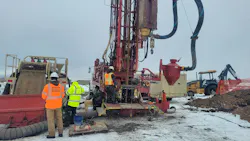
Sample and data collection for geochemical characterization does not need to be a separate effort from other MAR project activities. Samples for geochemical analysis can be collected from test pits or surficial borings for infiltration galleries. Drilling for the installation of monitoring or test wells can also provide materials for geochemical testing. Drilling methods often use fluids, such as potable water or compressed air, that may not be in equilibrium with suboxic aquifer conditions and could affect samples' geochemistry. However, these impacts can be minimized through careful planning and sample preservation.
Mineralogy analysis
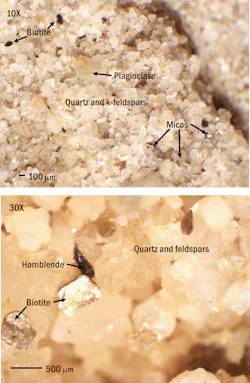
Once site-specific samples have been collected, identifying the mineral phases present is critical to identifying potential reactions and optimizing water treatment design. Mineralogy informs geochemical characterization by identifying which mineral phases host constituents, the geochemical reaction mechanisms, and methods to mitigate potential mobilization. Some mineral phases, such as silicates, are unlikely to react with treated recharge water. Other mineral phases, such as fine-grained clay minerals, iron- and manganese-hydroxides, and organic matter, may be sources of mobilized constituents.
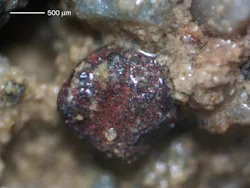
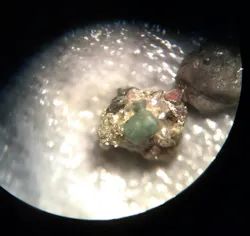
Mineral phases are evaluated using visual observations, X-ray diffraction (XRD), and scanning electron microscopy with energy dispersive spectroscopy (SEM-EDS). Each method has a unique purpose and analytical limitations. Visual observations can be used to estimate the bulk percentages, grain-size, habit, and texture to assess reactivity potential. For example, sulfide mineral texture can affect the reactive surface area, as individual grains with greater exposed surfaces may be more reactive than sulfides forming cementing around other rock fragments.
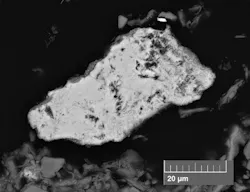
Visual mineralogy can also document evidence of the redox state of the aquifer, as shown by the presence of iron-oxide mineral phases. However, visual mineralogy is limited to minerals large enough to observe under magnification. Fine-grained minerals require additional methods, such as XRD and SEM-EDS. XRD provides bulk semi-quantitative mineral phase percentages regardless of grain size but does not provide much information on mineral chemical composition or absorbed constituents. SEM-EDS can generate images of fine-grained minerals or chemical maps to identify constituent sources; however, it may be too costly for routine bulk mineralogical analysis.
Mineralogical modeling software can supplement analytical mineralogy data and address gaps in the analytical techniques. Modeling estimates theoretical mineral percentages using mass-balance calculations based on laboratory whole-rock chemical compositions and can be used to verify visual observations and laboratory results.
Laboratory soil leaching analysis
Laboratory soil leaching analyses provide critical information for the site characterization process and important considerations related to water treatment methods to mitigate constituent mobilization. The soil leaching analysis can identify which constituents could mobilize when recharge water reacts with aquifer and vadose zone materials.
EPA Method 1312 is the synthetic precipitation leaching procedure (SPLP), a standard laboratory batch test to evaluate the mobility of constituents for soil. The method uses a 20:1 solution-to-mass ratio to extract readily dissolvable solid phases that can dilute constituents below the analytical detection limit. For MAR geochemical characterization, a modified SPLP using recharge water and a 4:1 solution-to-solids ratio can identify potential mobile constituents without diluting concentrations below the detection limits. Multiple rounds of modified SPLP tests can assess several different chemical conditions of the recharge water, that is, pH, calcium concentration, alkalinity and redox, to identify the most effective post-treatment conditioning protocol for mitigating geochemical mobilization. Additionally, the soil leaching analysis can evaluate an operational range for water treatment and the cost-effectiveness of different treatment chemicals. The modified SPLP laboratory test is a quick and cost-effective way to collect site-specific data to inform water treatment design and the feasibility of the MAR project.
In-situ geochemical analysis
In-situ geochemical analyses assess the potential for geochemical reactions by introducing water of differing chemical composition into the ambient aquifer or vadose zone. Site-specific hydrologic characterization can include pumping water into a test well or infiltration basin to evaluate the hydraulic properties of the injection or infiltration zone. The hydrologic testing can be combined with in-situ geochemical testing to maximize data collection with minimal additional cost.
Recharge water that is not in chemical equilibrium with the in-situ groundwater chemistry and the mineral phases in the aquifer matrix result in a "dress rehearsal" for full-scale operations. Potential geochemical reactions in the immediate vicinity of the test well or infiltration basin can be observed and managed before water treatment designs are finalized or significant funds have been spent on MAR infrastructure.

Recharge water used during an in-situ geochemical test can be captured stormwater, water from a pilot water treatment facility, or commercially available potable water. The geochemical response can be observed by either pumping out the recharged water after a set time or sampling the "bubble" of recharge water as it moves downgradient. Samples collected soon after recharge represent geochemical reactions between aquifer mineralogy and recharge water, whereas later samples reflect geochemical reactions among recharge water, mineralogy, and ambient groundwater. Analysis of a range of constituents, including conservative major ions such as chloride, can also provide semi-qualitative observations into hydrogeology. Post-test water chemistry trends can also indicate reaction rates if monitoring continues until concentrations return to pre-test conditions.
Geochemical modeling
Geochemical modeling is then used to simulate reactions that may occur from interactions among ambient groundwater, recharge water, and minerals. Laboratory data for recharge and groundwater, along with a single compiled set of estimated mineral abundances from all mineralogy datasets, are used as geochemical model inputs. Comparing modeled water chemistry with measured water chemistry from the laboratory soil leaching or in-situ geochemical analysis allows evaluation of model accuracy in predicting geochemical reactions. Modeling results can indicate both the tendency of minerals to release constituents and the potential for mineral precipitation. Precipitation of minerals in pore spaces can cause aquifer and well filter pack clogging, thus reducing permeability and injection rates.
Applying MAR program learnings
This geochemical characterization methodology has been applied successfully at multiple project sites in Arizona, California, Colorado and Idaho across a range of MAR objectives, including seawater intrusion prevention, groundwater supply augmentation, and increased climate resilience. The results demonstrate that site-specific characterization is a key component in assessing MAR feasibility, informing design, and achieving a utility's goals. Evaluating the potential for constituent mobilization and identifying mechanisms to reduce it provides critical information for designing water treatment systems and, ultimately, for safely turning recycled water into a reliable, sustainable groundwater resource.
About the Author
 Kelly Donahue
Kelly Donahue
Kelly Donahue is the Geosciences National Specialty Lead at Brown and Caldwell. She brings more than 20 years of experience as a geochemist. Her work spans a wide range of aqueous geochemistry projects, including impact assessments, baseline studies, feasibility studies, and water supply development.