Fort Drum Rehabilitates Four Large Road-Supporting Parallel Pipes
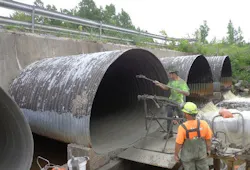
Fort Drum, N.Y., a 25.4-sq-mile U.S. military reservation and census-designated place, includes several towns. Aging infrastructure supporting military and residential activities requires ongoing maintenance and rehabilitation projects. A recent project focused on four, large parallel 142-by-91-in. arched corrugated metal pipes supporting a roadway over a trout stream with a separation of 3 ft between each barrel for a total span of 56.3 ft.
The project had to meet the existing structure’s military loading classification (MLC) for wheeled and tracked vehicle traffic. The existing buried bridge structure was classified for wheeled traffic of 41 tons for one-direction traffic and 27 tons for two-direction traffic; for tracked vehicles, it was classified as 37 tons for one-direction traffic and 25 tons for two-direction traffic.
Two other complications applied. The buried bridge is set in the Black River, a recognized trout stream, and the military roadway needed to stay open. The structure could not be torn out and replaced, and river diversions had to be limited and carefully managed.
CentriPipe, a centrifugally cast concrete pipe solution, was selected and designed for the key arc elements. The design and the material ensured a structurally sound, watertight, rehabilitated buried bridge structure that meets the MLC.
Following dewatering and pipe preparation, the CentriPipe spincaster was pulled through each pipe a total of nine passes to spray thin layers of Permacast PL-8000, a fine aggregate composite concrete distributed by AP/M Permaform and used with the CentriPipe process. The total thickness applied to each pipe was a little more than 2 in. over the corrugations, resulting in smoothly finished rehabilitated concrete arch pipes that look brand new. Rehabilitation of all four pipes, plus the installation of a specified fish ladder, also made with PL-8000, was completed in a month and a half.