Prescribed Burns Likely Protect Forests

Across the western US, fires are becoming more common as the climate warms and forests and scrublands are crowded with vegetation after years of fire exclusion. After the fire, debris flows and post-fire water quality impacts can have serious, long-term consequences for downslope communities that escape fires unburned. Preventing and minimizing the severity of wildfires is the first step to protecting water quality and minimizing post-fire erosion and debris flows. New research from the University of Washington and the US Forest Service suggests prescribed burns in Washington lessened the impacts of a large fire in 2014.
In just one day, the flames of the 2014 Carlton Complex wildfire in Washington spread over 160,000 acres of forest and rangeland. The megafire, which ultimately burned more than 250,000 acres in a particularly hot, dry summer, was the largest contiguous fire in the state's history. Driven by strong winds and explosive growth, it destroyed more than 300 homes in Washington's Methow Valley.
In the first major study following the devastating Carlton Complex fire, researchers from the University of Washington and US Forest Service found that previous tree thinning and prescribed burns helped forests survive the fire. The study, published February 22 in the journal Ecological Applications, shows that even in extreme wildfires, reducing built-up fuels such as small trees and shrubs pays off.
"Our study suggests that the fuel treatments were worth the investment, yielding a more desirable post-fire outcome than if they hadn't been implemented," said lead author Susan Prichard, a research scientist at the UW School of Environmental and Forest Sciences. "There are a lot of benefits to creating more resilient landscapes, and this study suggests that even in the worst-case scenario wildfires, it can be worth it."
On July 17, 2014, sustained winds of 35 miles per hour raced through the Methow Valley, blasting oxygen into several fires that had started earlier that week. Before long, the fires joined and spread. A column of smoke stretched 30,000 feet high, dropping embers and igniting dry grasses, trees, and other fuels on the ground over thousands of acres. Propelled by the fast-moving column of smoke and wind, the flames traveled all the way to the Columbia River.
"It was the kind of fire that even experts who have studied them for decades had not seen before," said Prichard, who lives in the Methow Valley. "It was a devastating fire for our community. I truly thought people would be killed by that fire, and it still feels miraculous that everyone survived."
In the aftermath, Prichard and collaborators wondered if actions such as controlled burns and thinning were helpful in the case of a megafire like the Carlton Complex. State and federal agencies sink ample resources into these efforts to increase the resiliency of forests to wildfires by removing small- and medium-sized trees, leaving larger, mature trees that are more likely to survive future drought and wildfires.
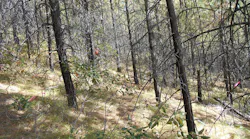
After a forest is thinned, prescribed burning is used to reduce leftover woody debris on logging sites or across landscapes that have built up downed trees, pine needles, grasses, and shrubs.
The Carlton Complex fire burned across hundreds of sites that were previously thinned or burned, offering a testbed for the researchers to analyze whether the work helped reduce fire impacts in those areas during the megafire. The researchers used satellite images of burn severity to examine how past fuel treatments performed in the context of this extreme wildfire event.
They found that even during the first explosive days of the Carlton Complex, areas that were thinned and prescribed burned had more trees survive than areas that didn't receive those fuel treatments.
"Some of the treatments measurably reduced fire impacts even under very hot, dry, and windy conditions," said co-author David W. Peterson, a research scientist at US Forest Service Wenatchee Forestry Sciences Lab. "Our results suggest that as we increase our 'restoration footprint'—the proportion of forest area treated to reduce fuels—forests may become increasingly resilient to wildfires under a broad range of conditions."
They also found that thinning and burning on slopes that were protected from prevailing winds was more effective in reducing the wildfire's impacts on the landscape than similar treatments in areas directly exposed to the wind. Because winds often move through the Methow Valley in a predictable pattern, fire managers could thin and burn strategically in areas where these activities would be most effective.
Those efforts helped mature, naturally fire-resistant ponderosa pines survive. These mature trees, in turn, will provide seeds that produce younger trees across the landscape.
While this study focused on the Carlton Complex fire, its results have broader implications for forests around the world that are prone to wildfires. This work adds to the growing library of studies showing how thinning trees and controlled burns can reduce the severity of the next fire on the landscape.
"I'm hopeful our study will encourage policymakers as well as managers to invest in restoration," Prichard said. "It's our best hope for protecting our streams, rivers, and landscapes from catastrophic fires."