A Little Off the Top and Sides
Anyone who does much cross-country driving can appreciate how verdant hillsides and varied terrain can add a bit of spice to the journey. But aside from providing a convenient passage between Savannah, GA, and neighboring communities, the highway stretch known as I-516 had come to be known for two things: its monotony and its many outcroppings of dense stands of trees.
The highway, coursing over the coastal plain outside of Savannah, was completed during the mid-1980s, serving as a bypass to relieve traffic congestion in the city. Soon after its construction in this hospitable climate, however, lush vegetation took hold along the median strip and adjacent to the right of way, edging its way right up to the shoulder. Andrew Dial of Ground Cover Clearing and Final Grade LLC explains that the highway had never been mowed, and trees obstructed visibility from several freeway ramps. Local authorities had attributed a number of serious wrecks to blocked sight lines resulting from the vegetation.
In several instances, drivers are believed to have lost control of their vehicles and crashed into woods abutting the travel lanes. During tropical storm emergencies, numerous felled trees blocked the roadway, which is a major hurricane evacuation and re-entry route, thereby threatening both escape and recovery efforts.
Although local papers reported that many people familiar with the locale felt the wooded areas gave the stretch of road a park-like aesthetic appeal, the Georgia Department of Transportation determined that, for the sake of public safety, the trees had to go. They would need to be clear-cut, and measures would need to be taken to ensure uncontrolled vegetation would not reemerge.
Andrew Dial, who joined the project as a subcontractor, says that clearing the trees was not a typical clear-cutting project such as those familiar with the logging industry. The traditional way of clear-cutting a woodland, using hand saws and harvesting the resulting timber for market, would not have been practical for much of the acreage here. Although the trees ranged in size from saplings to massive hardwoods with trunks 40 inches or more in diameter, which could potentially be marketable, there were several constraints. Harvesting any potentially valuable timber would require not just felling the trees but also extracting them from the woods and moving them to market. The need to keep freeway traffic going would have made loading and securing timbers onto a carrier in many areas quite challenging. At any rate, the Department of Transportation’s goal was clear sight lines and removal of road hazards.
The timbers would have to be disposed of somehow. Dial says he’s faced a similar dilemma elsewhere in the state when the question has arisen of how to get rid of unwanted biomass from a necessary clear-cutting operation. In the Atlanta region, where he has performed numerous clear-cutting projects, it has become particularly difficult to dispose of unwanted timber. There, he notes, stringent air quality standards prohibit burning, and landfills are closing as well, reducing the options for getting rid of waste.
Onsite mulching, however, can satisfy multiple goals, and this is the method he chose to use on his section of the bypass vegetation control project.
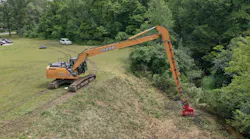
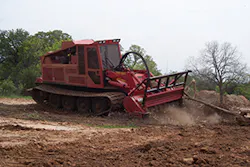
“Mulching gives the opportunity to get rid of vegetation, it doesn’t take space in a landfill, and it provides instant erosion control,” he says. “No permit is required to start clearing, because there is no going below grade.” He says when using a mulching method, clearing can begin while permits are still being sought for future phases of the project. Dial brought in a fleet of grinders and carriers to perform his section of the I-516 operation, with each of his key cutting machines outfitted with Denis Cimaf attachments.
Denis Cimaf manufactures mowing head attachments that can create customized solutions for any clear-cutting challenge. “The neat thing about it is the way it is engineered,” says Dial. “You’ve got a sharp edge compared to the carbide head that a lot of other manufacturers use. On other smooth drum rotors, the distance from the smooth surface to the tip of the tooth is seven to eight inches; on the Denis, it’s two inches. It’s not going to overbite into the tree, and that keeps your head turning and keeps your production up.”
Dial’s fleet of Denis Cimaf-equipped mowers includes a Caterpillar 323 carrier with a 161-HP motor split between the head and the carrier. The company also manufactures an optional power pack that can serve as dedicated power drive to the mulching head. “The heads plug straight in to the back of the hydraulics,” he notes. He says the company “sent down a technician from Denis Cimaf in Canada to make sure everything is going to work. They’ll train you in how to set it up and sharpen the teeth. That’s one of the most important services they can provide. They can help you problem-solve.”
Unlike the methods used by some of his colleagues in the industry, who need several pieces of gear to complete a cut-and-mulch procedure, he says, “We eliminate the need for a chipper. The carriers allow us to get into different areas. We can work in standing water where a hand crew would not be able to work. We can work extreme slopes.”
Dial believes that among the several subcontractors converged on the I-516 project in Savannah, each using a different method for clearing, “we’re outperforming all of them. We don’t get the number of callbacks that they do to fix erosion issues.”
The technology is also a labor saver. “It’s difficult to find people to do this kind of work. With Denis Cimaf, we can assign one man per machine,” he says.
“A 30-inch tree takes longer to grind up than an 8-inch tree, but you can take down any tree that you have time to grind. If we’re taking down a 40-inch tree, it could take 20 minutes.” But he said the result is a clear-cut covered with 10 to 12 inches of mulch, a highly effective hedge against erosion, and that same dense layer of mulch inhibits regrowth from stumps or remnants buried underneath.
Cutting a Shortcut Through the Woods
Mark Lee, owner and operator of ML Hydrocut, recently completed a project as a subcontractor for a four-lane bypass freeway around Greenville, NC. He does a fair amount of work in the Greenville area, and while working on projects in the coastal plain he frequently encounters environmentally sensitive areas. “When you go through wet areas, you need to use low-ground-pressure equipment,” he says.
The project started with a simple walk in the woods. “I was a subcontractor, and we went down and walked a lot of it. You’ve got to go into the woods. It’s flagged for clearing limits, and you go in there and walk it to determine what kind of terrain you have, what size trees, and the time you think it will take to mow it and mulch it. You come back and run your numbers and give them a price per acre. Once the job is done, you have your GPS and we can tell them exactly how many acres we cut.”
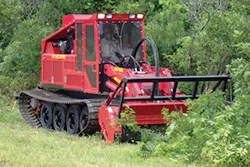
Not having the proper equipment can cause multiple problems. “It’s not like there’s a given set of rules on what to use. It’s like a mechanic working on a car, like tools in a toolbox. Where it’s very wet, you use something like an excavator with a mulching head or a low-ground-pressure tractor; you wouldn’t use the rubber tire machine, even though we have flotation tires. The rubber tires are for more high-ground, big production, high-horsepower type machines and large material. The Tigercat M822C we have is a high-horsepower machine—it’s like an excavator with a mulching head. It mulches trees from the top down. My mulchers include a Tigercat M726E and the Fecon FTX 250, a super-low-ground-pressure machine for going in real wet areas or a place you don’t want to disturb the ground—places where they don’t want the ground torn up, such as golf courses. There are a lot of low-lying areas in golf courses, particularly in the woods.”
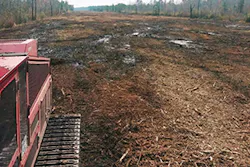
On the Greenville freeway project, he says, “They did not want to take the stumps out for the four-lane bypass. We mowed four miles 200 feet wide, and they were going to fill that with dirt in a 20-foot-deep field. They didn’t want to disturb any more than they had to; they didn’t want to go in there with bulldozers and excavators to get the stumps out and tear it all to pieces. They wanted it mulched up so that it was environmentally friendly without a lot of erosion problems.”
Near the Greenville Bypass
He notes, “It’s very hard to get permitting when you’re crossing these wet areas. We do power line right-of-way clearing. Power lines cross hills and swamps and creeks—they cross all kinds of terrain. Even though they come behind us and put in silt fence, we have very little erosion problem in any case because we’re leaving five or six inches of mulch everywhere on the ground.”
Lee says he deployed a variety of machines geared to the topography depending on how wet the various areas were and the size of the trees to be mulched. “We used the M726E with 44-inch-wide flotation tires. And we used the Fecon FTX 250 and the Cat dozer for smaller material, because it’s a low-ground-pressure machine. We had to mulch some of the larger trees from the top down. With trees 18 inches and up, we’d use the M822 to cut some of those. It’s not a given. They are just like tools in a toolbox; different tools work better in different applications.”
Lee believes having a wide range of tools at hand is an advantage in the land-clearing business. He says most companies probably start out with a larger machine and a smaller skid steer. “There are a lot of skid steers. They are more affordable, and I guess it’s easier for somebody to get into business with one of those. We’ve been doing this for 24 or 25 years.”
Mulching tractor
For the heavy jobs, he turns to the Tigercat M822 track machine, a purpose-built mulcher that he says “is kind of like an excavator, but it’s actually a feller buncher that cuts a tree down for logging. But they put a mulching head on it, and it’s custom-built to have the hydraulic horsepower to be able to mulch up a tree.”
To help the operators find their way through the woods, Lee says, “We have Trimble GPS on about half of our fleet. Each machine has a laptop so each driver can see where he is. You have a surveyor create your file, and that’s emailed and downloaded into the computer, and as they are cutting and driving they know exactly where they are.”
Occasionally, the GPS leads the driver directly into an obstacle. “If there’s a tree, we usually just grind it up, but if there’s a creek or something you can’t cross, you have to backtrack and get back in line on the other side,” he says. “But most of the time the center line they want mowed clear so they can go back with their surveying equipment.”
He notes that the Greenville region is a wet area. “It would be like cutting out close to the coast, maybe—not marsh, but a very wet area. When we walked it, we found some wet areas even though it was a dry time of year. In that particular area, you could get a tractor very stuck, and it would be very hard to get out of. And that could mean a visit from a very unhappy inspector,” he says.
“The inspectors, although they weren’t with us all the time, they were always on the site, because there were a lot of different things going on and they do check on you at different times during the day. We’ve been doing it so long we pretty much know what’s the right thing to do.”
He adds, “We beat the time frame that we thought we’d make. Most of the time we had good weather and experienced operators keeping the equipment up to shape. We have pretty state-of-the-art equipment.” In addition to Tigercat and Fecon, the company also has equipment from AWHI, Seppi, Denis Cimaf, FAE, and Caterpillar.
Clearing the Waters
“We’re an aquatic weed harvesting company,” says Mike Bauer, owner of Huron Lakes Weed Control. “We don’t just do weed harvesting. We can pump decayed vegetation from the bottom of the lake. We can rotovate and get the weeds out. We have an auger that looks like a snow blower with a pump on it, and that’s what we use to pump the black muck out from around swim areas.”
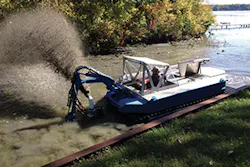
For each of these tasks, Bauer relies heavily on Berky aquatic weed harvesters. “We got the first Amphi-King (amphibious boat model 6450) that was sold in the US,” he notes. “We’ve got various attachments including the rotovator, the auger, and the sicklecutter, and we adapted a claw for the front of it to go around the shoreline and pick up logs that have fallen.
“We also have four aquatic weed harvesters that we can use to cut weeds down six feet deep. Last year they built us a transporter, so if we are out there in the middle of the lake with the harvesters, I can send the transporter over there and we can take the weeds from the harvester and shuttle them to shore, and [the crew] can keep on working.”
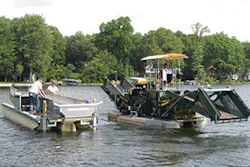
Huron Lakes Weed Control performs most of its work for municipalities and lake associations. “All the lakes are not the same—there are different types of weeds, different depths. We have a workboat with a sonar system on it, and we go out and mark prior to even sending our equipment out,” he says.
One recent job involved a section of the Huron River near a dam where aquatic weeds had become a problem. “They contacted us because there is a section out there where the current is so strong that they couldn’t use herbicides on it. They hired us to cut the weeds out of the river to keep the river flowing.” Bauer’s crews worked for about six days with three Berky machines and removed 300,000 pounds of aquatic weeds from the river. “We would cut into the flow, so any weeds that went astray would flow back into the heads, and anything we cut we’d take out of the lake,” he notes.
What happens to the vegetation that’s removed? “The weeds that we take out of the lake, the nurseries love them—they use them for fertilizer, because there is so much phosphorous and nitrogen in them. We use our trucks and haul it to them at no cost.”
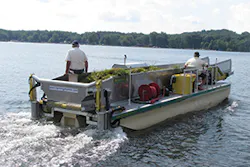
Berky weed harvesting equipment
Bauer says he has tried other harvesters as well. “We really like the Berky machines. They have hydraulic thrusters in the back.” He contrasts them to other makes of harvesters that use paddle wheels: “If you’re going through a weed bed, the paddle wheels disturb the weeds at the surface. With the Berky, the thrusters are on the back, so they don’t disturb the weed bed and that is very advantageous to us with the milfoil that we have here in Michigan. Milfoil is a very aggressive plant; if you disturb it, it spreads. If you get floaters that settle up along the shoreline, they’ll start spreading.”
He says the equipment has applications on the shore as well. “We have two machines that we built a rotary brush for—like a street sweeper. We can use them on the beaches to sweep up debris. We can also go in and mow the side of the shoreline, and if we have logs that have fallen, we can change the attachment and move them out of the way.”
About the Author
David C. Richardson
Related
 Van_Fleet_May_18.6372ba928ead4