Framingham, Mass., flood project restores natural flow, reconnects neighborhoods
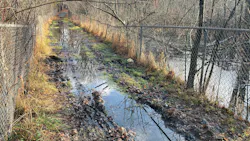
The Walnut Street Neighborhood Flood Mitigation Project is a comprehensive climate-resilience initiative that serves a densely populated vulnerable neighborhood in Framingham, Massachusetts. Situated in the Federal Emergency Management Agency (FEMA) 100- and 500-year flood zones, the area has experienced chronic flooding for many years, the impacts from which have only been exacerbated by
- Climate-driven increases in precipitation,
- Impaired wetlands and
- Legacy infrastructure that constrained natural hydrology.
Through a multiyear effort supported by state-funded Municipal Vulnerability Preparedness Action Grants and FEMA Flood Mitigation Assistance funding, the city removed an earthen berm impeding flow, restored wetlands and stream channels, expanded flood storage capacity, and constructed an elevated, ADA-accessible boardwalk. The completed corridor now provides a safe and reliable pedestrian and bicycle connection between schools, senior facilities, recreational amenities and surrounding residential neighborhoods.
By integrating nature-based flood mitigation, sustainable materials, low-impact construction practices and coordinated public engagement, the finished project provides resilient public works infrastructure that enhances hydraulic performance, protects environmental resources, promotes nonvehicular transportation, and improves equitable access for the community.
The project also demonstrates how municipalities can move beyond conventional stormwater infrastructure to implement watershed-scale, nature-based solutions that reduce flood risk while enhancing community connectivity and ecological function.
A flood-prone corridor under pressure
Frequent storm-related flooding in the Walnut Street corridor not only disrupted daily life for neighborhood residents but also posed safety concerns due to pedestrian access being limited and impediments to emergency response.
At the center of the issue was a degraded hydrologic system. A former earthen berm, used as an informal cut through and nicknamed "swamp path," crossed wetlands and streams that restricted flow and disconnected the floodplain. Eventually, accumulated debris and sediment, along with a failing wetland, had significant additional impacts to the entire system's capacity to manage stormwater.
With climate change-related increases in precipitation, these constraints translated into more frequent and severe flooding that impacted adjacent residential properties and community infrastructure. Recognizing the limitations of traditional stormwater conveyance approaches in settings like this, the city pursued a fundamentally different strategy: restore the system's natural ability to absorb, store and convey water.
Nature-based design as core infrastructure
The city began by retaining Weston & Sampson and their subconsultant, SSV Engineering, to help them reimagine the corridor as a resilient system with restored and functional streams and wetlands, along with expanded flood storage and vulnerable infrastructure replaced with adaptive, accessible design.
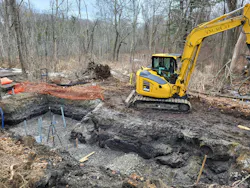
Rather than relying on new gray infrastructure features like pipes or culverts, the Walnut Street project centered on restoring more natural ecological processes to improve hydraulic performance. The team's design prioritized stream restoration, wetland rehabilitation and floodplain reconnection as primary flood mitigation tools. Key interventions included:
- The removal of the flow-restricting berm ("school path") to restore hydraulic connectivity
- More than 800 linear feet of stream restoration along Sucker Brook and its tributaries
- Reconstruction and stabilization of more than 500 linear feet of channel and banks
- Debris dam removal and sediment management to improve flow reliability
- Expansion of flood storage capacity through wetland restoration
Together, these actions reestablished natural flow regimes that allowed stormwater to spread into restored floodplain areas rather than be concentrated in constrained channels. By expanding storage and improving conveyance, the entire system now performs more effectively under both current and projected storm conditions.
These improvements were combined with further ecological enhancements like establishing native vegetation and invasive species management. The team also used targeted slope stabilization with seeding and coir logs to improve habitat quality.
This integrated approach demonstrates how green infrastructure strategies can address flood resilience while also improving water quality and restoring ecosystem functionality and health.
Reimagining access: infrastructure that adapts
While hydrologic function was central to the project, community connectivity emerged as an equally critical design driver.
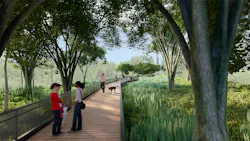
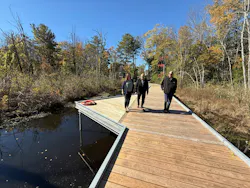
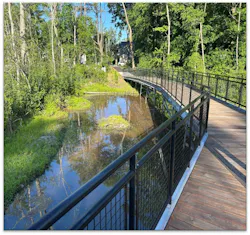
Frequent flooding had rendered the former "school path" that bisected the wetlands unsafe and often made it impassable. In its place, our team designed an elevated, ADA-compliant boardwalk to maintain continuous access regardless of hydrologic conditions. The new boardwalk now provides a reliable connection between neighborhoods, schools, senior facilities and recreational areas while maintaining hydrologic continuity by spanning wetland areas without obstructing flow.
It also enhances public safety by eliminating exposure to floodwaters and extends accessibility through new sidewalks and ADA ramps. It now serves as both infrastructure and public space, supporting transportation needs while creating opportunities for recreation, environmental education and community interaction.
And its location within a vulnerable neighborhood underscores the importance of equitable infrastructure investment. By ensuring continuous, safe access during storm events, the project addresses long-standing disparities in equity, mobility and resilience.
"The construction of an accessible boardwalk path and other innovative, multifaceted restorations and improvements through the Walnut Street Flood Mitigation Project represents a critical opportunity to link surrounding neighborhoods together and build further support for the development of nature-based solutions across Framingham," Shawn Luz, Framingham's sustainability coordinator, said.
Water quality and system performance
In addition to mitigating flood risk, the project also addresses water quality, a long-overlooked component of urban stormwater management. The installation of a new stormwater treatment system captures and treats runoff that previously entered wetlands untreated. This reduces pollutant loads, supports healthier aquatic ecosystems, and limits less-desirable secondary impacts like mosquito breeding.
Combined with restored wetland function, these improvements enhance the watershed's ability to filter contaminants, regulate temperature and support biodiversity. A key aspect of the project is that it demonstrates the multibenefit potential of nature-based systems. It improves not only how water moves through the landscape but also its quality and ecological value.
Delivering results under challenging conditions
Implementing a project of this complexity within an active wetland system posed significant engineering and construction challenges. Unstable soils and fluctuating groundwater conditions required adaptive solutions, including the use of helical piles driven deeper than initially anticipated to support boardwalk foundations. To minimize disturbance, construction activities were carefully sequenced, resorting to handwork in sensitive areas and temporary mat roads to protect soils.
At the same time, the team navigated a complex regulatory landscape that required coordination across multiple agencies to obtain the necessary approvals. These included:
- Massachusetts Environmental Policy Act review through submission of an Expanded Environmental Notification Form and a Single Environmental Impact Report
- Chapter 91 Waterways License
- Section 401 Water Quality Certification
- An Order of Conditions issued by the city's Conservation Commission under the Massachusetts Wetlands Protection Act
- U.S. Army Corps of Engineers Pre-Construction Notification
- Section 106 Massachusetts Historical Commission consultation
Despite these constraints, the project remained on track through strong interagency coordination, proactive construction management and a commitment to low-impact and green infrastructure practices.
Sustainability was at the forefront throughout the design and construction process, with materials and methods selected purposefully to minimize environmental impact and lifecycle costs, including:
- Use of black locust decking, a naturally rot-resistant timber that eliminates the need for chemical treatment
- Transport and reuse of clean soils off-site to divert it from landfills
- Repurposing of removed trees as mulch and access materials
These strategies reduced waste, lowered costs and reinforced the project's environmental goals.
Funding a multiyear vision
As mentioned previously, the Walnut Street project evolved through a phased funding strategy that leveraged state and federal resources to advance planning, design and construction.
By coordinating project phases with available funding opportunities, the project team maintained consistent progress over several years while minimizing the fiscal burden on the city. This approach offers a valuable model for other municipalities: large-scale resilience projects can be achieved incrementally through strategic funding alignment rather than requiring a single, comprehensive capital investment.
Community engagement as a design tool
A defining feature of the Walnut Street project was its emphasis on community engagement, not as a peripheral activity but as a consistent and core component of project delivery.
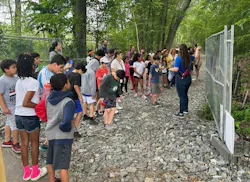
A dedicated resident inspector served as a liaison between the project team and the local residents, ensuring ongoing transparency and responsiveness throughout construction. Community feedback obtained in this manner directly informed decisions, including identifying and removing additional debris dams in Sucker Brook.
In addition to construction, the project incorporated robust educational programming that was supported by grant funding. Initiatives included:
- Environmental leadership programs for high school students
- Stormwater education using interactive watershed models
- Youth engagement through Girl Scout activities and field-based learning
- Distribution of climate education materials across local schools
It is expected that these efforts will build long-term resilience by increasing public understanding of stormwater systems, climate impacts and the value of natural infrastructure. By linking physical improvements with education, the project will foster a culture of stewardship that extends beyond the project footprint.
Measurable outcomes and lasting benefits
The Walnut Street Neighborhood Flood Mitigation Project delivered tangible benefits across multiple dimensions, including:
Flood resilience
- Reduced frequency and severity of flooding
- Expanded flood storage capacity
- Improved hydraulic conveyance and system reliability
Environmental restoration
- Reestablished stream connectivity
- Enhanced wetland function and habitat quality
- Improved water quality through treatment and natural filtration
Community connectivity
- Reliable, ADA-accessible pedestrian infrastructure
- Improved safety and mobility during storm events
- Increased access to recreational and natural resources
Social and educational impact
- Strengthened community engagement and trust
- Expanded environmental education and workforce development
- Increased awareness of climate resilience strategies
Many residents have already expressed strong support, citing reduced flooding, improved safety and renewed access to natural areas for activities like walking and birdwatching.
A replicable model for stormwater management
As communities across the country grapple with the impacts of climate change, the Walnut Street project offers a compelling model for the future of stormwater management. Its success lies in its integration of:
- Engineering and ecology, working together rather than in isolation
- Flood mitigation and transportation infrastructure, aligned to serve multiple needs
- Climate resilience and vulnerable populations, ensuring equitable outcomes
- Construction and education, building both physical and social capacity
By prioritizing green, nature-based solutions and system-wide thinking, the project moved beyond incremental improvements toward transformative change. For stormwater practitioners, it reinforces a key lesson, that restoring natural processes is not only environmentally beneficial but also a powerful and practical approach to managing urban flood risk. In addition to serving as a model upon which other communities across the country can build, the Walnut Street Neighborhood Flood Mitigation Project was honored with two awards.
First, the project received a 2026 "Stormy" Award from the New England Stormwater Collaborative, which was formed by the New England Water Environment Association, the New England Water Works Association and the New England Chapter of the American Public Works Association, celebrating the best, most imaginative ideas in stormwater management in EPA Region 1.
The project was also honored with the "Community Choice Award" by the Environmental Business Council of New England at their annual awards event.
Looking forward
The Walnut Street project stands as a testament to what is possible when municipalities embrace innovation, collaboration and long-term vision. As extreme weather events become more frequent and our public infrastructure faces increasing strain, projects like this illustrate a path forward. They leverage the resilience of natural systems, the ingenuity of engineering and the strength of community engagement.
For cities seeking to enhance stormwater performance while delivering broader public value, Framingham's approach provides both inspiration and a roadmap.
About the Author
 Jaurice Schwartz
Jaurice Schwartz
Jaurice A. Schwartz, PE, is a Senior Team Leader and Vice President with Weston & Sampson in Reading, Massachusetts with 25 years of experience. She provides comprehensive stormwater planning and design services helping communities to address regulatory compliance, protect water quality, and mitigate flooding risks. She also assists municipalities in developing and implementing stormwater funding mechanisms, supporting long-term program sustainability, effective asset management, and resilient infrastructure investment. She can be reached at [email protected].
 Alison Eliot
Alison Eliot
Alison L. Eliot, PE, LSP, is the Interim Director of Parks, Recreation, and Cultural Affairs for the City of Framingham. She has 18 years of experience in environmental remediation and geotechnical engineering, and her work reflects a practical, forward-looking approach to public infrastructure and open-space management, with an emphasis on continuous improvement, community needs, and climate resilience. She can be reached at [email protected].
 Eric Johnson
Eric Johnson
Eric V. Johnson, PE, is the City Engineer for the City of Framingham. He has more than 20 years of experience in technical and organizational leadership on complex municipal infrastructure, utility, transportation, and stormwater projects. His deep institutional knowledge, practical approach, and commitment to public service have helped guide major infrastructure improvements throughout the community. He can be reached at [email protected].