Newfoundland city digs trenches up to 40 feet deep to replace aging culvert

To replace an aging culvert, the city of Corner Brook, Newfoundland and Labrador, embarked upon the largest excavation project in its history. But it wasn't only the trench depths reaching 10 meters (33 feet) to 12 meters (40 feet) that were a concern. The new pipe itself would have to provide protection from the high velocity of sediment contained in the stormwater runoff and be strong enough to be deeply buried under a major road. Plus, for this community of nearly 30,000 on the western shore of Newfoundland, the new culvert would have to handle a 100-year storm, be watertight and last for generations. It ties in a brook in the Deep Gulch area with the Corner Brook Stream at the intersection of University and O'Connell drives.
The site also presented significant engineering challenges, including a steep slope. These extreme conditions made traditional materials, such as concrete, unsuitable for the project. The area receives 1.4 meters (55 to 56 inches) a year of combined snow and rainfall. With a design flow of 11.714 cubic meters (414 cubic feet) per second, the new system had to handle a maximum velocity of 8.6 cubic meters (304 cubic feet) per second for a predicted 100-year storm. The old culvert was a single-barrel, 1,350-millimeter (54-inch) diameter corrugated steel pipe that increased to 2,500 millimeters (98 inches) for portions of its run. Recent sinkholes have been attributed to the rapid flow rate of the stormwater runoff and the deteriorated and leaking steel culvert.
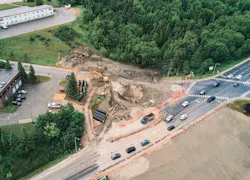
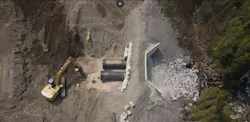
“We considered various pipe material options, but ultimately selected high-density polyethylene, or HDPE, pipe,” said Scott Batt of Anderson Engineering Consultants Ltd. in Corner Brook, “due to its inherent resistance to scour caused by sediment transport at high velocities. This was essential for ensuring the longevity of the pipe and minimizing future maintenance and replacement costs.”
The pipe's relative flexibility also made it well suited to the site's hilly topography. The plan called for two runs of 1,500-millimeter (60-inch) diameter HDPE pipe plus 45 meters (145 feet) of 2,200-millimeter (87-inch) diameter HDPE pipe to convey the Deep Gulch Brook under two city streets toward the Corner Brook Stream.
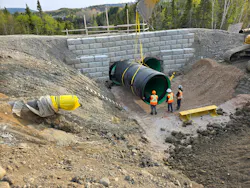
Engineers elected to use HDPE pipe and manholes from Soleno Inc. of Saint-Jean-sur-Richelieu, Quebec. The company's Kustomflo product offered superior abrasion resistance, lightweight handling and a fully watertight system provided by the gasketed joints. To address the complex hydraulic and structural requirements, Soleno provided a fully customized system. In addition to the pipe and manholes, this included oversized outlet pipes designed to withstand steep-grade discharge, and energy dissipation rings to control flow velocity and prevent erosion. Another key feature was the ability to integrate custom flow control baffles, or energy dissipaters, directly into the pipe, manufactured off-site and delivered to the site fully assembled. This significantly reduced on-site fabrication time and helped maintain construction momentum despite the logistical constraints.
The Kustomflo pipe comes in gasketed 6-meter (20-foot) lengths and meets requirements of current standards and ASTM F894 for both gravity and pressure pipe applications. Additionally, the new culverts meet CL-625 and HS-25 structural load specifications. With a Manning's n rating of 0.009, Kustomflo has a higher flow capacity than other piping materials, which was another important consideration that met the engineering design requirement. Class B bedding compacted to 95% standard Proctor density was used. Native soil cover was as much as 9 meters (29.5 feet) in some locations.
“The endwall was engineered to transfer thrust from the HDPE baffles into the subgrade and surrounding backfill, ensuring structural integrity,” Batt said.
Four manholes, two at 1,500 millimeters (60 inches) and two at 2,200 millimeters (87 inches) to match the diameters of the pipe, were equipped with aluminum ladders and safety platforms and were also fabricated to meet strict access standards. Because the manholes were manufactured from HDPE and fully integrated into the system, their diameter matched the pipe diameter, eliminating the need to oversize structures, as is often required with conventional manhole materials. This optimized design reduced excavation, simplified installation and improved hydraulic continuity, which also, according to Batt, “streamlined installation and ensured compatibility.”
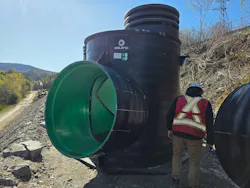
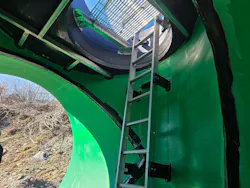
Additionally, due to the lightweight nature of HDPE components, no heavy lifting equipment such as cranes was required on-site, further reducing costs, logistical constraints and safety risks.
"I was particularly impressed that the Soleno team designed access ladders and platforms to conform with municipal regulations, allowing these structures to be safely used in softscaped areas of the project," Batt said.
The success of the Deep Gulch project earned the Project of the Year Award from the Drainage Division of the Plastics Pipe Institute Inc., the major North American trade association representing the plastic pipe industry. PPI member company Soleno received the award during the association's annual membership meeting in May.
“This project demonstrates how advanced HDPE systems can deliver durable, high-performance stormwater rehabilitation solutions even for fast-moving, abrasive water,” Daniel Currence, P.E., director of engineering for the PPI Drainage Division, said. "With a service life exceeding 100 years, the HDPE system ensures long-term durability while significantly reducing future maintenance and lifecycle costs. It all adds up to a smart, sustainable, long-life solution. It's also important to note that our industry is a leader in the use of recycled plastic content, using more than 500 million pounds every year to manufacturer pipe and other related products.”
“A life cycle analysis conducted by Franklin Associates on drainage alternatives, the global warming potential for corrugated HDPE pipe was found to be 59% lower than that of reinforced concrete pipe,” he added.
“The project showcased the advantages of integrating plastic pipe into a challenging drainage project design, reinforcing confidence among engineers and specifiers,” Currence said. “Because HDPE was the only solution able to meet the site's structural, hydraulic, and access requirements, this project is likely to influence future designs and increase adoption of plastic pipe in similar complex applications.”